
可穿戴传感器信号和自我报告症状用于提示美国急性呼吸道病毒在家检测的可行性(DETECT-AHEAD):一项去中心化、随机对照试验。
Feasibility of wearable sensor signals and self-reported symptoms to prompt at-home testing for acute respiratory viruses in the USA (DETECT-AHEAD): a decentralised, randomised controlled trial.
机构信息
Scripps Research Translational Institute, La Jolla, CA, USA.
Scripps Research Translational Institute, La Jolla, CA, USA.
出版信息
Lancet Digit Health. 2024 Aug;6(8):e546-e554. doi: 10.1016/S2589-7500(24)00096-7.
BACKGROUND
Early identification of an acute respiratory infection is important for reducing transmission and enabling earlier therapeutic intervention. We aimed to prospectively evaluate the feasibility of home-based diagnostic self-testing of viral pathogens in individuals prompted to do so on the basis of self-reported symptoms or individual changes in physiological parameters detected via a wearable sensor.
METHODS
DETECT-AHEAD was a prospective, decentralised, randomised controlled trial carried out in a subpopulation of an existing cohort (DETECT) of individuals enrolled in a digital-only observational study in the USA. Participants aged 18 years or older were randomly assigned (1:1:1) with a block randomisation scheme stratified by under-represented in biomedical research status. All participants were offered a wearable sensor (Fitbit Sense smartwatch). Participants in groups 1 and 2 received an at-home self-test kit (Alveo be.well) for two acute respiratory viral pathogens: SARS-CoV-2 and respiratory syncytial virus. Participants in group 1 could be alerted through the DETECT study app to take the at-home test on the basis of changes in their physiological data (as detected by our algorithm) or due to self-reported symptoms; those in group 2 were prompted via the app to self-test only due to symptoms. Group 3 served as the control group, without alerts or home testing capability. The primary endpoints, assessed on an intention-to-treat basis, were the number of acute respiratory infections presented (self-reported) and diagnosed (electronic health record), and the number of participants using at-home testing in groups 1 and 2. This trial is registered with ClinicalTrials.gov, NCT04336020.
FINDINGS
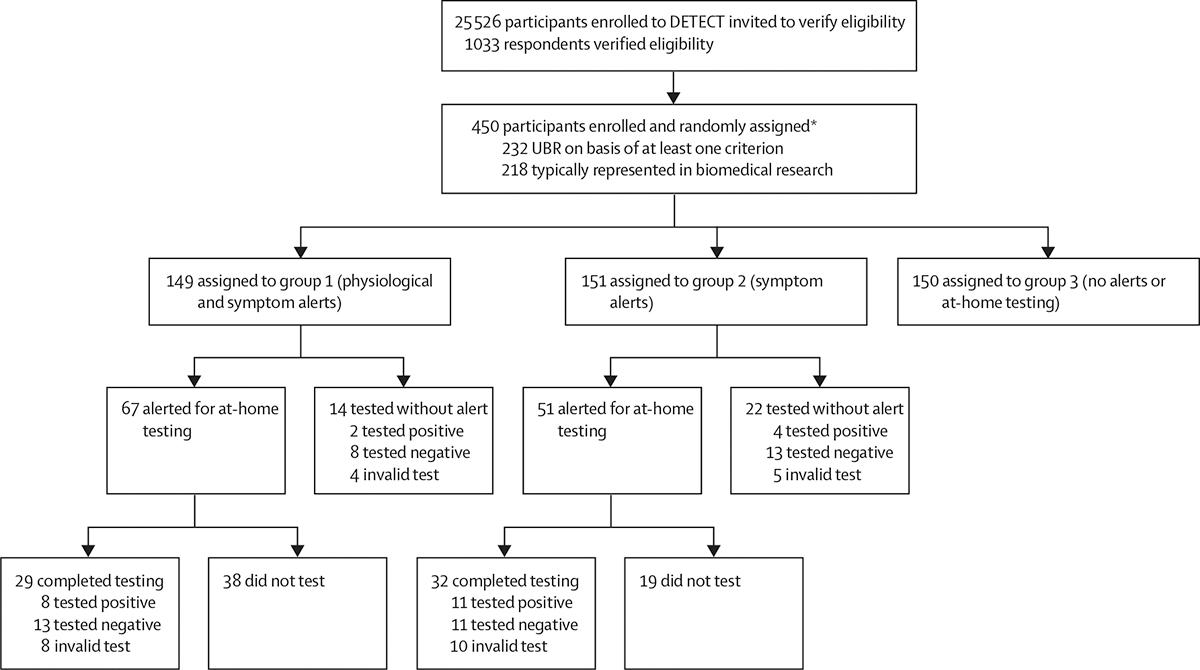
Between Sept 28 and Dec 30, 2021, 450 participants were recruited and randomly assigned to group 1 (n=149), group 2 (n=151), or group 3 (n=150). 179 (40%) participants were male, 264 (59%) were female, and seven (2%) identified as other. 232 (52%) were from populations historically under-represented in biomedical research. 118 (39%) of the 300 participants in groups 1 and 2 were prompted to self-test, with 61 (52%) successfully completing self-testing. Participants were prompted to home-test more frequently due to symptoms (41 [28%] in group 1 and 51 [34%] in group 2) than due to detected physiological changes (26 [17%] in group 1). Significantly more participants in group 1 received alerts to test than did those in group 2 (67 [45%] vs 51 [34%]; p=0·047). Of the 61 individuals who were prompted to test and successfully did so, 19 (31%) tested positive for a viral pathogen-all for SARS-CoV-2. The individuals diagnosed as positive for SARS-CoV-2 in the electronic health record were eight (5%) in group 1, four (3%) in group 2, and two (1%) in group 3, but it was difficult to confirm if they were tied to symptomatic episodes documented in the trial. There were no adverse events.
INTERPRETATION
In this direct-to-participant trial, we showed early feasibility of a decentralised programme to prompt individuals to use a viral pathogen diagnostic test based on symptoms tracked in the study app or physiological changes detected using a wearable sensor. Barriers to adequate participation and performance were also identified, which would need to be addressed before large-scale implementation.
FUNDING
Janssen Pharmaceuticals.
背景
早期识别急性呼吸道感染对于减少传播和尽早进行治疗干预很重要。我们旨在前瞻性评估基于自我报告的症状或通过可穿戴传感器检测到的生理参数的个体变化,促使个体在家中进行病毒病原体诊断自我检测的可行性。
方法
DETECT-AHEAD 是一项前瞻性、去中心化、随机对照试验,在一个现有的(DETECT)队列的亚群中进行,该队列的参与者是在美国参加全数字化观察性研究的个体。年龄在 18 岁或以上的参与者按照 1:1:1 的比例随机分配,采用分层的不代表性生物医学研究状态的分组随机化方案。所有参与者都提供了一个可穿戴传感器(Fitbit Sense 智能手表)。第 1 组和第 2 组的参与者收到了两种急性呼吸道病毒病原体的家用自我检测试剂盒(Alveo be.well):SARS-CoV-2 和呼吸道合胞病毒。第 1 组的参与者可以通过 DETECT 研究应用程序根据其生理数据(由我们的算法检测到)的变化或由于自我报告的症状而收到进行家用测试的警报;第 2 组的参与者仅由于症状而通过应用程序提示进行自我测试。第 3 组作为对照组,没有警报或家庭测试能力。主要终点是基于意向治疗原则评估的报告的(自我报告)和诊断的(电子健康记录)急性呼吸道感染数量,以及第 1 组和第 2 组中使用家用测试的参与者数量。这项试验在 ClinicalTrials.gov 上注册,NCT04336020。
结果
在 2021 年 9 月 28 日至 12 月 30 日期间,招募了 450 名参与者并随机分配到第 1 组(n=149)、第 2 组(n=151)或第 3 组(n=150)。179 名(40%)参与者为男性,264 名(59%)为女性,7 名(2%)为其他性别。300 名第 1 组和第 2 组的参与者中有 118 名(39%)被提示进行自我检测,其中 61 名(52%)成功完成了自我检测。参与者因症状(第 1 组 41 [28%],第 2 组 51 [34%])而被提示家庭检测的频率高于因检测到的生理变化(第 1 组 26 [17%])。提示检测的第 1 组参与者明显多于第 2 组(67 [45%]比 51 [34%];p=0.047)。在被提示进行测试且成功测试的 61 名参与者中,有 19 名(31%)检测出病毒病原体呈阳性——均为 SARS-CoV-2。电子健康记录中诊断为 SARS-CoV-2 阳性的个体在第 1 组中为 8 人(5%),第 2 组中为 4 人(3%),第 3 组中为 2 人(1%),但很难确认他们是否与试验中记录的有症状发作有关。没有不良事件。
解释
在这项直接面向参与者的试验中,我们展示了一种去中心化计划的早期可行性,该计划基于研究应用程序中跟踪的症状或通过可穿戴传感器检测到的生理变化,提示个人使用病毒病原体诊断测试。还确定了充分参与和表现的障碍,在大规模实施之前需要解决这些障碍。
资金来源
Janssen 制药公司。


 Zotero 插件