
可穿戴传感器信号与孕期预期激素变化之间的关联。
Association between wearable sensor signals and expected hormonal changes in pregnancy.
作者信息
Milan Giulia, Ariniello Lauren, Baca-Motes Katie, Faksh Arij, Kueper Jacqueline K, Pandit Jay A, Àjàyí Tolúwalàṣẹ, Quer Giorgio
机构信息
Scripps Research Translational Institute, 3344 N Torrey Pines Ct Plaza Level, La Jolla, CA, 92037, USA; University of California San Diego, La Jolla, CA, 92037, USA.
Scripps Research Translational Institute, 3344 N Torrey Pines Ct Plaza Level, La Jolla, CA, 92037, USA.
出版信息
EBioMedicine. 2025 Aug 27;119:105888. doi: 10.1016/j.ebiom.2025.105888.
BACKGROUND
The rising maternal health crisis in the United States necessitates innovative approaches to pregnancy monitoring. This observational cohort study aimed to assess whether wearable sensors can effectively track physiological and behavioural changes during pregnancy and examine their associations with pregnancy-related hormonal fluctuations.
METHODS
This longitudinal cohort study recruited participants via a bilingual mobile research platform. Eligible participants were aged ≥16 years, pregnant or within eight weeks postpartum, residing in the United States, and consented to share data collected by their own wearable device (Apple, Garmin, or Fitbit). Self-reported survey responses and wearable sensor data were collected from 99 participants who experienced a live birth pregnancy, from three months pre-pregnancy to six months postpartum. Key outcomes included changes in resting heart rate (RHR), physical activity, and sleep patterns, analysed in relation to expected hormonal fluctuations during pregnancy.
FINDINGS
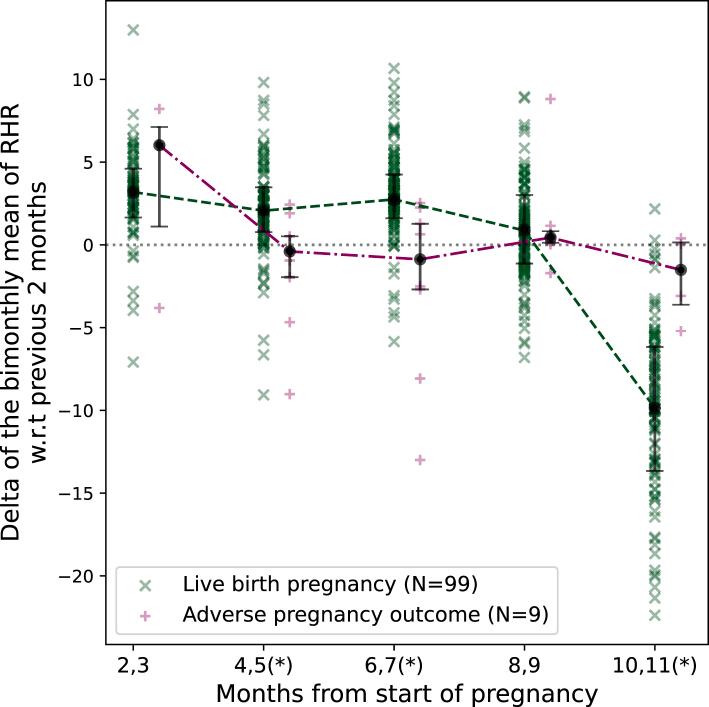
In live birth pregnancies, RHR initially decreased between weeks 5-9, followed by a steady increase until 8-9 weeks before delivery, then declined until birth, dropping below pre-pregnancy levels postpartum before stabilising at six months. Total sleep time increased in the first trimester but decreased throughout the remainder of pregnancy. A strong correlation was observed between RHR fluctuations and pregnancy-induced hormonal changes (R = 0.93). Pregnancies ending in adverse outcomes displayed distinct RHR patterns compared to live birth pregnancies.
INTERPRETATION
These findings suggest that wearable sensors provide a non-invasive method to monitor pregnancy-related physiological and behavioural changes, which align with hormonal shifts. This study provides population-level insights in live birth pregnancies, and an exploratory analysis of adverse outcomes reflecting the feasibility of recruiting and capturing physiological signals also in these cases. This approach may enable early risk assessment for adverse pregnancy outcomes, including miscarriage and preterm birth.
FUNDING
This work was supported by the National Center for Advancing Translational Sciences (UM1TR004407) and from the Patrick J. McGovern Foundation.
背景
美国孕产妇健康危机日益严重,需要创新的妊娠监测方法。这项观察性队列研究旨在评估可穿戴传感器能否有效跟踪孕期的生理和行为变化,并研究它们与妊娠相关激素波动的关联。
方法
这项纵向队列研究通过一个双语移动研究平台招募参与者。符合条件的参与者年龄≥16岁,怀孕或产后八周内,居住在美国,并同意分享其自身可穿戴设备(苹果、佳明或Fitbit)收集的数据。从99名经历活产妊娠的参与者中收集了自我报告的调查回复和可穿戴传感器数据,时间跨度从孕前三个月到产后六个月。主要结果包括静息心率(RHR)、身体活动和睡眠模式的变化,并与孕期预期的激素波动相关联进行分析。
结果
在活产妊娠中,RHR最初在第5至9周下降,随后稳步上升直至分娩前8至9周,然后下降直至出生,产后降至孕前水平以下,直至六个月时稳定。总睡眠时间在孕早期增加,但在孕期其余时间减少。观察到RHR波动与妊娠引起的激素变化之间存在强烈相关性(R = 0.93)。与活产妊娠相比,以不良结局告终的妊娠表现出不同的RHR模式。
解读
这些发现表明,可穿戴传感器提供了一种非侵入性方法来监测与妊娠相关的生理和行为变化,这些变化与激素变化一致。这项研究提供了活产妊娠人群水平的见解,以及对不良结局的探索性分析,反映了在这些情况下招募和捕捉生理信号的可行性。这种方法可能有助于对包括流产和早产在内的不良妊娠结局进行早期风险评估。
资金
这项工作得到了美国国立转化医学推进中心(UM1TR004407)和帕特里克·J·麦戈文基金会的支持。


 Zotero 插件