
跨越地理差异:在美国各地的产科荒漠中获得产科医院的服务。
Navigating geographical disparities: access to obstetric hospitals in maternity care deserts and across the United States.
机构信息
Perinatal Data Center, March of Dimes, 1550 Crystal Drive Suite 1300, Arlington, VA, USA.
出版信息
BMC Pregnancy Childbirth. 2024 May 8;24(1):350. doi: 10.1186/s12884-024-06535-7.
BACKGROUND
Access to maternity care in the U.S. remains inequitable, impacting over two million women in maternity care "deserts." Living in these areas, exacerbated by hospital closures and workforce shortages, heightens the risks of pregnancy-related complications, particularly in rural regions. This study investigates travel distances and time to obstetric hospitals, emphasizing disparities faced by those in maternity care deserts and rural areas, while also exploring variances across races and ethnicities.
METHODS
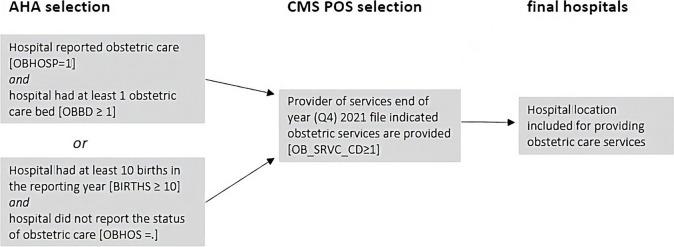
The research adopted a retrospective secondary data analysis, utilizing the American Hospital Association and Centers for Medicaid and Medicare Provider of Services Files to classify obstetric hospitals. The study population included census tract estimates of birthing individuals sourced from the U.S. Census Bureau's 2017-2021 American Community Survey. Using ArcGIS Pro Network Analyst, drive time and distance calculations to the nearest obstetric hospital were conducted. Furthermore, Hot Spot Analysis was employed to identify areas displaying significant spatial clusters of high and low travel distances.
RESULTS
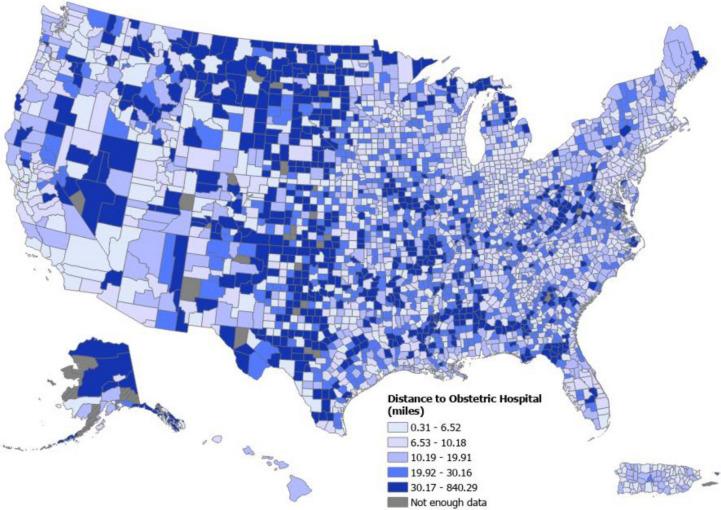
The mean travel distance and time to the nearest obstetric facility was 8.3 miles and 14.1 minutes. The mean travel distance for maternity care deserts and rural counties was 28.1 and 17.3 miles, respectively. While birthing people living in rural maternity care deserts had the highest average travel distance overall (33.4 miles), those living in urban maternity care deserts also experienced inequities in travel distance (25.0 miles). States with hotspots indicating significantly higher travel distances included: Montana, North Dakota, South Dakota, and Nebraska. Census tracts where the predominant race is American Indian/Alaska Native (AIAN) had the highest travel distance and time compared to those of all other predominant races/ethnicities.
CONCLUSIONS
Our study revealed significant disparities in obstetric hospital access, especially affecting birthing individuals in maternity care deserts, rural counties, and communities predominantly composed of AIAN individuals, resulting in extended travel distances and times. To rectify these inequities, sustained investment in the obstetric workforce and implementation of innovative programs are imperative, specifically targeting improved access in maternity care deserts as a priority area within healthcare policy and practice.
背景
美国的产妇护理服务仍然存在不平等现象,这影响了超过 200 万在“产妇护理荒漠”地区接受护理的女性。生活在这些地区(由于医院关闭和劳动力短缺而加剧)会增加与妊娠相关的并发症的风险,尤其是在农村地区。本研究调查了前往产科医院的距离和时间,重点关注产妇护理荒漠地区和农村地区所面临的差异,同时还探讨了不同种族和族裔之间的差异。
方法
本研究采用回顾性二次数据分析,利用美国医院协会和医疗补助和医疗保险服务提供者文件对产科医院进行分类。研究人群包括美国人口普查局 2017-2021 年美国社区调查的产妇个体的普查区估计数。使用 ArcGIS Pro Network Analyst 进行了到最近产科医院的行车时间和距离计算。此外,还使用热点分析来识别显示高和低旅行距离显著空间聚类的区域。
结果
到最近产科医院的平均旅行距离和时间为 8.3 英里和 14.1 分钟。产妇护理荒漠地区和农村县的平均旅行距离分别为 28.1 英里和 17.3 英里。虽然生活在农村产妇护理荒漠地区的产妇的平均旅行距离最长(33.4 英里),但生活在城市产妇护理荒漠地区的产妇的旅行距离也存在不平等(25.0 英里)。旅行距离显著较高的热点州包括:蒙大拿州、北达科他州、南达科他州和内布拉斯加州。与所有其他主要种族/族裔相比,以美洲印第安人/阿拉斯加原住民(AIAN)为主的普查区的旅行距离和时间最长。
结论
我们的研究表明,产科医院的准入存在显著差异,特别是对产妇护理荒漠地区、农村县以及以 AIAN 为主的社区的产妇产生影响,导致旅行距离和时间延长。为了解决这些不平等问题,必须对产科劳动力进行持续投资,并实施创新计划,特别是将改善产妇护理荒漠地区的获得途径作为医疗保健政策和实践的优先领域。

 Zotero 插件