
诱导训练免疫中的代谢调控。
Metabolic Regulation in the Induction of Trained Immunity.
机构信息
Department of Internal Medicine and Radboud Center for Infectious Diseases (RCI), Radboud University Nijmegen Medical Center, 6500HB, Nijmegen, The Netherlands.
Department of Medical Genetics, Iuliu Hatieganu University of Medicine and Pharmacy, Cluj-Napoca-Napoca, Romania.
出版信息
Semin Immunopathol. 2024 Jul 25;46(3-4):7. doi: 10.1007/s00281-024-01015-8.
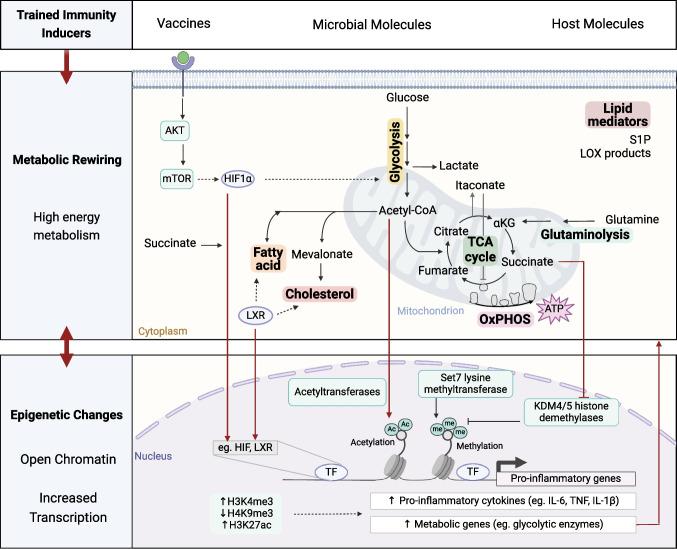
The innate immune system exhibits features of memory, termed trained immunity, which promote faster and more robust responsiveness to heterologous challenges. Innate immune memory is sustained through epigenetic modifications, affecting gene accessibility, and promoting a tailored gene transcription for an enhanced immune response. Alterations in the epigenetic landscape are intertwined with metabolic rewiring. Here, we review the metabolic pathways that underscore the induction and maintenance of trained immunity, including glycolysis, oxidative phosphorylation, the tricarboxylic acid cycle, and amino acid and lipid metabolism. The intricate interplay of these pathways is pivotal for establishing innate immune memory in distinct cellular compartments. We explore in particular the case of resident lung alveolar macrophages. We propose that leveraging the memory of the innate immune system may present therapeutic potential. Specifically, targeting the metabolic programs of innate immune cells is an emerging strategy for clinical interventions, either to boost immune responses in immunosuppressed conditions or to mitigate maladaptive activation in hyperinflammatory diseases.
先天性免疫系统表现出记忆的特征,称为训练有素的免疫,这促进了对异源挑战更快、更强的反应。先天免疫记忆通过表观遗传修饰来维持,影响基因的可及性,并促进定制的基因转录以增强免疫反应。表观遗传景观的改变与代谢重排交织在一起。在这里,我们回顾了突出训练有素的免疫诱导和维持的代谢途径,包括糖酵解、氧化磷酸化、三羧酸循环以及氨基酸和脂质代谢。这些途径的错综复杂相互作用对于在不同的细胞区室中建立先天免疫记忆至关重要。我们特别探讨了常驻肺肺泡巨噬细胞的情况。我们提出,利用先天免疫系统的记忆可能具有治疗潜力。具体来说,靶向先天免疫细胞的代谢程序是临床干预的一种新兴策略,无论是在免疫抑制条件下增强免疫反应,还是减轻过度炎症性疾病中的适应性激活。



 Zotero 插件