
用于抗癌治疗的天然健康产品:证据与争议
Natural Health Products for Anti-Cancer Treatment: Evidence and Controversy.
作者信息
Conti Valeria, Polcaro Giovanna, De Bellis Emanuela, Donnarumma Danilo, De Rosa Federica, Stefanelli Berenice, Corbi Graziamaria, Sabbatino Francesco, Filippelli Amelia
机构信息
Department of Medicine, Surgery, and Dentistry, Scuola Medica Salernitana, University of Salerno, 84081 Baronissi, Italy.
Clinical Pharmacology Unit, San Giovanni di Dio e Ruggi d'Aragona University Hospital, 84131 Salerno, Italy.
出版信息
J Pers Med. 2024 Jun 26;14(7):685. doi: 10.3390/jpm14070685.
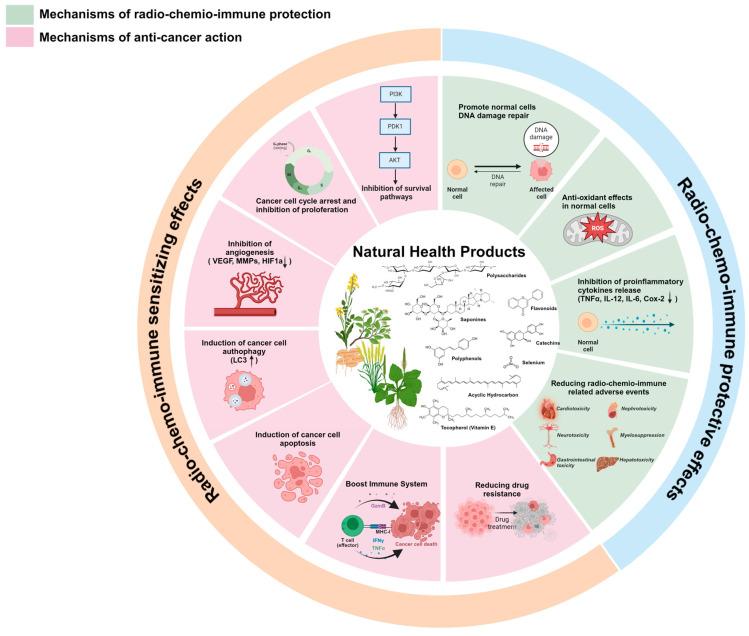
Natural Health Products (NHPs) have long been considered a valuable therapeutic approach for the prevention and treatment of various diseases, including cancer. However, research on this topic has led to inconclusive and often controversial results. This review aims to provide a comprehensive update of the effects and mechanisms related to the use of NHPs, to describe the results of randomized clinical trials (RCTs) on their effects in cancer patients, and to critically discuss factors influencing clinical outcomes. RCTs available in the literature, even those studying the same NHP, are very heterogeneous in terms of indications, doses, route and timing of administration, and outcomes evaluated. Silymarin, ginsenoside, and vitamin E appear to be useful in attenuating adverse events related to radiotherapy or chemotherapy, and curcumin and lycopene might provide some benefit in patients with prostate cancer. Most RCTs have not clarified whether NHP supplementation provides any real benefit, while harmful effects have been shown in some cases. Overall, the available data suggest that although there is some evidence to support the benefits of NHPs in the management of cancer patients, further clinical trials with the same design are needed before their introduction into clinical practice can be considered.
天然健康产品(NHPs)长期以来一直被视为预防和治疗包括癌症在内的各种疾病的一种有价值的治疗方法。然而,关于这一主题的研究结果尚无定论,且往往存在争议。本综述旨在全面更新与使用NHPs相关的作用和机制,描述关于其对癌症患者疗效的随机临床试验(RCTs)结果,并批判性地讨论影响临床结果的因素。文献中现有的RCTs,即使是那些研究相同NHP的试验,在适应症、剂量、给药途径和时间以及评估的结果方面都非常异质。水飞蓟素、人参皂苷和维生素E似乎有助于减轻与放疗或化疗相关的不良事件,姜黄素和番茄红素可能对前列腺癌患者有一些益处。大多数RCTs尚未阐明补充NHP是否提供任何实际益处,而在某些情况下已显示出有害影响。总体而言,现有数据表明,尽管有一些证据支持NHPs在癌症患者管理中的益处,但在考虑将其引入临床实践之前,还需要进行相同设计的进一步临床试验。
 Zotero 插件