
认知不确定性挑战了衰老时钟预测年轻化效果的可靠性。
Epistemic uncertainty challenges aging clock reliability in predicting rejuvenation effects.
机构信息
Skolkovo Institute of Science and Technology, Moscow, Russia.
Artificial Intelligence Research Institute, Moscow, Russia.
出版信息
Aging Cell. 2024 Nov;23(11):e14283. doi: 10.1111/acel.14283. Epub 2024 Jul 28.
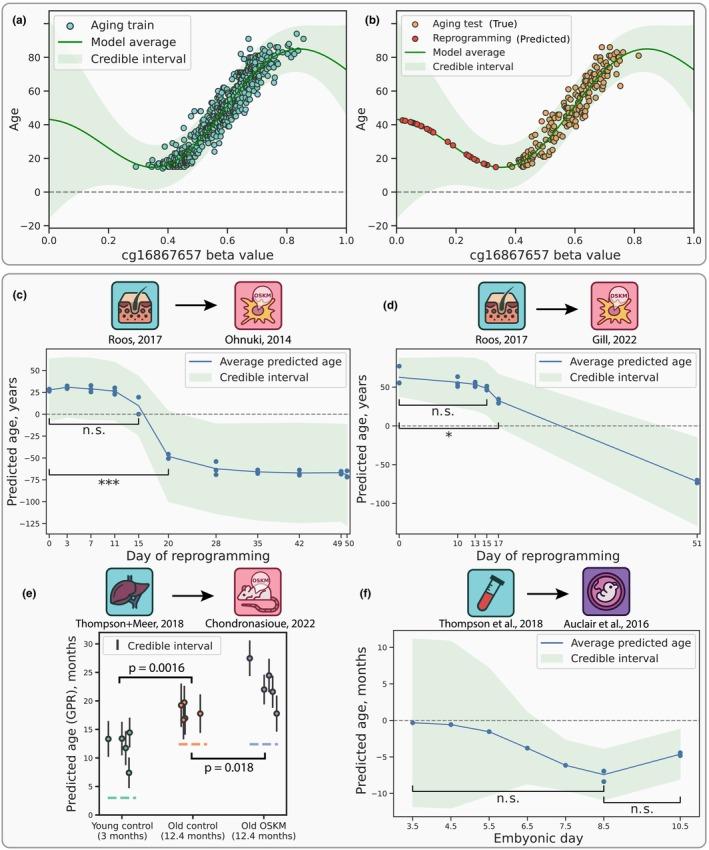
Epigenetic aging clocks have been widely used to validate rejuvenation effects during cellular reprogramming. However, these predictions are unverifiable because the true biological age of reprogrammed cells remains unknown. We present an analytical framework to consider rejuvenation predictions from the uncertainty perspective. Our analysis reveals that the DNA methylation profiles across reprogramming are poorly represented in the aging data used to train clock models, thus introducing high epistemic uncertainty in age estimations. Moreover, predictions of different published clocks are inconsistent, with some even suggesting zero or negative rejuvenation. While not questioning the possibility of age reversal, we show that the high clock uncertainty challenges the reliability of rejuvenation effects observed during in vitro reprogramming before pluripotency and throughout embryogenesis. Conversely, our method reveals a significant age increase after in vivo reprogramming. We recommend including uncertainty estimation in future aging clock models to avoid the risk of misinterpreting the results of biological age prediction.
表观遗传衰老时钟已被广泛用于验证细胞重编程过程中的年轻化效果。然而,这些预测是无法验证的,因为重编程细胞的真实生物学年龄仍然未知。我们提出了一个分析框架,从不确定性的角度来考虑年轻化预测。我们的分析表明,在用于训练时钟模型的衰老数据中,重编程过程中的 DNA 甲基化图谱代表性很差,因此在年龄估计中引入了高度的认知不确定性。此外,不同已发表时钟的预测结果不一致,有些甚至表明零或负年轻化。虽然我们不质疑年龄逆转的可能性,但我们表明,高时钟不确定性挑战了体外重编程过程中在多能性之前和整个胚胎发生过程中观察到的年轻化效果的可靠性。相反,我们的方法显示体内重编程后年龄显著增加。我们建议在未来的衰老时钟模型中纳入不确定性估计,以避免错误解释生物年龄预测结果的风险。


 Zotero 插件