
普通人群中甘油三酯-葡萄糖相关指标与全因死亡率和特定病因死亡率之间的关联:一项队列研究。
Association between triglyceride-glucose related indices and all-cause and cause-specific mortality in the general population: a cohort study.
作者信息
Li Shan, An Li, Fu Zhiqing, Zhang Wei, Liu Hongbin
机构信息
Department of Cardiology, The Second Medical Center & National Clinical Research Center for Geriatric Diseases, Chinese PLA General Hospital, Beijing, 100853, China.
Department of Respiratory Medicine, The Second Medical Center & National Clinical Research Center for Geriatric Diseases, Chinese PLA General Hospital, Beijing, 100853, China.
出版信息
Cardiovasc Diabetol. 2024 Aug 7;23(1):286. doi: 10.1186/s12933-024-02390-0.
BACKGROUND
Although triglyceride-glucose (TyG) index is a reliable indicator of insulin resistance and cardiometabolic disease, its effectiveness in predicting mortality risk has not been adequately validated. We aimed to investigate the association between the TyG-related indices and all-cause and cause-specific mortality in the general population.
METHODS
A total of 27,642 individuals were included from the National Health and Nutrition Examination Survey (NHANES) between 1999 and 2018. Three indicators were constructed, including the TyG index, TyG combined with waist-to-height ratio (TyG-WHtR), and TyG combined with waist circumference (TyG-WC). Mortality data was acquired through the linkage of NHANES data with National Death Index records. Weighted Cox proportional hazards models were used to estimate the independent association between the TyG-related indices and mortality. Nonlinear associations were explored using restricted cubic splines.
RESULTS
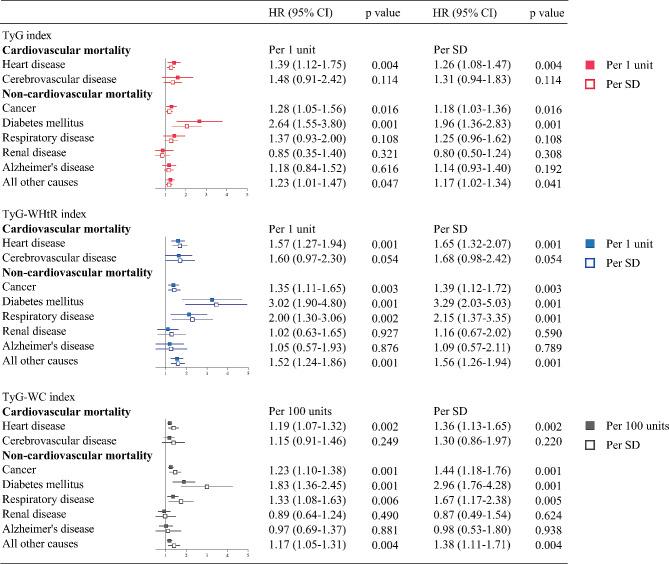
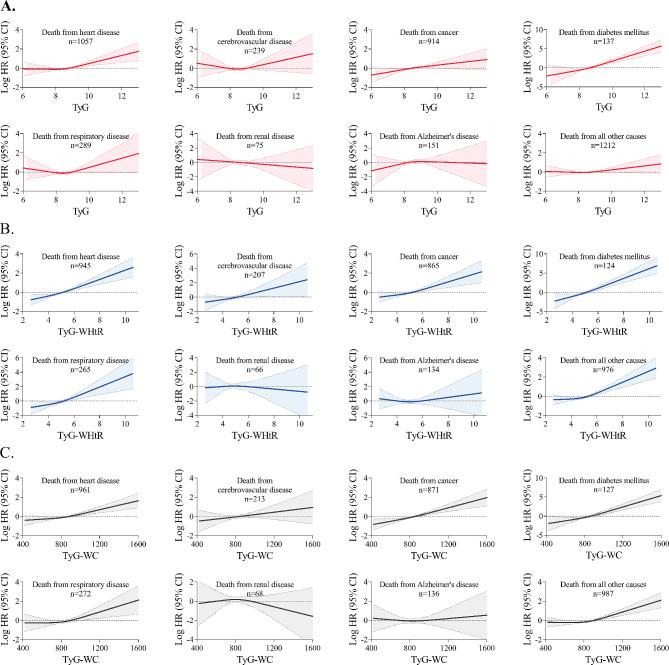
Multivariable adjusted models showed a progressive increase in all-cause and cause-specific mortality across quartiles of the TyG-related indices. Compared with the lowest quartile of the TyG index, the highest quartile had adjusted hazard ratios of 1.26 (95% CI 1.04-1.52) for all-cause mortality, 1.38 (1.04-1.74) for cardiovascular mortality, and 1.23 (1.01-1.50) for non-cardiovascular mortality, respectively. For the TyG-WHtR index, the corresponding hazard ratios were 1.60 (1.25-2.05), 1.86 (1.26-2.50), and 1.48 (1.10-1.99), respectively. For the TyG-WC index, the corresponding hazard ratios were 1.42 (1.11-1.75), 1.48 (1.04-1.96), and 1.38 (1.05-1.72), respectively. The associations between the three TyG-related indices and all-cause, cardiovascular and non-cardiovascular mortality were J-shaped. Interaction tests revealed significant effect modification by age, low-density lipoprotein cholesterol (LDL-C) level, and statin use (all P values < 0.05).
CONCLUSIONS
The TyG-related indices were independent predictors of all-cause and cause-specific mortality in the general population. Young individuals should be particularly vigilant, whereas low LDL-C levels and statin use are potentially protective.
背景
尽管甘油三酯-葡萄糖(TyG)指数是胰岛素抵抗和心脏代谢疾病的可靠指标,但其在预测死亡风险方面的有效性尚未得到充分验证。我们旨在研究TyG相关指数与一般人群全因死亡率和特定病因死亡率之间的关联。
方法
纳入1999年至2018年期间美国国家健康与营养检查调查(NHANES)中的27642名个体。构建了三个指标,包括TyG指数、TyG与腰高比(TyG-WHtR)的组合以及TyG与腰围(TyG-WC)的组合。通过将NHANES数据与国家死亡指数记录相链接来获取死亡率数据。使用加权Cox比例风险模型来估计TyG相关指数与死亡率之间的独立关联。使用受限立方样条来探索非线性关联。
结果
多变量调整模型显示,TyG相关指数的四分位数范围内全因死亡率和特定病因死亡率呈逐步上升趋势。与TyG指数的最低四分位数相比,最高四分位数的全因死亡率调整后风险比为1.26(95%CI 1.04-1.52),心血管死亡率为1.38(1.04-1.74),非心血管死亡率为1.23(1.01-1.50)。对于TyG-WHtR指数,相应的风险比分别为1.60(1.25-2.05)、1.86(1.26-2.50)和1.48(1.10-1.99)。对于TyG-WC指数,相应的风险比分别为1.42(1.11-1.75)、1.48(1.04-1.96)和1.38(1.05-1.72)。三个TyG相关指数与全因、心血管和非心血管死亡率之间的关联呈J形。交互作用检验显示年龄、低密度脂蛋白胆固醇(LDL-C)水平和他汀类药物使用有显著的效应修饰作用(所有P值<0.05)。
结论
TyG相关指数是一般人群全因死亡率和特定病因死亡率的独立预测因子。年轻人应特别警惕,而低LDL-C水平和他汀类药物使用可能具有保护作用。


 Zotero 插件