
心血管-肾脏-代谢综合征患者血浆致动脉粥样硬化指数与全因死亡率和心血管死亡率之间的关联
Association between atherogenic index of plasma with all-cause and cardiovascular mortality in individuals with Cardiovascular-Kidney-Metabolic syndrome.
作者信息
Zheng Qianrong, Cao Zhenyang, Teng Jiayi, Lu Qian, Huang Pan, Zhou Jianghua
机构信息
Department of Cardiology, The First Affiliated Hospital of Wenzhou Medical University, Wenzhou Medical University, Wenzhou, China.
College of Nursing, Wenzhou Medical University, Wenzhou, China.
出版信息
Cardiovasc Diabetol. 2025 Apr 26;24(1):183. doi: 10.1186/s12933-025-02742-4.
BACKGROUND
Cardiovascular-Kidney-Metabolic (CKM) syndrome, as a new clinical concept, emphasizes the multifaceted interaction between metabolic disorders, chronic kidney disease (CKD), and cardiovascular disease (CVD). Some evidence suggests atherogenic index of plasma (AIP) is strongly linked to cardiovascular mortality. However, data on its association with mortality across CKM syndrome remain scarce. Our study aimed to investigate the association between AIP and all-cause and cardiovascular mortality among individuals with CKM syndrome.
METHODS
This study included 15,703 participants with CKM syndrome from the National Health and Nutrition Examination Survey (NHANES) from 2005 to 2018. The AIP index is calculated as log10(triglycerides/high-density lipoprotein cholesterol [TG/HDL-C]). Mortality outcomes were determined by linking NHANES participants with the National Death Index (NDI), with follow-up data available through December 31, 2019. Kaplan-Meier (K-M) survival curves, Cox regression analysis, restricted cubic spline (RCS) and subgroups analysis were used to explore the relationship between AIP levels and mortality in individuals with CKM syndrome.
RESULTS
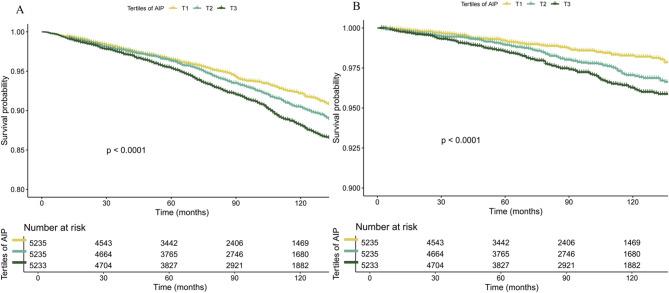
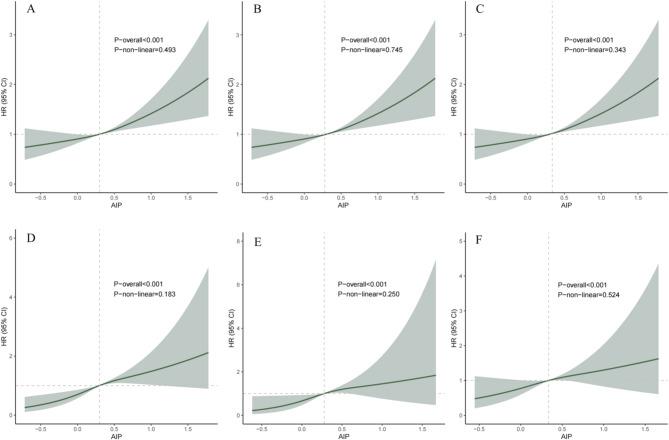
Over a median follow-up of 7.67 years, a total of 1570 deaths were documented, including 344 cardiovascular deaths. Kaplan-Meier survival analysis demonstrated that the lowest all-cause and CVD mortality rates were observed in the lowest AIP tertile. Compared with individuals in the lowest AIP tertile, Cox analysis indicated that those in highest tertile were associated with a higher risk of all-cause and CVD mortality (HR = 1.19, 95% CI 1.08-1.31, P < 0.001; HR = 1.38, 95% CI 1.22-1.57, P < 0.001) after adjusting for covariates, respectively. As a continuous variable, AIP levels had an approximate positive linear dose-response relationship with all-cause and CVD mortality. Subgroup analysis revealed no significant interactions with the examined variables, except for gender.
CONCLUSIONS
This study demonstrated that elevated AIP levels in individuals with CKM syndrome are strongly linked to higher mortality risks, notably all-cause mortality in advanced stages and CVD mortality across both non-advanced and advanced stages. These findings further highlight the importance of AIP as a valuable risk biomarker, providing a simple and effective tool for identifying mortality risk in individuals with CKM syndrome.
背景
心血管 - 肾脏 - 代谢(CKM)综合征作为一个新的临床概念,强调代谢紊乱、慢性肾脏病(CKD)和心血管疾病(CVD)之间的多方面相互作用。一些证据表明血浆致动脉粥样硬化指数(AIP)与心血管死亡率密切相关。然而,关于其与CKM综合征患者死亡率之间关联的数据仍然稀少。我们的研究旨在调查CKM综合征患者中AIP与全因死亡率和心血管死亡率之间的关联。
方法
本研究纳入了2005年至2018年美国国家健康与营养检查调查(NHANES)中的15703名CKM综合征参与者。AIP指数计算为log10(甘油三酯/高密度脂蛋白胆固醇[TG/HDL-C])。通过将NHANES参与者与国家死亡指数(NDI)相链接来确定死亡结局,随访数据截至2019年12月31日。采用Kaplan-Meier(K-M)生存曲线、Cox回归分析、限制性立方样条(RCS)和亚组分析来探讨CKM综合征患者中AIP水平与死亡率之间的关系。
结果
在中位随访7.67年期间,共记录了1570例死亡,其中包括344例心血管死亡。Kaplan-Meier生存分析表明,在AIP三分位数最低的组中观察到最低的全因死亡率和心血管疾病死亡率。与AIP三分位数最低的组相比,Cox分析表明,在调整协变量后,三分位数最高的组全因死亡率和心血管疾病死亡率风险更高(HR = 1.19,95%CI 1.08 - 1.31,P < 0.001;HR = 1.38,95%CI 1.22 - 1.57,P < 0.001)。作为连续变量,AIP水平与全因死亡率和心血管疾病死亡率之间存在近似的正线性剂量反应关系。亚组分析显示,除性别外,与所检查的变量无显著交互作用。
结论
本研究表明,CKM综合征患者中升高的AIP水平与更高的死亡风险密切相关,特别是晚期的全因死亡率以及非晚期和晚期的心血管疾病死亡率。这些发现进一步凸显了AIP作为一种有价值的风险生物标志物的重要性,为识别CKM综合征患者的死亡风险提供了一种简单有效的工具。


 Zotero 插件