
一项关于舒尼替尼的美国食品药品监督管理局不良事件报告系统(FAERS)事件的真实世界药物警戒研究。
A real-world pharmacovigilance study of FDA adverse event reporting system (FAERS) events for sunitinib.
作者信息
Zhang Xusheng, Ren Xiuli, Zhu Tianyu, Zheng Wanjin, Shen Chengwu, Lu Cuicui
机构信息
Department of Pharmacology, Shandong Provincial Hospital Affiliated to Shandong First Medical University, Jinan, China.
Cheeloo College of Medicine, Shandong University, Jinan, China.
出版信息
Front Pharmacol. 2024 Jul 24;15:1407709. doi: 10.3389/fphar.2024.1407709. eCollection 2024.
BACKGROUND
Sunitinib is approved for the treatment of metastatic renal cell carcinoma (mRCC), imatinib-resistant gastrointestinal stromal tumors (GIST), and advanced pancreatic neuroendocrine tumors (PNET). This study aims to investigate the safety profiles of sunitinib through data mining of the US Food and Drug Administration Adverse Event Reporting System (FAERS).
METHODS
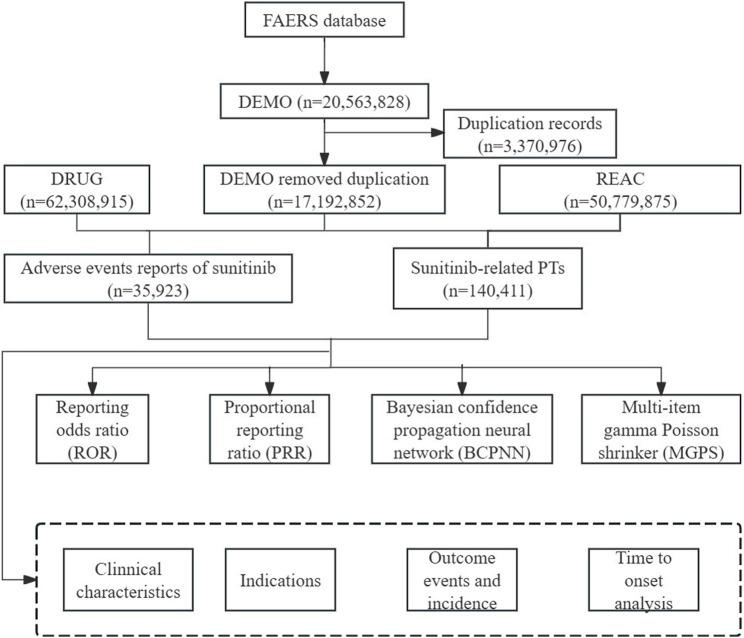
The individual case safety reports (ICSRs) on sunitinib from 2006 Q1 to 2024 Q1 were collected from the ASCII data packages in the Food and Drug Administration Adverse Event Reporting System (FAERS). After standardizing the data, a variety of disproportionality analyses, including the reporting odds ratio (ROR), the proportional reporting ratio (PRR), the bayesian confidence propagation neural network (BCPNN), and the multi-item gamma Poisson shrinker (MGPS) were employed to identify the potential safety signals of sunitinib-associated AEs.
RESULTS
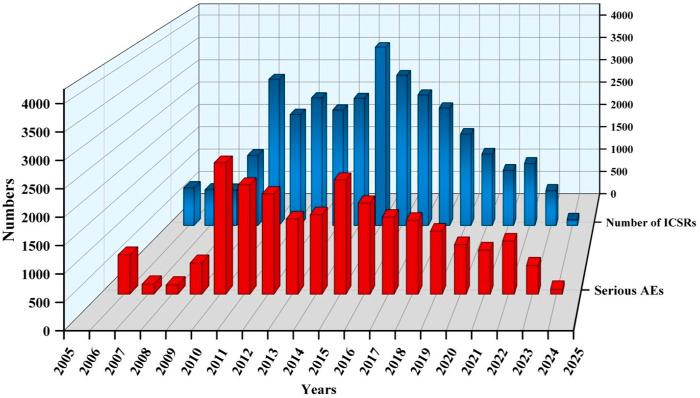
A total of 35,923 ICSRs of sunitinib as the "primary suspected" drug were identified within the reporting period. The search detected 276 disproportionate preferred terms (PTs). The most common AEs, including diarrhea, asthenia, decreased appetite, hypertension, and dysgeusia, were consistent with the drug label and clinical trials. Unexpected significant AEs, such as uveal melanocytic proliferation, salivary gland fistula, yellow skin, eyelash discoloration, scrotal inflammation, were detected. The median onset time of sunitinib-related AEs was 57 days (interquartile range [IQR]16-170 days), with most of the ICSRs developing within the first month (n = 4,582, 39.73%) after sunitinib therapy as initiated.
CONCLUSION
The results of our study were consistent with routine clinical observations, and some unexpected AEs signals were also identified for sunitinib, providing valuable evidence for the safe use of sunitinib in the real-world and contributing to the clinical monitoring and risk identification of sunitinib.
背景
舒尼替尼被批准用于治疗转移性肾细胞癌(mRCC)、伊马替尼耐药的胃肠道间质瘤(GIST)和晚期胰腺神经内分泌肿瘤(PNET)。本研究旨在通过对美国食品药品监督管理局不良事件报告系统(FAERS)的数据挖掘来调查舒尼替尼的安全性概况。
方法
从食品药品监督管理局不良事件报告系统(FAERS)的ASCII数据包中收集2006年第一季度至2024年第一季度关于舒尼替尼的个体病例安全报告(ICSR)。在对数据进行标准化处理后,采用多种不成比例分析方法,包括报告比值比(ROR)、比例报告比值(PRR)、贝叶斯置信传播神经网络(BCPNN)和多项目伽马泊松收缩器(MGPS),以识别舒尼替尼相关不良事件的潜在安全信号。
结果
在报告期内共识别出35923份以舒尼替尼为“主要怀疑”药物的ICSR。该搜索检测到276个不成比例的首选术语(PT)。最常见的不良事件,包括腹泻、乏力、食欲减退、高血压和味觉障碍,与药物标签和临床试验一致。检测到一些意外的严重不良事件,如葡萄膜黑素细胞增生、唾液腺瘘、皮肤发黄、睫毛变色、阴囊炎症。舒尼替尼相关不良事件的中位发病时间为57天(四分位间距[IQR]16 - 170天),大多数ICSR在开始舒尼替尼治疗后的第一个月内出现(n = 4582,39.73%)。
结论
我们的研究结果与常规临床观察一致,同时也为舒尼替尼识别出一些意外的不良事件信号,为舒尼替尼在现实世界中的安全使用提供了有价值的证据,并有助于舒尼替尼的临床监测和风险识别。

 Zotero 插件