
基于中国三省六市的一项研究:老年人的收入不平等与医疗保健利用情况
Income inequality and healthcare utilization of the older adults-based on a study in three provinces and six cities in China.
作者信息
Chi Zhang, Lun Hai, Ma Jiaxin, Zhou Yaping
机构信息
School of Philosophy and Sociology, Lanzhou University, Lanzhou, China.
School of Public Policy and Administration, Xi'an Jiaotong University, Xi'an, China.
出版信息
Front Public Health. 2024 Jul 24;12:1435162. doi: 10.3389/fpubh.2024.1435162. eCollection 2024.
PURPOSE
The objective of this study is to gain a more nuanced understanding of the specific impact of income inequality on the utilization of healthcare services for older adults. Additionally, the study aims to elucidate the moderating and mediating roles of public transfer income and psychological health in this context.
METHODS
A systematic examination of the impact of income inequality on healthcare utilization among older adults was conducted through field questionnaire surveys in six cities across three major geographical regions (West, Central, and East). The analysis employed baseline regression, as well as mediating and moderating effect tests.
RESULTS
First, there is a negative relationship between income inequality and the use of therapeutic healthcare services (β = -0.484, < 0.01) and preventive healthcare services (β = -0.576, < 0.01) by older adults. This relationship is more pronounced in the low- and medium-income groups as well as in the western region. The mediating effect of psychological state is significant (β = -0.331, < 0.05, β = -0.331, < 0.05). Public transfer income plays a significant role in regulation. The moderating effect of public transfer income on therapeutic services was more significant in low-income groups (β = 0.821, < 0.01). The moderating effect of public transfer income on preventive services was more significant in middle-income groups (β = 0.833, < 0.01).
CONCLUSION
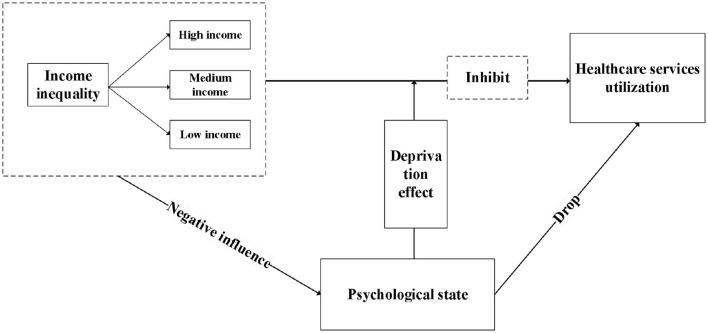
The study clearly demonstrates a significant negative correlation between income inequality and the utilization of healthcare services by older adults. Furthermore, the study reveals that this relationship is particularly pronounced among older adults in low- and medium-income and Western regions. This detailed analysis of regional and income level heterogeneity is of particular value in this field of research. Secondly, this study attempts to integrate the two pivotal dimensions of public transfer income and psychological state for the first time, elucidating their moderating and mediating roles in this relationship. The findings indicate that public transfer income serves as a moderating factor, exerting a notable "reordering effect" on income inequality and resulting in a "deprivation effect." Such factors may impede the utilization of medical services, potentially influencing the psychological state of older adults.
目的
本研究的目的是更细致地了解收入不平等对老年人医疗服务利用的具体影响。此外,该研究旨在阐明公共转移收入和心理健康在此背景下的调节和中介作用。
方法
通过对三大地理区域(西部、中部和东部)六个城市的实地问卷调查,系统考察了收入不平等对老年人医疗服务利用的影响。分析采用了基线回归以及中介和调节效应检验。
结果
首先,收入不平等与老年人使用治疗性医疗服务(β = -0.484,p < 0.01)和预防性医疗服务(β = -0.576,p < 0.01)之间存在负相关关系。这种关系在低收入和中等收入群体以及西部地区更为明显。心理状态的中介效应显著(β = -0.331,p < 0.05,β = -0.331,p < 0.05)。公共转移收入发挥了显著的调节作用。公共转移收入对治疗性服务的调节作用在低收入群体中更为显著(β = 0.821,p < 0.01)。公共转移收入对预防性服务的调节作用在中等收入群体中更为显著(β = 0.833,p < 0.01)。
结论
该研究清楚地表明,收入不平等与老年人医疗服务利用之间存在显著的负相关关系。此外,该研究表明,这种关系在低收入和中等收入老年人以及西部地区尤为明显。这种对区域和收入水平异质性的详细分析在该研究领域具有特别的价值。其次,本研究首次尝试将公共转移收入和心理状态这两个关键维度整合起来,阐明它们在这种关系中的调节和中介作用。研究结果表明,公共转移收入作为一个调节因素,对收入不平等产生显著的“重新排序效应”,并导致“剥夺效应”。这些因素可能会阻碍医疗服务的利用,潜在地影响老年人的心理状态。

 Zotero 插件