
纳米技术在恶性肿瘤诊断与治疗中的最新进展。
Current advance of nanotechnology in diagnosis and treatment for malignant tumors.
机构信息
Department of Pharmacy, Evidence-based Pharmacy Center, Children's Medicine Key Laboratory of Sichuan Province, West China Second University Hospital, Sichuan University, Chengdu, 610041, China.
Key Laboratory of Birth Defects and Related Diseases of Women and Children, Ministry of Education, West China Second University Hospital, Sichuan University, Chengdu, 610041, P.R. China.
出版信息
Signal Transduct Target Ther. 2024 Aug 12;9(1):200. doi: 10.1038/s41392-024-01889-y.
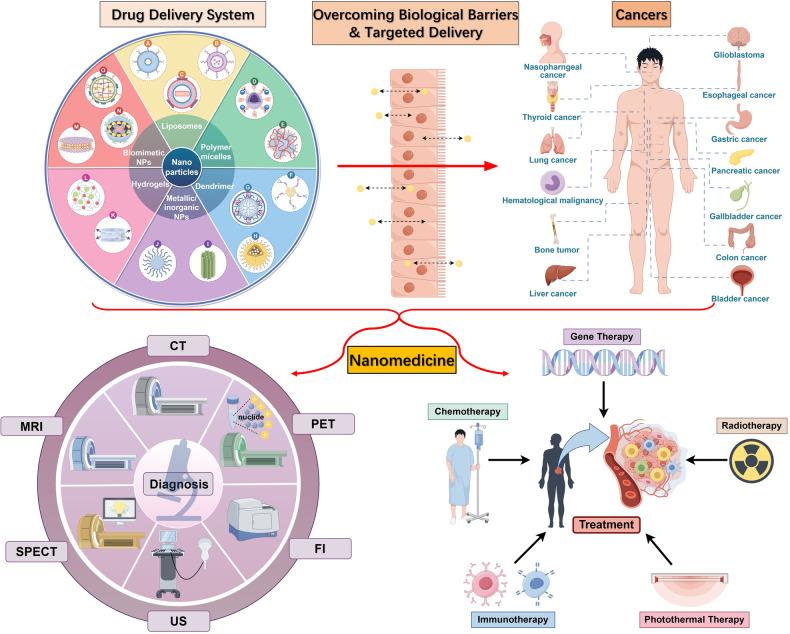
Cancer remains a significant risk to human health. Nanomedicine is a new multidisciplinary field that is garnering a lot of interest and investigation. Nanomedicine shows great potential for cancer diagnosis and treatment. Specifically engineered nanoparticles can be employed as contrast agents in cancer diagnostics to enable high sensitivity and high-resolution tumor detection by imaging examinations. Novel approaches for tumor labeling and detection are also made possible by the use of nanoprobes and nanobiosensors. The achievement of targeted medication delivery in cancer therapy can be accomplished through the rational design and manufacture of nanodrug carriers. Nanoparticles have the capability to effectively transport medications or gene fragments to tumor tissues via passive or active targeting processes, thus enhancing treatment outcomes while minimizing harm to healthy tissues. Simultaneously, nanoparticles can be employed in the context of radiation sensitization and photothermal therapy to enhance the therapeutic efficacy of malignant tumors. This review presents a literature overview and summary of how nanotechnology is used in the diagnosis and treatment of malignant tumors. According to oncological diseases originating from different systems of the body and combining the pathophysiological features of cancers at different sites, we review the most recent developments in nanotechnology applications. Finally, we briefly discuss the prospects and challenges of nanotechnology in cancer.
癌症仍然是人类健康的重大威胁。纳米医学是一个新兴的多学科领域,引起了广泛的关注和研究。纳米医学在癌症的诊断和治疗方面显示出巨大的潜力。经过特殊设计的纳米粒子可用作癌症诊断中的对比剂,通过成像检查实现高灵敏度和高分辨率的肿瘤检测。纳米探针和纳米生物传感器的使用也为肿瘤标记和检测提供了新的方法。通过合理设计和制造纳米药物载体,可以实现癌症治疗中的靶向药物输送。纳米粒子能够通过被动或主动靶向过程,将药物或基因片段有效递送到肿瘤组织中,从而提高治疗效果,同时最大限度地减少对健康组织的伤害。同时,纳米粒子可用于辐射增敏和光热治疗,以增强恶性肿瘤的治疗效果。本文综述了纳米技术在恶性肿瘤的诊断和治疗中的应用。根据来源于不同系统的肿瘤性疾病,并结合不同部位癌症的病理生理特点,我们综述了纳米技术应用的最新进展。最后,我们简要讨论了纳米技术在癌症治疗中的前景和挑战。



 Zotero 插件