
帕金森病中的疼痛:一种基于神经解剖学的方法。
Pain in Parkinson's disease: a neuroanatomy-based approach.
作者信息
Nardelli Domiziana, Gambioli Francesco, De Bartolo Maria Ilenia, Mancinelli Romina, Biagioni Francesca, Carotti Simone, Falato Emma, Leodori Giorgio, Puglisi-Allegra Stefano, Vivacqua Giorgio, Fornai Francesco
机构信息
Laboratory of Microscopic and Ultrastructural Anatomy, Campus Biomedico University of Roma, Rome 00128, Italy.
IRCCS Neuromed, Pozzilli, IS 86077, Italy.
出版信息
Brain Commun. 2024 Jun 18;6(4):fcae210. doi: 10.1093/braincomms/fcae210. eCollection 2024.
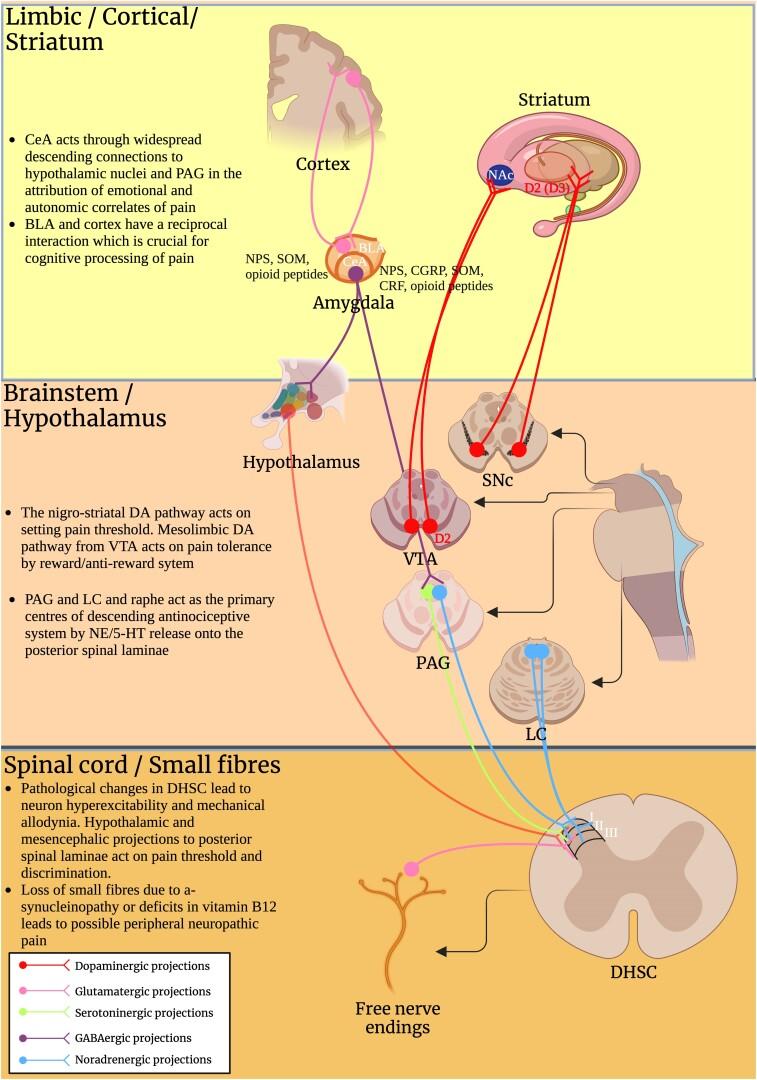
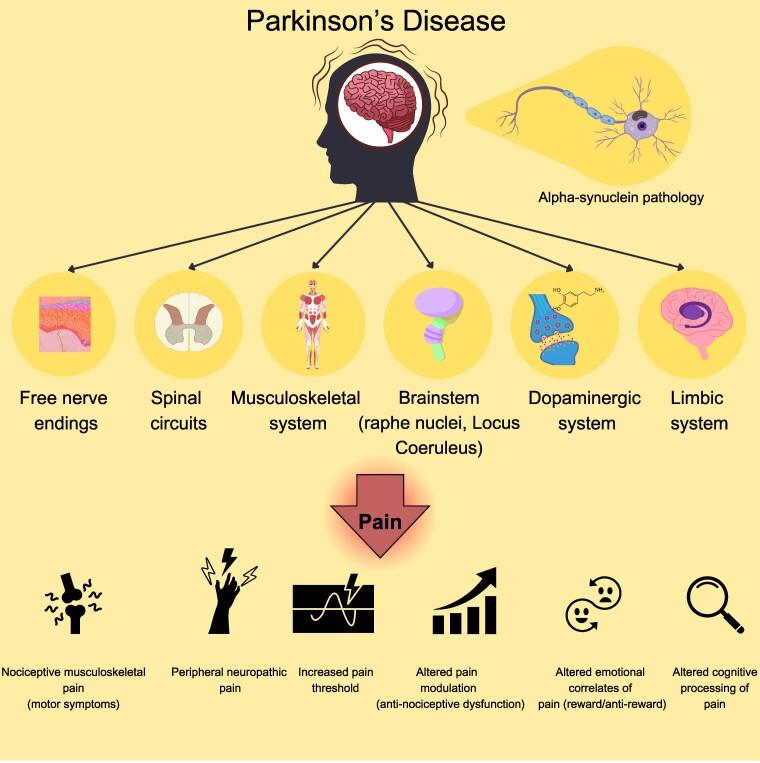
Parkinson's disease is a progressive neurodegenerative disorder characterized by the deposition of misfolded alpha-synuclein in different regions of the central and peripheral nervous system. Motor impairment represents the signature clinical expression of Parkinson's disease. Nevertheless, non-motor symptoms are invariably present at different stages of the disease and constitute an important therapeutic challenge with a high impact for the patients' quality of life. Among non-motor symptoms, pain is frequently experienced by patients, being present in a range of 24-85% of Parkinson's disease population. Moreover, in more than 5% of patients, pain represents the first clinical manifestation, preceding by decades the exordium of motor symptoms. Pain implies a complex biopsychosocial experience with a downstream complex anatomical network involved in pain perception, modulation, and processing. Interestingly, all the anatomical areas involved in pain network can be affected by a-synuclein pathology, suggesting that pathophysiology of pain in Parkinson's disease encompasses a 'pain spectrum', involving different anatomical and neurochemical substrates. Here the various anatomical sites recruited in pain perception, modulation and processing are discussed, highlighting the consequences of their possible degeneration in course of Parkinson's disease. Starting from peripheral small fibres neuropathy and pathological alterations at the level of the posterior laminae of the spinal cord, we then describe the multifaceted role of noradrenaline and dopamine loss in driving dysregulated pain perception. Finally, we focus on the possible role of the intertwined circuits between amygdala, nucleus accumbens and habenula in determining the psycho-emotional, autonomic and cognitive experience of pain in Parkinson's disease. This narrative review provides the first anatomically driven comprehension of pain in Parkinson's disease, aiming at fostering new insights for personalized clinical diagnosis and therapeutic interventions.
帕金森病是一种进行性神经退行性疾病,其特征是错误折叠的α-突触核蛋白在中枢和周围神经系统的不同区域沉积。运动障碍是帕金森病标志性的临床表现。然而,非运动症状在疾病的不同阶段总是存在,对患者的生活质量产生重大影响,构成了重要的治疗挑战。在非运动症状中,疼痛是患者经常经历的症状,在24%至85%的帕金森病患者中存在。此外,超过5%的患者中,疼痛是首发临床表现,比运动症状出现早几十年。疼痛意味着一种复杂的生物心理社会体验,涉及疼痛感知、调节和处理的下游复杂解剖网络。有趣的是,疼痛网络涉及的所有解剖区域都可能受到α-突触核蛋白病理改变的影响,这表明帕金森病疼痛的病理生理学涵盖了一个“疼痛谱”,涉及不同的解剖和神经化学底物。本文讨论了在疼痛感知、调节和处理中涉及的各种解剖部位,强调了它们在帕金森病过程中可能发生退化的后果。从外周小纤维神经病变和脊髓后板层水平的病理改变开始,我们接着描述去甲肾上腺素和多巴胺缺失在驱动疼痛感知失调中的多方面作用。最后,我们关注杏仁核、伏隔核和缰核之间相互交织的回路在确定帕金森病患者疼痛的心理情绪、自主神经和认知体验方面的可能作用。这篇叙述性综述首次从解剖学角度对帕金森病疼痛进行了理解,旨在为个性化临床诊断和治疗干预提供新的见解。

 Zotero 插件