
探讨在马拉维为常见围产期心理健康问题的女性扩大筛查和心理社会治疗的投资回报:开发成本效益计算器工具。
Exploring the return-on-investment for scaling screening and psychosocial treatment for women with common perinatal mental health problems in Malawi: Developing a cost-benefit-calculator tool.
机构信息
Care Policy and Evaluation Centre, Department of Health Policy, London School of Economics and Political Science, London, England, United Kingdom.
Research Department of Primary Care and Population Health, University College London Medical School, London, England, United Kingdom.
出版信息
PLoS One. 2024 Aug 12;19(8):e0308667. doi: 10.1371/journal.pone.0308667. eCollection 2024.
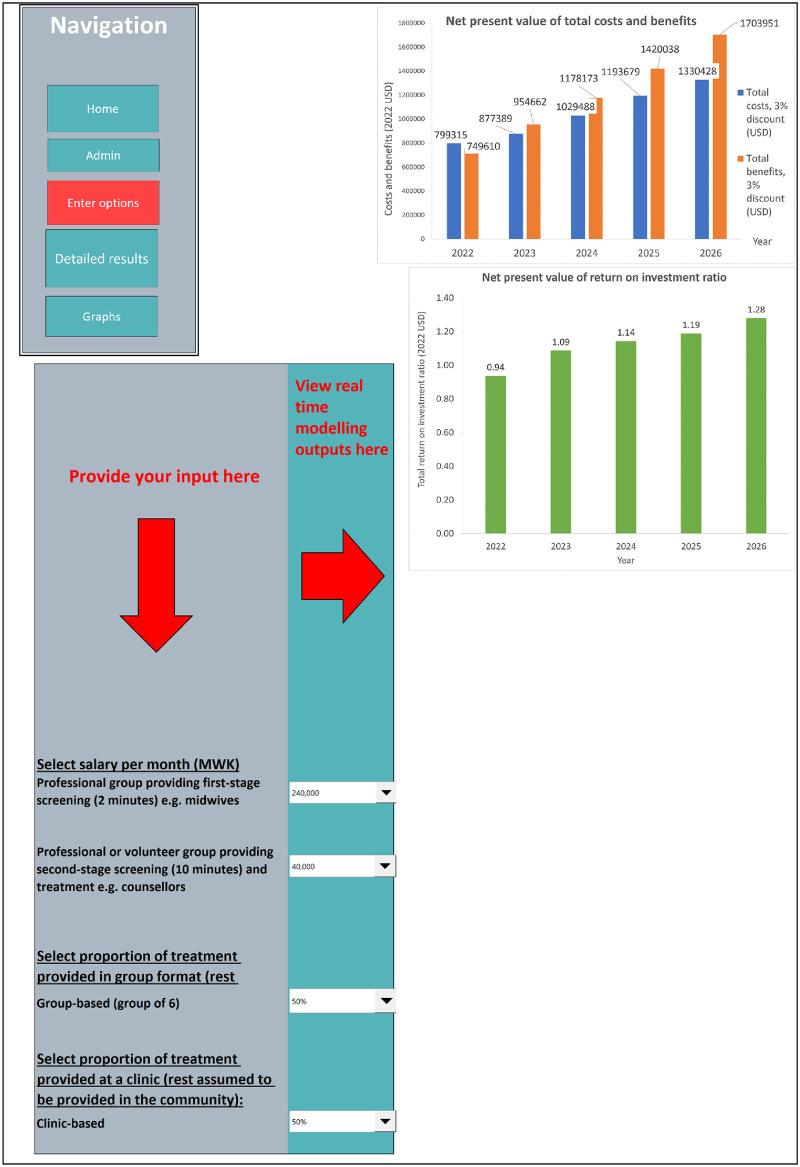
This study sought to develop a user-friendly decision-making tool to explore country-specific estimates for costs and economic consequences of different options for scaling screening and psychosocial interventions for women with common perinatal mental health problems in Malawi. We developed a simple simulation model using a structure and parameter estimates that were established iteratively with experts, based on published trials, international databases and resources, statistical data, best practice guidance and intervention manuals. The model projects annual costs and returns to investment from 2022 to 2026. The study perspective is societal, including health expenditure and productivity losses. Outcomes in the form of health-related quality of life are measured in Disability Adjusted Life Years, which were converted into monetary values. Economic consequences include those that occur in the year in which the intervention takes place. Results suggest that the net benefit is relatively small at the beginning but increases over time as learning effects lead to a higher number of women being identified and receiving (cost‑)effective treatment. For a scenario in which screening is first provided by health professionals (such as midwives) and a second screening and the intervention are provided by trained and supervised volunteers to equal proportions in group and individual sessions, as well as in clinic versus community setting, total costs in 2022 amount to US$ 0.66 million and health benefits to US$ 0.36 million. Costs increase to US$ 1.03 million and health benefits to US$ 0.93 million in 2026. Net benefits increase from US$ 35,000 in 2022 to US$ 0.52 million in 2026, and return-on-investment ratios from 1.05 to 1.45. Results from sensitivity analysis suggest that positive net benefit results are highly sensitive to an increase in staff salaries. This study demonstrates the feasibility of developing an economic decision-making tool that can be used by local policy makers and influencers to inform investments in maternal mental health.
本研究旨在开发一个用户友好的决策工具,以探索马拉维针对常见围产期心理健康问题的女性扩大筛查和心理社会干预的不同方案的国家特定成本和经济后果的估计。我们使用基于专家意见、已发表试验、国际数据库和资源、统计数据、最佳实践指南和干预手册建立的结构和参数估计,开发了一个简单的模拟模型。该模型预测 2022 年至 2026 年的年度成本和投资回报。研究视角是全社会的,包括卫生支出和生产力损失。以残疾调整生命年 (DALY) 的形式衡量健康相关生活质量的结果,这些结果被转换为货币价值。经济后果包括干预发生当年发生的后果。结果表明,最初的净效益相对较小,但随着学习效应导致更多的女性被识别并接受(成本)有效的治疗,净效益会随着时间的推移而增加。在一种情况下,由卫生专业人员(如助产士)提供初次筛查,由经过培训和监督的志愿者以同等比例提供二次筛查和干预,包括在小组和个别会议中,以及在诊所和社区环境中提供,2022 年的总费用为 66 万美元,健康效益为 36 万美元。2026 年,成本增加到 103 万美元,健康效益增加到 930 万美元。2022 年的净效益从 3.5 万美元增加到 2026 年的 52 万美元,投资回报率从 1.05 增加到 1.45。敏感性分析结果表明,积极的净效益结果对员工工资的增加高度敏感。本研究证明了开发经济决策工具的可行性,该工具可供当地决策者和影响者使用,以投资于产妇心理健康。
 Zotero 插件