
基于CMill步态数据的基于机器学习的步态适应功能障碍识别
Machine learning-based gait adaptation dysfunction identification using CMill-based gait data.
作者信息
Yang Hang, Liao Zhenyi, Zou Hailei, Li Kuncheng, Zhou Ye, Gao Zhenzhen, Mao Yajun, Song Caiping
机构信息
Department of Rehabilitation Medicine, the First Affiliated Hospital of Zhejiang Chinese Medical University, Zhejiang, China.
College of Science, China Jiliang University, Zhejiang, China.
出版信息
Front Neurorobot. 2024 Jul 29;18:1421401. doi: 10.3389/fnbot.2024.1421401. eCollection 2024.
BACKGROUND
Combining machine learning (ML) with gait analysis is widely applicable for diagnosing abnormal gait patterns.
OBJECTIVE
To analyze gait adaptability characteristics in stroke patients, develop ML models to identify individuals with GAD, and select optimal diagnostic models and key classification features.
METHODS
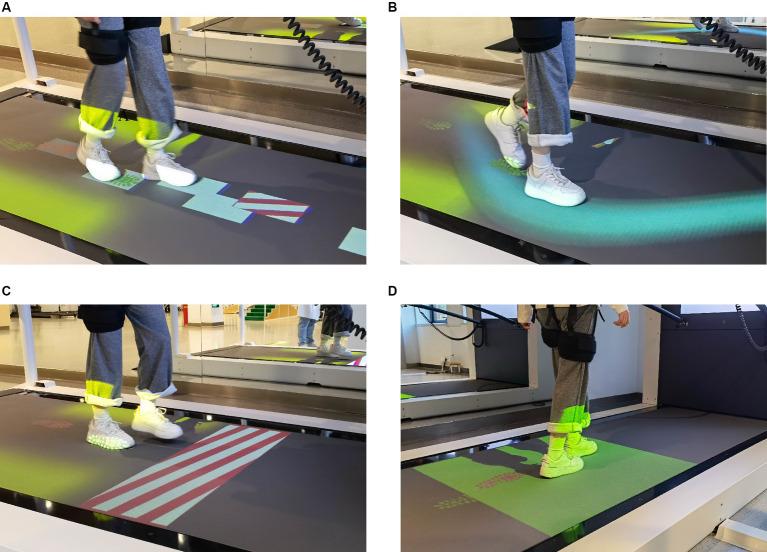
This study was investigated with 30 stroke patients (mean age 42.69 years, 60% male) and 50 healthy adults (mean age 41.34 years, 58% male). Gait adaptability was assessed using a CMill treadmill on gait adaptation tasks: target stepping, slalom walking, obstacle avoidance, and speed adaptation. The preliminary analysis of variables in both groups was conducted using t-tests and Pearson correlation. Features were extracted from demographics, gait kinematics, and gait adaptability datasets. ML models based on Support Vector Machine, Decision Tree, Multi-layer Perceptron, K-Nearest Neighbors, and AdaCost algorithm were trained to classify individuals with and without GAD. Model performance was evaluated using accuracy (ACC), sensitivity (SEN), F1-score and the area under the receiver operating characteristic (ROC) curve (AUC).
RESULTS
The stroke group showed a significantly decreased gait speed ( = 0.000) and step length (SL) ( = 0.000), while the asymmetry of SL ( = 0.000) and ST ( = 0.000) was higher compared to the healthy group. The gait adaptation tasks significantly decreased in slalom walking ( = 0.000), obstacle avoidance ( = 0.000), and speed adaptation ( = 0.000). Gait speed ( = 0.000) and obstacle avoidance ( = 0.000) were significantly correlated with global F-A score in stroke patients. The AdaCost demonstrated better classification performance with an ACC of 0.85, SEN of 0.80, F1-score of 0.77, and ROC-AUC of 0.75. Obstacle avoidance and gait speed were identified as critical features in this model.
CONCLUSION
Stroke patients walk slower with shorter SL and more asymmetry of SL and ST. Their gait adaptability was decreased, particularly in obstacle avoidance and speed adaptation. The faster gait speed and better obstacle avoidance were correlated with better functional mobility. The AdaCost identifies individuals with GAD and facilitates clinical decision-making. This advances the future development of user-friendly interfaces and computer-aided diagnosis systems.
背景
将机器学习(ML)与步态分析相结合广泛应用于异常步态模式的诊断。
目的
分析中风患者的步态适应性特征,开发ML模型以识别患有步态适应障碍(GAD)的个体,并选择最佳诊断模型和关键分类特征。
方法
本研究纳入了30例中风患者(平均年龄42.69岁,60%为男性)和50例健康成年人(平均年龄41.34岁,58%为男性)。使用CMill跑步机在步态适应任务中评估步态适应性:目标步幅、曲折行走、避障和速度适应。使用t检验和Pearson相关性对两组变量进行初步分析。从人口统计学、步态运动学和步态适应性数据集中提取特征。基于支持向量机、决策树、多层感知器、K近邻和AdaCost算法的ML模型被训练用于对患有和未患有GAD的个体进行分类。使用准确率(ACC)、灵敏度(SEN)、F1分数和受试者工作特征(ROC)曲线下面积(AUC)评估模型性能。
结果
中风组的步态速度( = 0.000)和步长(SL)( = 0.000)显著降低,而与健康组相比,SL( = 0.000)和步宽(ST)( = 0.000)的不对称性更高。在曲折行走( = 0.000)、避障( = 0.000)和速度适应( = 0.000)方面,步态适应任务显著下降。中风患者的步态速度( = 0.000)和避障( = 0.000)与整体F - A评分显著相关。AdaCost表现出更好的分类性能,ACC为0.85,SEN为0.80,F1分数为0.77,ROC - AUC为0.75。避障和步态速度被确定为该模型的关键特征。
结论
中风患者行走速度较慢,步长较短,SL和ST的不对称性更大。他们的步态适应性下降,尤其是在避障和速度适应方面。较快的步态速度和更好的避障能力与更好的功能移动性相关。AdaCost可识别患有GAD的个体并促进临床决策。这推动了用户友好界面和计算机辅助诊断系统的未来发展。



 Zotero 插件