
[F]F-成纤维细胞活化蛋白抑制剂(FAPI)-42正电子发射断层扫描/计算机断层扫描(PET/CT)在评估复发或转移性胃肠道间质瘤反应中的预测性能:是[F]氟脱氧葡萄糖(FDG)PET/CT的补充还是替代?
Predictive performance of [F]F-fibroblast activation protein inhibitor (FAPI)-42 positron emission tomography/computed tomography (PET/CT) in evaluating response of recurrent or metastatic gastrointestinal stromal tumors: complementary or alternative to [F]fluorodeoxyglucose (FDG) PET/CT?
作者信息
Wu Chunhui, Wen Fang, Lin Fangzeng, Zeng Yu, Lin Xiaojie, Hu Xin, Zhang Xiangsong, Zhang Xinhua, Wang Xiaoyan
机构信息
Department of Nuclear Medicine, The First Affiliated Hospital of Sun Yat-sen University, Guangzhou, China.
Department of Radiology, The First Affiliated Hospital of Sun Yat-sen University, Guangzhou, China.
出版信息
Quant Imaging Med Surg. 2024 Aug 1;14(8):5333-5345. doi: 10.21037/qims-24-192. Epub 2024 Jun 21.
BACKGROUND
Accurately and promptly predicting the response of gastrointestinal stromal tumors (GISTs) to targeted therapy is essential for optimizing treatment strategies. However, some fractions of recurrent or metastatic GISTs present as non-FDG-avid lesions, limiting the value of [F]fluorodeoxyglucose positron emission tomography/computed tomography ([F]FDG PET/CT) in treatment evaluation. This study evaluated the efficacy of [F]F-fibroblast activation protein inhibitor (FAPI)-42 [F]FAPI-42) PET/CT for assessing the treatment response in recurrent or metastatic GISTs, in comparison to [F]FDG PET/CT and explores a model integrating PET/CT imaging and clinical parameters to optimize the clinical use of these diagnostic tools.
METHODS
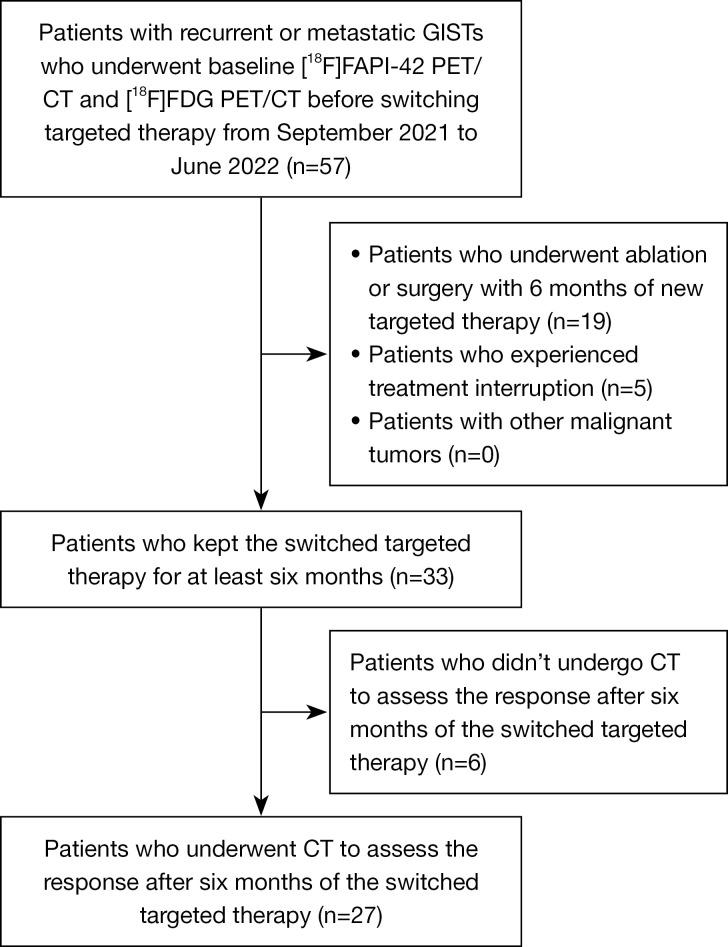
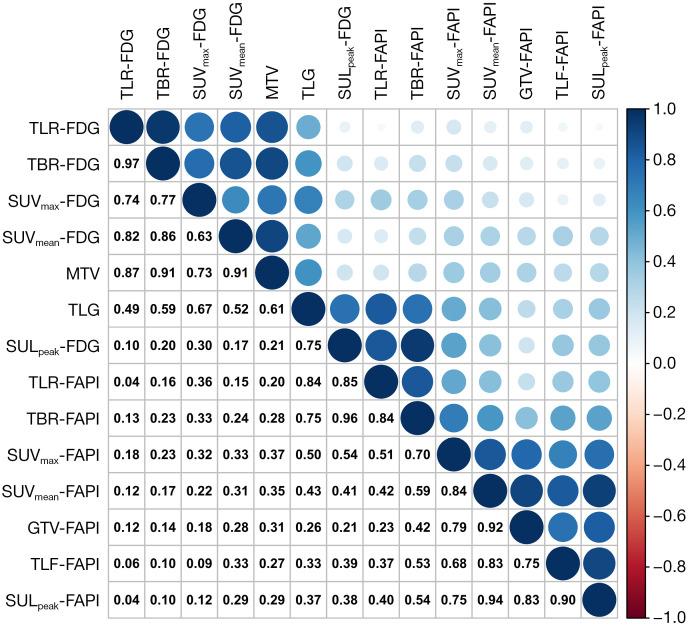
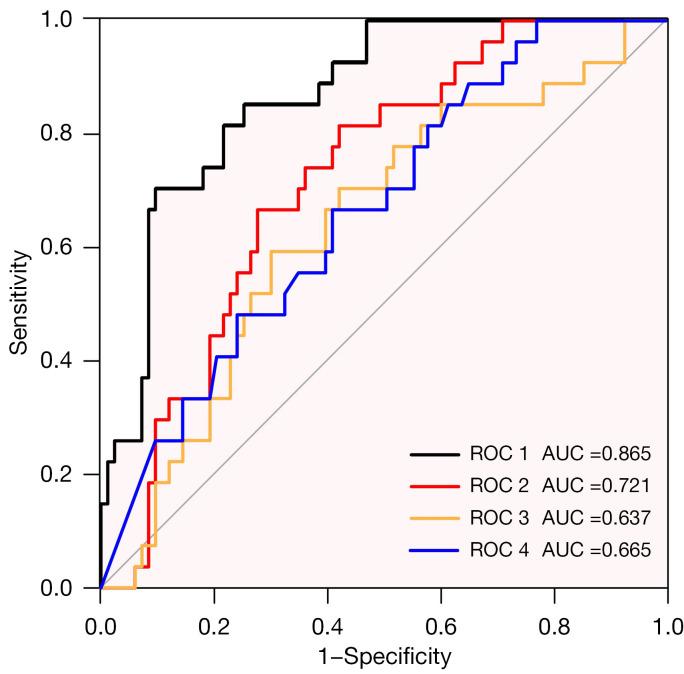
Our retrospective analysis included 27 patients with recurrent or metastatic GISTs who underwent [F]FAPI-42 PET/CT and [F]FDG PET/CT at baseline before switching targeted therapy. Treatment response status was divided into a progression group (PG) and a non-progression group (NPG) based on the Response Criteria in Solid Tumors (RECIST) 1.1, according to the contrast-enhanced computed tomography (CT) scan at six months. [F]FAPI-42 and [F]FDG PET/CT parameters including the mean standardized uptake value (SUV), the standard uptake value corrected for lean body mass (SUL), the maximum standardized uptake value (SUV), tumor-to-blood pool SUV ratio (TBR), tumor-to-liver SUV ratio (TLR), metabolic tumor volume (MTV)/FAPI-positive tumor volume (GTV-FAPI), total lesion glycolysis (TLG)/FAPI-positive total lesion accumulation (TLF) were correlated with the response status to identify indicative of treatment response. The predictive performance of them was quantified by generating receiver operating characteristic curves (ROC), calibration curves, and cross-validation.
RESULTS
A total of 110 lesions were identified in 27 patients. Compared with PG, NPG was associated with lower levels of TBR and SUV in FDG PET/CT (TBR-FDG, SUV-FDG; P=0.033 and P=0.038, respectively), with higher SUL and TLF in FAPI PET/CT (SUL-FAPI, TLF-FAPI; P=0.10 and P=0.049, respectively). The predictive power of a composite-parameter model, including TBR-FDG, SUL-FAPI, gene mutation, and type of targeted therapy [area under the curve (AUC) =0.865], was superior to the few-parameter models incorporating TBR-FDG (AUC =0.637, P<0.001), SUL-FAPI (AUC =0.665, P<0.001) or both (AUC =0.721, P<0.001).
CONCLUSIONS
Both [F]FAPI-42 PET/CT and [F]FDG PET/CT have value in predicting the treatment response of recurrent or metastatic GISTs. And [F]FAPI-42 PET/CT offers synergistic value when used in combination with [F]FDG PET/CT. Notably, the nomogram generated from the model incorporating [F]FAPI-42 PET/CT, [F]FDG PET/CT parameters, gene mutation, and type of targeted therapy could yield more precise predictions of the response of recurrent metastatic GISTs.
背景
准确且及时地预测胃肠道间质瘤(GISTs)对靶向治疗的反应对于优化治疗策略至关重要。然而,部分复发或转移性GISTs表现为非氟代脱氧葡萄糖(FDG)摄取性病变,限制了[F]氟代脱氧葡萄糖正电子发射断层扫描/计算机断层扫描([F]FDG PET/CT)在治疗评估中的价值。本研究评估了[F]F-成纤维细胞激活蛋白抑制剂(FAPI)-42([F]FAPI-42)PET/CT在评估复发或转移性GISTs治疗反应方面的疗效,并与[F]FDG PET/CT进行比较,同时探索一种整合PET/CT成像和临床参数的模型,以优化这些诊断工具的临床应用。
方法
我们的回顾性分析纳入了27例复发或转移性GISTs患者,这些患者在更换靶向治疗前于基线时接受了[F]FAPI-42 PET/CT和[F]FDG PET/CT检查。根据实体瘤疗效评价标准(RECIST)1.1,基于六个月时的对比增强计算机断层扫描(CT)扫描,将治疗反应状态分为进展组(PG)和非进展组(NPG)。[F]FAPI-42和[F]FDG PET/CT参数,包括平均标准化摄取值(SUV)、去脂体重校正后的标准化摄取值(SUL)、最大标准化摄取值(SUV)、肿瘤与血池SUV比值(TBR)、肿瘤与肝脏SUV比值(TLR)、代谢肿瘤体积(MTV)/FAPI阳性肿瘤体积(GTV-FAPI)、总病灶糖酵解(TLG)/FAPI阳性总病灶蓄积(TLF),与反应状态相关,以确定治疗反应的指标。通过生成受试者操作特征曲线(ROC)、校准曲线和交叉验证来量化它们的预测性能。
结果
27例患者共识别出110个病灶。与PG相比,NPG在FDG PET/CT中的TBR和SUV水平较低(TBR-FDG,SUV-FDG;分别为P = 0.033和P = 0.038),在FAPI PET/CT中的SUL和TLF较高(SUL-FAPI,TLF-FAPI;分别为P = 0.10和P = 0.049)。包括TBR-FDG、SUL-FAPI、基因突变和靶向治疗类型的复合参数模型的预测能力[曲线下面积(AUC)= 0.865]优于包含TBR-FDG(AUC = 0.637,P < 0.001)、SUL-FAPI(AUC = 0.665,P < 0.001)或两者(AUC = 0.721,P < 0.001)的少参数模型。
结论
[F]FAPI-42 PET/CT和[F]FDG PET/CT在预测复发或转移性GISTs的治疗反应方面均有价值。并且[F]FAPI-42 PET/CT与[F]FDG PET/CT联合使用时具有协同价值。值得注意的是,由包含[F]FAPI-42 PET/CT、[F]FDG PET/CT参数、基因突变和靶向治疗类型的模型生成的列线图可以更精确地预测复发转移性GISTs的反应。



 Zotero 插件