
欧洲癌症前瞻性调查与营养研究(EPIC)和英国生物库中体型表型和体脂肪分布指数与炎症生物标志物的相关性。
Association of body shape phenotypes and body fat distribution indexes with inflammatory biomarkers in the European Prospective Investigation into Cancer and Nutrition (EPIC) and UK Biobank.
机构信息
Nutrition and Metabolism Branch, International Agency for Research On Cancer, World Health Organization, 69372, Lyon, CEDEX 08, France.
Department of Clinical Sciences, Faculty of Medicine, University of Barcelona, Barcelona, Spain.
出版信息
BMC Med. 2024 Aug 15;22(1):334. doi: 10.1186/s12916-024-03544-3.
BACKGROUND
The allometric body shape index (ABSI) and hip index (HI), as well as multi-trait body shape phenotypes, have not yet been compared in their associations with inflammatory markers. The aim of this study was to examine the relationship between novel and traditional anthropometric indexes with inflammation using data from the European Prospective Investigation into Cancer and Nutrition (EPIC) and UK Biobank cohorts.
METHODS
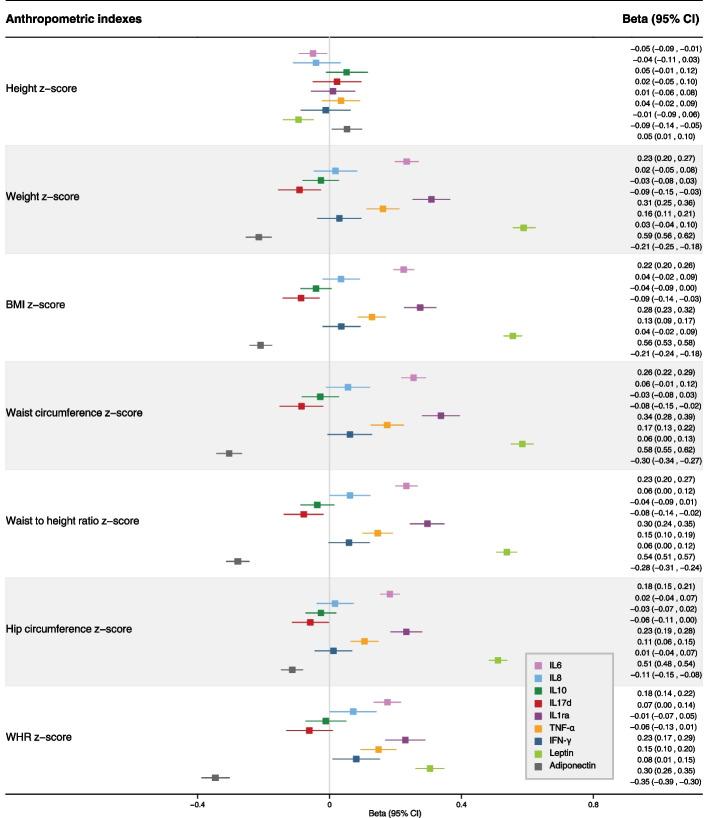
Participants from EPIC (n = 17,943, 69.1% women) and UK Biobank (n = 426,223, 53.2% women) with data on anthropometric indexes and C-reactive protein (CRP) were included in this cross-sectional analysis. A subset of women in EPIC also had at least one measurement for interleukins, tumour necrosis factor alpha, interferon gamma, leptin, and adiponectin. Four distinct body shape phenotypes were derived by a principal component (PC) analysis on height, weight, body mass index (BMI), waist (WC) and hip circumferences (HC), and waist-to-hip ratio (WHR). PC1 described overall adiposity, PC2 tall with low WHR, PC3 tall and centrally obese, and PC4 high BMI and weight with low WC and HC, suggesting an athletic phenotype. ABSI, HI, waist-to-height ratio and waist-to-hip index (WHI) were also calculated. Linear regression models were carried out separately in EPIC and UK Biobank stratified by sex and adjusted for age, smoking status, education, and physical activity. Results were additionally combined in a random-effects meta-analysis.
RESULTS
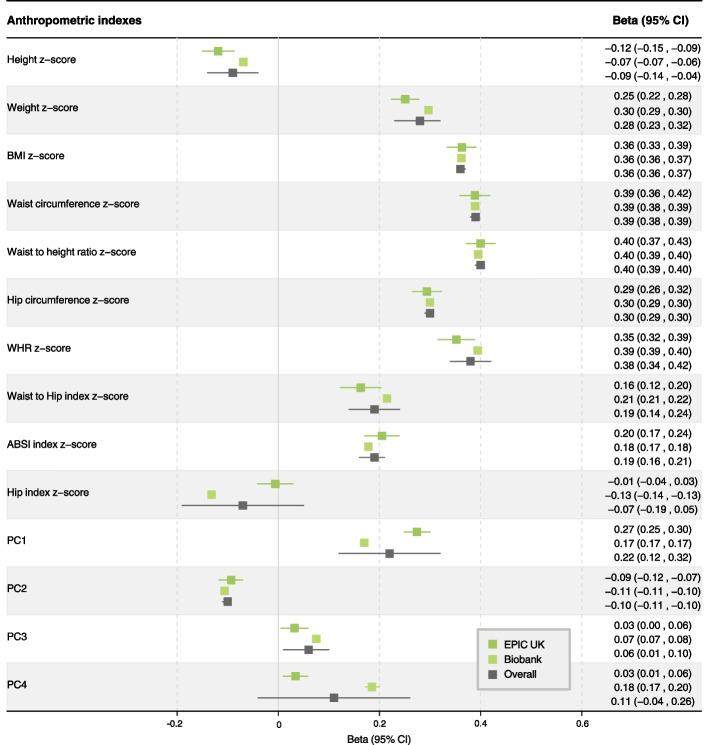
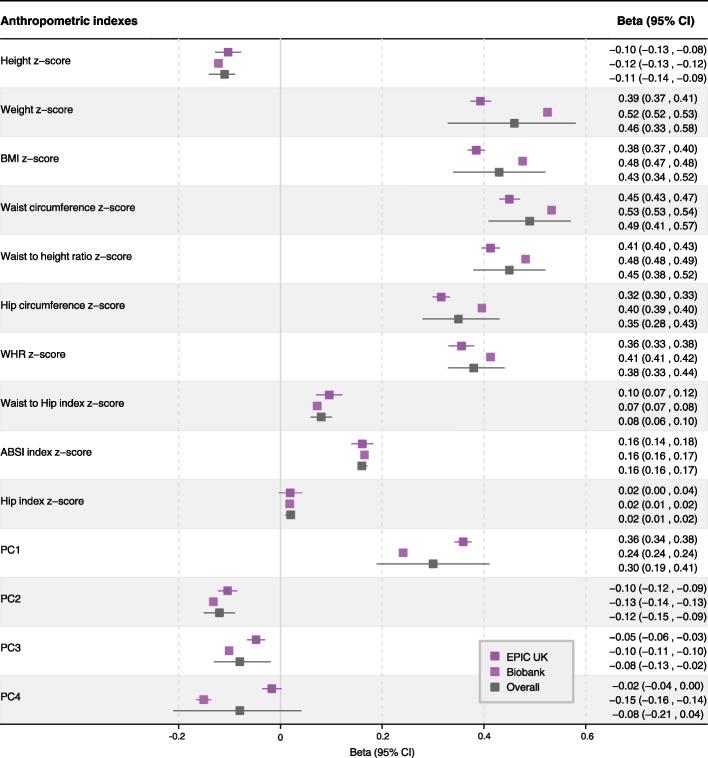
Traditional anthropometric indexes, particularly BMI, WC, and weight were positively associated with CRP levels, in men and women. Body shape phenotypes also showed distinct associations with CRP. Specifically, PC2 showed inverse associations with CRP in EPIC and UK Biobank in both sexes, similarly to height. PC3 was inversely associated with CRP among women, whereas positive associations were observed among men.
CONCLUSIONS
Specific indexes of body size and body fat distribution showed differential associations with inflammation in adults. Notably, our results suggest that in women, height may mitigate the impact of a higher WC and HC on inflammation. This suggests that subtypes of adiposity exhibit substantial variation in their inflammatory potential, which may have implications for inflammation-related chronic diseases.
背景
身体形态的比例指数(ABSI)和髋指数(HI)以及多特征身体形态表型,尚未在与炎症标志物的相关性方面进行比较。本研究的目的是使用欧洲癌症前瞻性调查(EPIC)和英国生物银行队列的数据,检查新型和传统人体测量指标与炎症之间的关系。
方法
纳入了 EPIC(n=17943,69.1%女性)和 UK Biobank(n=426223,53.2%女性)中具有人体测量指数和 C 反应蛋白(CRP)数据的参与者。EPIC 中至少有一组女性至少有一项白细胞介素、肿瘤坏死因子-α、干扰素-γ、瘦素和脂联素的测量值。通过对身高、体重、体重指数(BMI)、腰围(WC)和髋围(HC)以及腰臀比(WHR)进行主成分(PC)分析,得出了四个不同的体型表型。PC1 描述了总体肥胖程度,PC2 为高个子且 WHR 低,PC3 为高个子且中央肥胖,PC4 为高 BMI 和体重,WC 和 HC 低,提示运动型表型。还计算了 ABSI、HI、腰高比和腰臀指数(WHI)。按性别分层,在 EPIC 和 UK Biobank 中分别进行线性回归模型,并根据年龄、吸烟状况、教育程度和身体活动进行调整。结果在随机效应荟萃分析中进行了补充。
结果
传统人体测量指标,尤其是 BMI、WC 和体重,与 CRP 水平呈正相关,在男性和女性中均如此。体型表型也与 CRP 有明显的关联。具体而言,PC2 在 EPIC 和 UK Biobank 中在两性中与 CRP 呈负相关,与身高相似。PC3 与女性 CRP 呈负相关,而男性则呈正相关。
结论
身体大小和体脂肪分布的特定指标与成年人的炎症有不同的关联。值得注意的是,我们的结果表明,在女性中,身高可能会减轻 WC 和 HC 升高对炎症的影响。这表明不同的肥胖亚型在其炎症潜力方面存在显著差异,这可能对与炎症相关的慢性疾病产生影响。

 Zotero 插件