
丁醇溶剂木质素热解过程中纳米金刚石的形成。
Formation of Nanodiamonds during Pyrolysis of Butanosolv Lignin.
作者信息
Feng Yi, Davidson Daniel J, Sun Weihao, Milani Valentina, Howieson Grant W, Westwood Nicholas J, Zhou Wuzong
机构信息
EaStChem, School of Chemistry, University of St Andrews, Fife, St Andrews KY16 9ST, U.K.
Biomedical Sciences Research Complex, University of St Andrews, North Haugh, Fife, St Andrews KY16 9ST, U.K.
出版信息
ACS Nano. 2024 Sep 10;18(36):24803-24811. doi: 10.1021/acsnano.4c02950. Epub 2024 Aug 23.
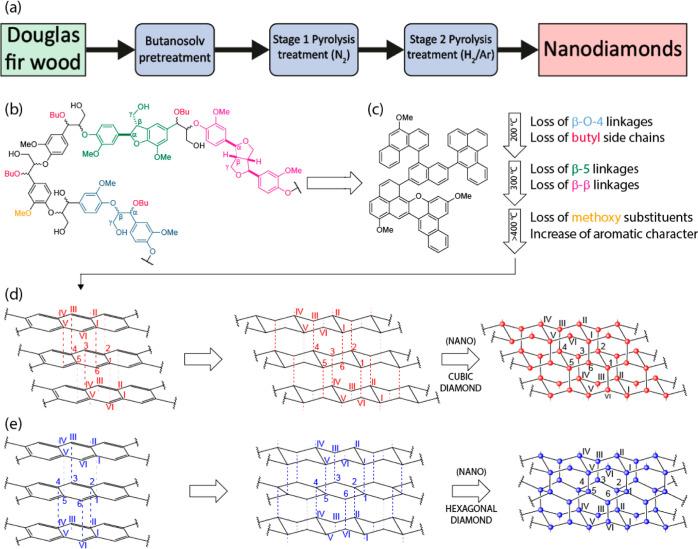
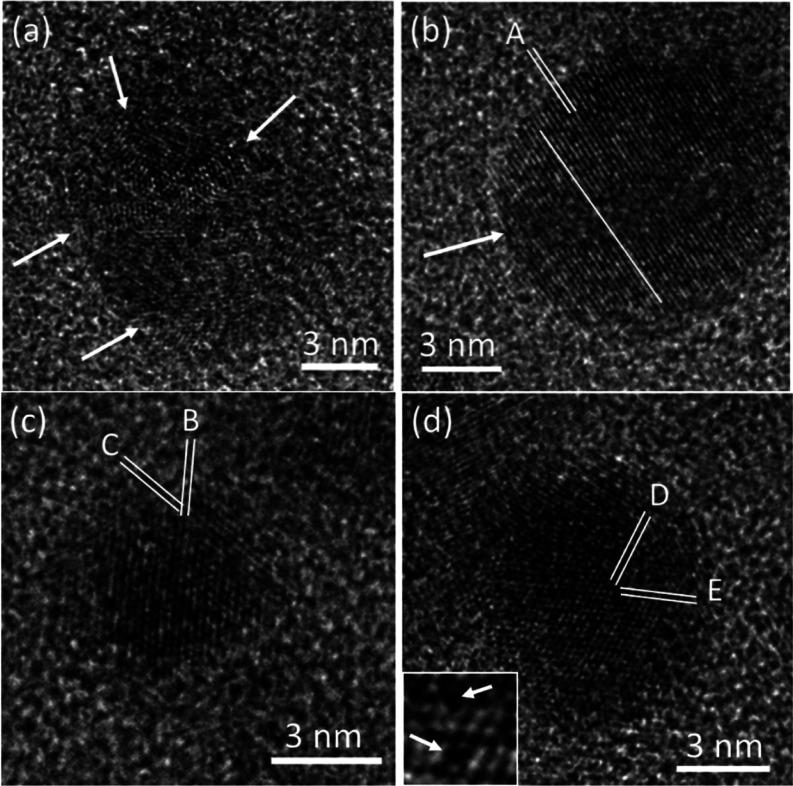
The preparation of artificial diamonds has a long history driven by decreased costs compared to naturally occurring diamonds and ethical issues. However, fabrication of diamonds in the laboratory from readily available biomass has not been extensively investigated. This work demonstrates a convenient method for producing nanodiamonds from biopolymer lignin at ambient pressure. Lignin was extracted from Douglas Fir sawdust using a butanosolv pretreatment and was pyrolyzed in N at 1000 °C, followed by a second thermal treatment in 5% H/Ar at 1050 °C, both at ambient pressure. This led to the formation of nanodiamonds embedded in an amorphous carbon substrate. The changes occurring at various stages of the pyrolysis process were monitored by scanning electron microscopy, Fourier transform infrared spectroscopy, and nuclear magnetic resonance spectroscopy. High resolution transmission electron microscopy revealed that nanodiamond crystallites, 4 nm in diameter on average, formed via multiple nucleation events in some carbon-containing high density spheres. It is proposed that highly defected graphene-like flakes form during the pyrolysis of lignin as an intermediate phase. These flakes are more deformable with more localized π electrons in comparison with graphene and join together face-to-face in different manners to form cubic or hexagonal nanodiamonds. This proposed mechanism for the formation of nanodiamonds is relevant to the future fabrication of diamonds from biomass under relatively mild conditions.
与天然钻石相比,成本降低以及伦理问题推动了人造钻石制备技术的长期发展。然而,利用易于获取的生物质在实验室中制备钻石尚未得到广泛研究。这项工作展示了一种在常压下从生物聚合物木质素制备纳米钻石的简便方法。使用丁醇溶剂预处理从花旗松锯末中提取木质素,并在常压下于1000 °C的氮气中进行热解,随后在1050 °C的5%氢气/氩气中进行第二次热处理。这导致在非晶碳基质中形成了嵌入的纳米钻石。通过扫描电子显微镜、傅里叶变换红外光谱和核磁共振光谱监测热解过程各个阶段发生的变化。高分辨率透射电子显微镜显示,平均直径为4纳米的纳米钻石微晶在一些含碳高密度球体中通过多次成核事件形成。有人提出,在木质素热解过程中会形成高度缺陷的类石墨烯薄片作为中间相。与石墨烯相比,这些薄片具有更多局部化的π电子,更易于变形,并以不同方式面对面结合形成立方或六边形纳米钻石。这种提出的纳米钻石形成机制与未来在相对温和条件下从生物质制备钻石相关。




 Zotero 插件