
膜性肾病中免疫复合物的命运。
The fate of immune complexes in membranous nephropathy.
机构信息
School of Life Sciences, Beijing University of Chinese Medicine, Beijing, China.
Qi Huang of Traditional Chinese Medicine, Beijing University of Chinese Medicine, Beijing, China.
出版信息
Front Immunol. 2024 Aug 8;15:1441017. doi: 10.3389/fimmu.2024.1441017. eCollection 2024.
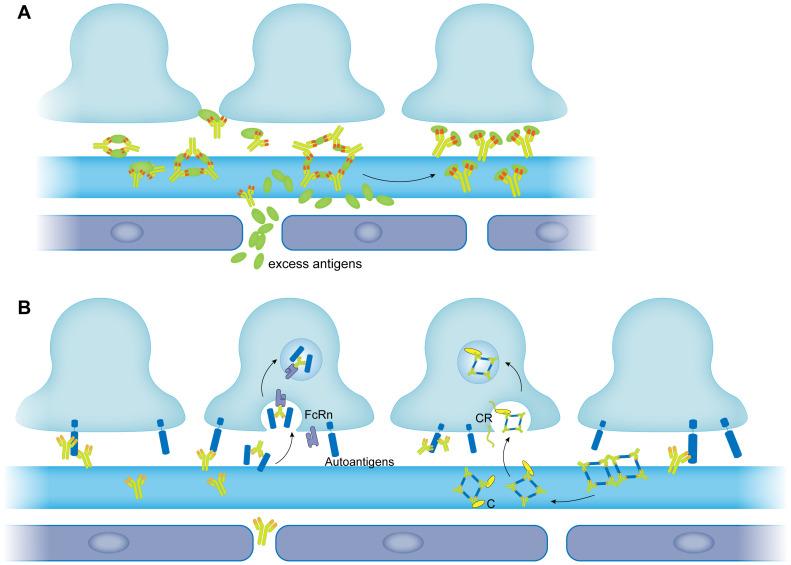
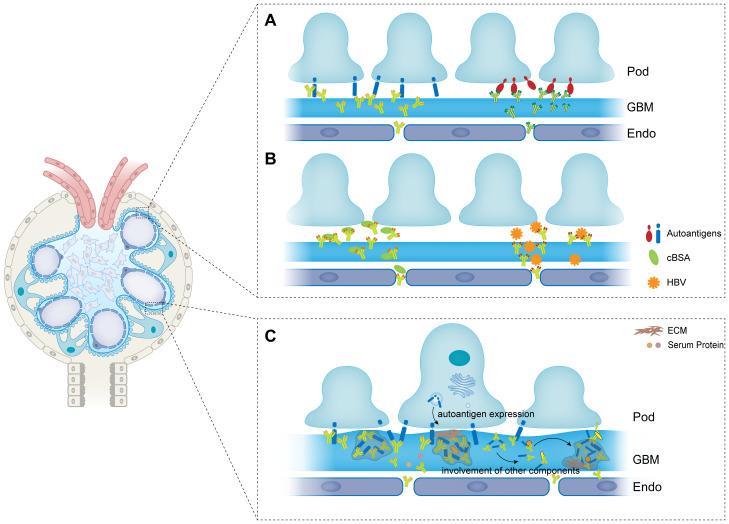
The most characteristic feature of membranous nephropathy (MN) is the presence of subepithelial electron dense deposits and the consequential thickening of the glomerular basement membrane. There have been great advances in the understanding of the destiny of immune complexes in MN by the benefit of experimental models represented by Heymann nephritis. Subepithelial immune complexes are formed by autoantibodies targeting native autoantigens or exogenous planted antigens such as the phospholipase A2 receptor (PLA2R) and cationic BSA respectively. The nascent immune complexes would not be pathogenic until they develop into immune deposits. Podocytes are the major source of autoantigens in idiopathic membranous nephropathy. They also participate in the modulation and removal of the immune complexes to a large extent. The balance between deposition and clearance is regulated by a wide range of factors such as the composition and physicochemical properties of the immune complexes and the complement system. Complement components such as C3 and C1q have been reported to be precipitated with the deposits whereas a complement regulatory protein CR1 expressed by podocytes is involved in the phagocytosis of immune complexes by podocytes. Podocytes regulate the dynamic change of immune complexes which is disturbed in membranous nephropathy. To elucidate the precise fate of the immune complexes is essential for developing more rational and novel therapies for membranous nephropathy.
膜性肾病(MN)最典型的特征是上皮下电子致密沉积物的存在,以及由此导致的肾小球基底膜增厚。通过实验模型(如 Heymann 肾炎)的受益,人们对 MN 中免疫复合物的命运有了很大的了解。上皮下免疫复合物是由针对天然自身抗原或外源性种植抗原(如磷脂酶 A2 受体(PLA2R)和阳离子 BSA)的自身抗体形成的。新形成的免疫复合物在发展成免疫沉积物之前不会具有致病性。足细胞是特发性膜性肾病中自身抗原的主要来源。它们在很大程度上还参与了免疫复合物的调节和清除。沉积和清除之间的平衡受到多种因素的调节,如免疫复合物的组成和理化性质以及补体系统。已经报道补体成分(如 C3 和 C1q)与沉积物一起沉淀,而由足细胞表达的补体调节蛋白 CR1 则参与了足细胞对免疫复合物的吞噬作用。足细胞调节免疫复合物的动态变化,在膜性肾病中这种变化被打乱。阐明免疫复合物的确切命运对于开发更合理和新颖的膜性肾病治疗方法至关重要。
 Zotero 插件