
鄂毕河(西西伯利亚)海滩沙粒中的微塑料和持久性有机污染物污染
Pollution of Beach Sands of the Ob River (Western Siberia) with Microplastics and Persistent Organic Pollutants.
作者信息
Frank Yulia A, Sotnikova Yulia S, Tsygankov Vasiliy Yu, Rednikin Aleksey R, Donets Maksim M, Karpova Elena V, Belanov Maksim A, Rakhmatullina Svetlana, Borovkova Aleksandra D, Polovyanenko Dmitriy N, Vorobiev Danil S
机构信息
Biological Institute, Tomsk State University, 36 Lenin Ave., 634050 Tomsk, Russia.
N.N. Vorozhtsov Institute, Organic Chemistry, Siberian Branch, Russian Academy of Sciences (SB RAS), 9 Acad. Lavrentiev Ave., 630090 Novosibirsk, Russia.
出版信息
J Xenobiot. 2024 Jul 25;14(3):989-1002. doi: 10.3390/jox14030055.
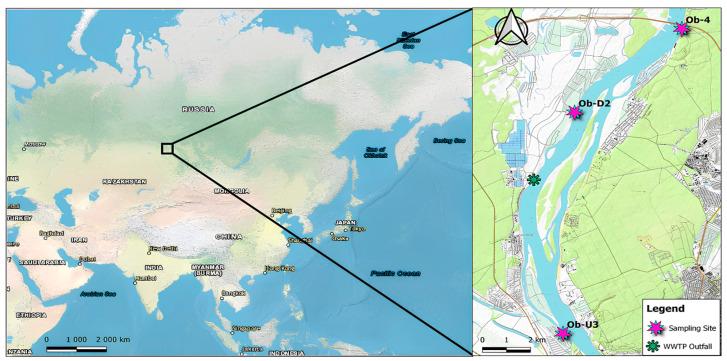
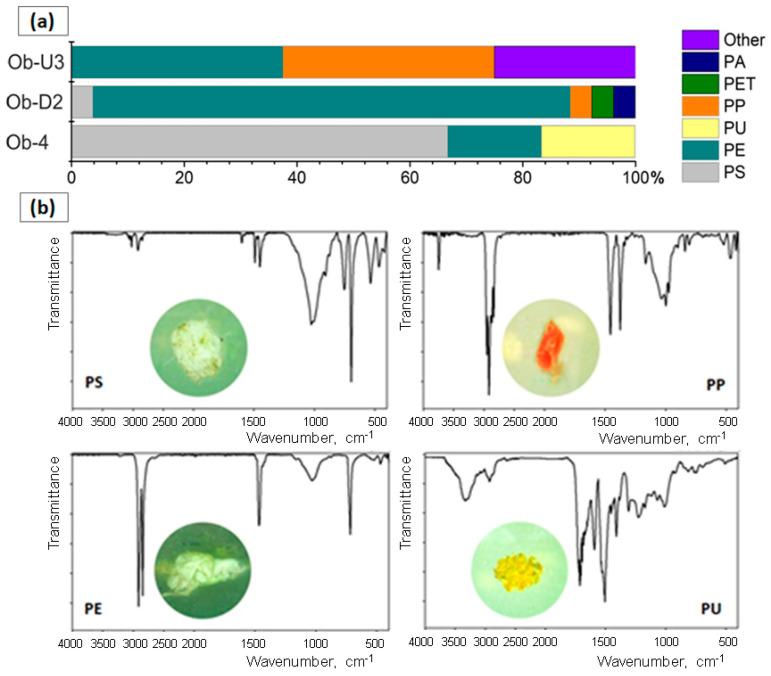
Microplastics (MPs) in aquatic environments can be associated with various substances, including persistent organic pollutants, which add to the problem of plastic ecotoxicity. The abundance of 1-5 mm microplastics and concentrations of particle-adsorbed organochlorine pesticides (OCPs) and polychlorinated biphenyls (PCBs) in sandy sediments from three beaches in recreational areas along the upper Ob River in Western Siberia were assessed. MP pollution levels in the Ob River beach sands ranged from 24 ± 20.7 to 104 ± 46.2 items m or, in terms of mass concentration, from 0.26 ± 0.21 to 1.22 ± 0.39 mg m. The average abundance of MP particles reached 0.67 ± 0.58 items kg or 8.22 ± 6.13 μg kg in the studied sediments. MP concentrations were significantly higher in number ( < 0.05) and mass ( < 0.01) at the riverbank site downstream of the Novosibirsk wastewater treatment plant (WWTP) outfall compared to these at the upstream and more distant beaches. Most MPs (70-100%) were represented by irregularly shaped fragments. The polymer composition of MPs varied between sites, with a general predominance of polyethylene (PE). The study revealed associations of MPs with PCBs and OCPs not previously detected in the riverbed and beach sediments, suggesting that these substances are circulating in the Ob River basin. Although MP concentrations were higher downstream of the WWTP, the maximum levels of particle-associated OCPs were observed in the beach sands of the site farthest from the urban agglomeration. The pesticides γ-HCH, 4,4-DDT, and 4,4-DDE were detected on MPs at relatively low concentrations. PCBs were more abundant in the studied samples, including 118 dioxin-like congener. The results obtained indicate that the Ob River is susceptible to plastic and persistent organic pollutant (POP) contamination and serve as a starting point for further studies and practical solutions to the problem.
水生环境中的微塑料(MPs)可能与各种物质相关联,包括持久性有机污染物,这加剧了塑料生态毒性问题。对西西伯利亚鄂毕河上游休闲区三个海滩的沙质沉积物中1-5毫米微塑料的丰度以及颗粒吸附的有机氯农药(OCPs)和多氯联苯(PCBs)的浓度进行了评估。鄂毕河河滩沙地中的微塑料污染水平为每平方米24±20.7至104±46.2个,按质量浓度计为每平方米0.26±0.21至1.22±0.39毫克。在所研究的沉积物中,微塑料颗粒的平均丰度达到每千克0.67±0.58个或每千克8.22±6.13微克。与新西伯利亚污水处理厂(WWTP)排放口下游河岸站点相比,上游和更远海滩处的微塑料数量(<0.05)和质量(<0.01)浓度显著更高。大多数微塑料(70-100%)为不规则形状的碎片。不同站点微塑料的聚合物组成有所不同,总体上以聚乙烯(PE)为主。该研究揭示了微塑料与多氯联苯和有机氯农药之间的关联,这些关联在河床和海滩沉积物中此前未被检测到,表明这些物质在鄂毕河流域循环。尽管污水处理厂下游的微塑料浓度较高,但在距离城市群最远的站点的海滩沙地中观察到颗粒相关有机氯农药的最高水平。在微塑料上检测到农药γ-六氯环己烷、4,4-滴滴涕和4,4-滴滴伊的浓度相对较低。多氯联苯在所研究的样本中更为丰富,包括118种二噁英类同系物。所得结果表明鄂毕河易受塑料和持久性有机污染物(POP)污染,是进一步研究和解决该问题实际方案的起点。

 Zotero 插件