
“伤害感受性疼痛”分级系统在慢性原发性和慢性继发性疼痛病症中的应用:一项现场研究。
Application of the grading system for "nociplastic pain" in chronic primary and chronic secondary pain conditions: a field study.
作者信息
Schmidt Hannah, Drusko Armin, Renz Malika Pia, Schlömp Lea, Tost Heike, Schuh-Hofer Sigrid, Tesarz Jonas, Meyer-Lindenberg Andreas, Treede Rolf-Detlef
机构信息
Department of Psychiatry and Psychotherapy, Central Institute of Mental Health, Medical Faculty Mannheim, Heidelberg University, Mannheim, Germany.
Department of Neurophysiology, Medical Faculty Mannheim, Heidelberg University, Mannheim, Germany.
出版信息
Pain. 2025 Jan 1;166(1):196-211. doi: 10.1097/j.pain.0000000000003355. Epub 2024 Aug 26.
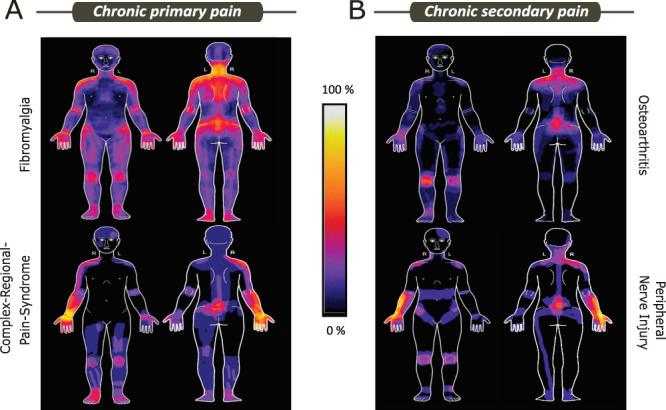
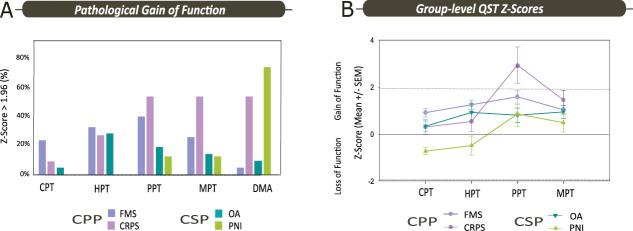
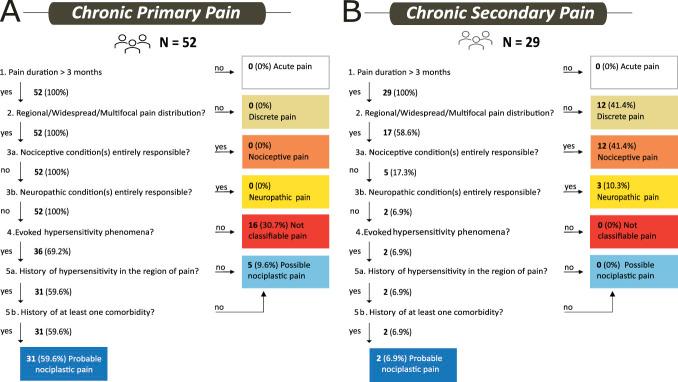
The concept "nociplastic pain" has been developed for patients with features of nociceptive system sensitization that are not explained as nociceptive or neuropathic. Here, we tested how well the recently published grading system differentiates between chronic primary and secondary pain conditions. We recruited patients with fibromyalgia (FMS, n = 41), complex regional pain syndrome (CRPS, n = 11), osteoarthritis (OA, n = 21), or peripheral nerve injury (PNI, n = 8). We used clinical history, pain drawings, quantitative sensory testing (QST), and questionnaires to classify their pains as possibly or probably "nociplastic." All patients with chronic primary pain exhibited widespread/regional pain not explainable by either nociceptive or neuropathic mechanisms. Widespread pain occurred in 12 patients with OA but was identified as nociceptive in 11 of 12. Regional pain occurred in 4 patients with PNI but was identified as neuropathic in 3 of 4. At this step, the grading system had 100% sensitivity and 93% specificity. Clinical evidence for pain hypersensitivity by QST, and history of hypersensitivity and mental comorbidities did not differentiate between chronic primary pain (QST: 36/52 = 69%, history: 43/52 = 83%) and secondary pain conditions (QST: 20/29 = 69%, history: 24/29 83%). Based on these data, specificity remained excellent (93%), but sensitivity dropped substantially (60%) due to lacking evidence for pain hypersensitivity in many patients with FMS. This low sensitivity suggests that the published grading system is not suitable for screening purposes. We suggest structural and content modifications to improve sensitivity, including placement of patient history before clinical examination and addition of a high tender point count as evidence for widespread pain hypersensitivity.
“伤害性可塑性疼痛”这一概念是为具有伤害性感受系统敏化特征但无法解释为伤害性或神经性疼痛的患者而提出的。在此,我们测试了最近发布的分级系统对慢性原发性和继发性疼痛状况的区分能力。我们招募了纤维肌痛(FMS,n = 41)、复杂性区域疼痛综合征(CRPS,n = 11)、骨关节炎(OA,n = 21)或周围神经损伤(PNI,n = 8)患者。我们使用临床病史、疼痛绘图、定量感觉测试(QST)和问卷将他们的疼痛分类为可能或很可能是“伤害性可塑性疼痛”。所有慢性原发性疼痛患者均表现出广泛/局部疼痛,无法用伤害性或神经性机制解释。12例OA患者出现广泛疼痛,但其中11例被确定为伤害性疼痛。4例PNI患者出现局部疼痛,但其中3例被确定为神经性疼痛。在这一步骤中,分级系统的敏感性为100%,特异性为93%。QST显示的疼痛超敏临床证据以及超敏病史和精神共病在慢性原发性疼痛(QST:36/52 = 69%,病史:43/52 = 83%)和继发性疼痛状况(QST:20/29 = 69%,病史:24/29 = 83%)之间并无差异。基于这些数据,特异性仍然很高(93%),但由于许多FMS患者缺乏疼痛超敏证据,敏感性大幅下降(60%)。这种低敏感性表明,已发布的分级系统不适用于筛查目的。我们建议进行结构和内容修改以提高敏感性,包括在临床检查前询问患者病史,并增加高压痛点数作为广泛疼痛超敏的证据。


 Zotero 插件