
通过整合血浆、CSF 和大脑的 pQTLs 与 GWAS 汇总数据,鉴定双相情感障碍的新型蛋白。
Identifying novel proteins underlying bipolar disorder via integrating pQTLs of the plasma, CSF, and brain with GWAS summary data.
机构信息
Fujian Medical University Union Hospital, Fuzhou, China.
Department of Neurosurgery, Fujian Medical University Union Hospital, Fuzhou, China.
出版信息
Transl Psychiatry. 2024 Aug 27;14(1):344. doi: 10.1038/s41398-024-03056-x.
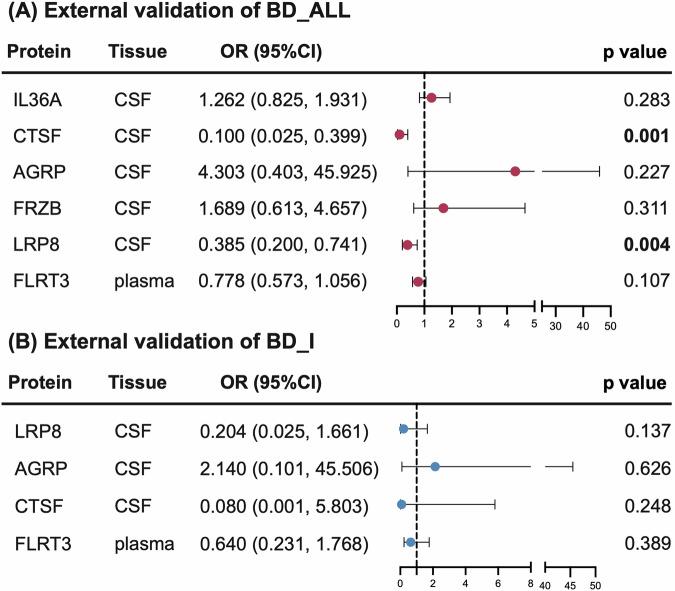
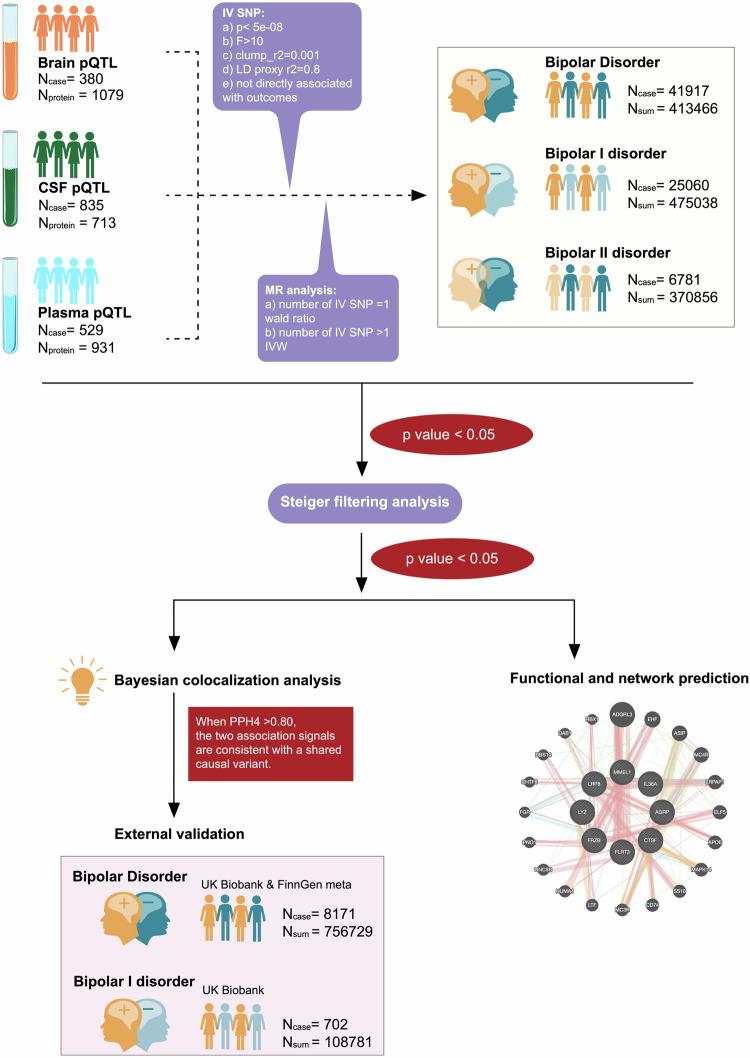
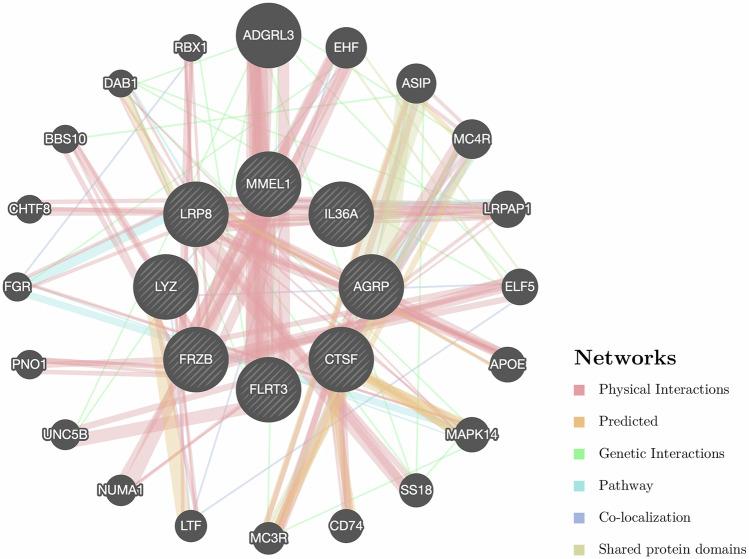
Bipolar disorder (BD) presents a significant challenge due to its chronic and relapsing nature, with its underlying pathogenesis remaining elusive. This study employs Mendelian randomization (MR), a widely recognized genetic approach, to unveil intricate causal associations between proteins and BD, leveraging protein quantitative trait loci (pQTL) as key exposures. We integrate pQTL data from brain, cerebrospinal fluid (CSF), and plasma with genome-wide association study (GWAS) findings of BD within a comprehensive systems analysis framework. Our analyses, including two-sample MR, Steiger filtering, and Bayesian colocalization, reveal noteworthy associations. Elevated levels of AGRP, FRZB, and IL36A in CSF exhibit significant associations with increased BD_ALL risk, while heightened levels of CTSF and LRP8 in CSF, and FLRT3 in plasma, correlate with decreased BD_ALL risk. Specifically for Bipolar I disorder (BD_I), increased CSF AGRP levels are significantly linked to heightened BD_I risk, whereas elevated CSF levels of CTSF and LRP8, and plasma FLRT3, are associated with reduced BD_I risk. Notably, genes linked to BD-related proteins demonstrate substantial enrichment in functional pathways such as "antigen processing and presentation," "metabolic regulation," and "regulation of myeloid cell differentiation." In conclusion, our findings provide beneficial evidence to support the potential causal relationship between IL36A, AGRP, FRZB, LRP8 in cerebrospinal fluid, and FLRT3 in plasma, and BD and BD_I, providing insights for future mechanistic studies and therapeutic development.
双相情感障碍 (BD) 具有慢性和复发性的特点,其发病机制尚不清楚,因此带来了重大挑战。本研究采用孟德尔随机化 (MR) 这一广泛认可的遗传方法,揭示了蛋白质与 BD 之间复杂的因果关系,利用蛋白质数量性状基因座 (pQTL) 作为关键暴露因素。我们将脑、脑脊液 (CSF) 和血浆中的 pQTL 数据与 BD 的全基因组关联研究 (GWAS) 结果整合到一个全面的系统分析框架中。我们的分析包括两样本 MR、Steiger 过滤和贝叶斯共定位,揭示了显著的关联。CSF 中 AGRP、FRZB 和 IL36A 的水平升高与 BD_ALL 风险增加显著相关,而 CSF 中 CTSF 和 LRP8 以及血浆中 FLRT3 的水平升高与 BD_ALL 风险降低相关。具体来说,对于双相 I 型障碍 (BD_I),CSF 中 AGRP 水平升高与 BD_I 风险增加显著相关,而 CSF 中 CTSF 和 LRP8 以及血浆中 FLRT3 水平升高与 BD_I 风险降低相关。值得注意的是,与 BD 相关蛋白相关的基因在“抗原加工和呈递”、“代谢调节”和“髓样细胞分化调节”等功能途径中表现出显著的富集。总之,我们的研究结果提供了有益的证据,支持了 CSF 中 IL36A、AGRP、FRZB、LRP8 和血浆中 FLRT3 与 BD 和 BD_I 之间潜在的因果关系,为未来的机制研究和治疗开发提供了新的思路。


 Zotero 插件