
通过孟德尔随机化分析鉴定多发性硬化症的潜在药物靶点。
Potential drug targets for multiple sclerosis identified through Mendelian randomization analysis.
机构信息
Peking Union Medical College Hospital, Chinese Academy of Medical Sciences and Peking Union Medical College, Beijing, 100730, PR China.
Center of Multiple Sclerosis and Related Disorders, Peking Union Medical College Hospital, Beijing, 100730, PR China.
出版信息
Brain. 2023 Aug 1;146(8):3364-3372. doi: 10.1093/brain/awad070.
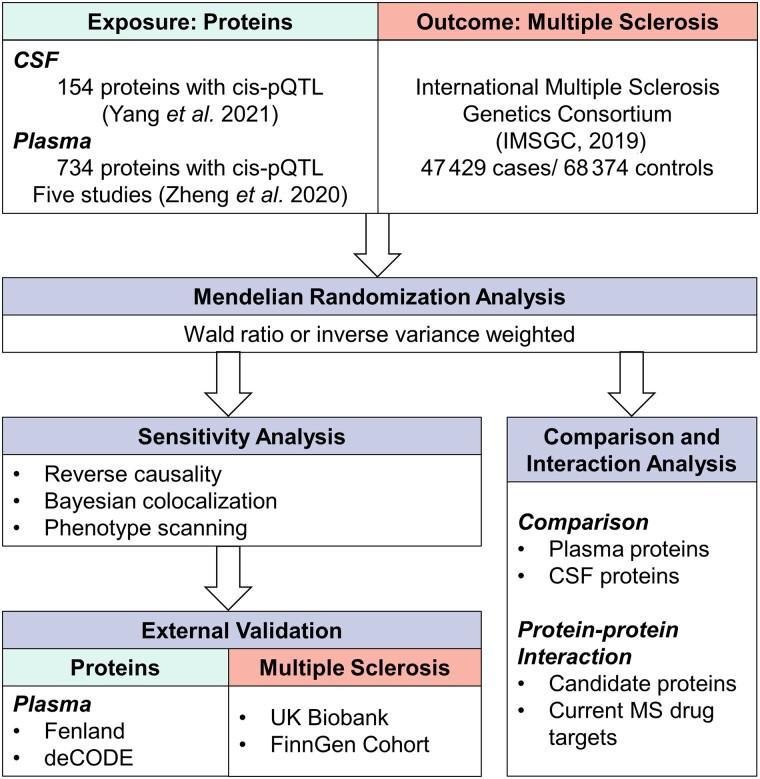
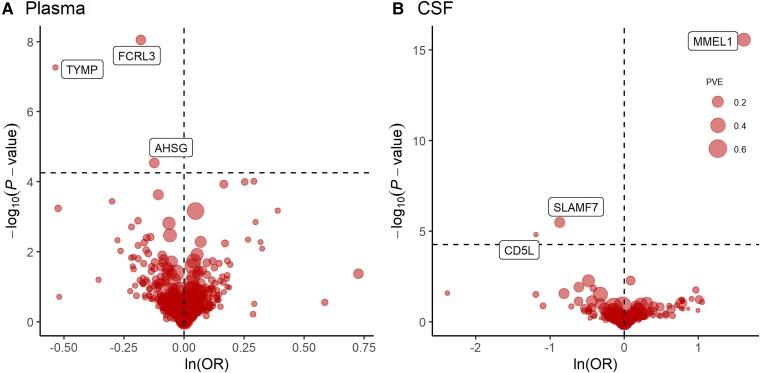
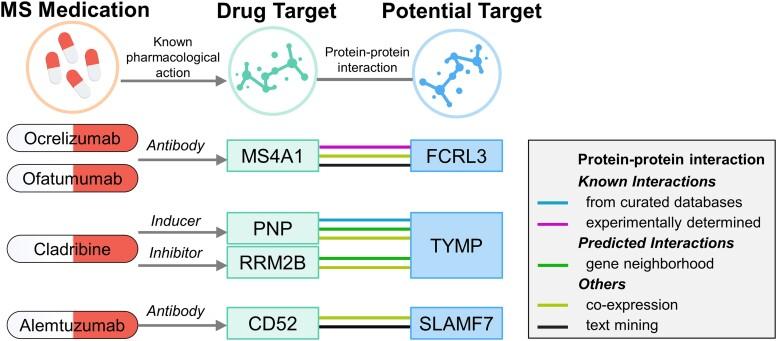
Multiple sclerosis is a complex autoimmune disease, and several therapies for multiple sclerosis have been developed and widely used. However, existing medications for multiple sclerosis were far from satisfactory due to their failure to suppress relapses and alleviate disease progression. Novel drug targets for multiple sclerosis prevention are still needed. We performed Mendelian randomization to explore potential drug targets for multiple sclerosis using summary statistics from the International Multiple Sclerosis Genetics Consortium (nCase = 47 429, nControl = 68 374) and further replicated in UK Biobank (nCase = 1356, nControl = 395 209) and FinnGen cohorts (nCase = 1326, nControl = 359 815). Genetic instruments for 734 plasma and 154 CSF proteins were obtained from recently published genome-wide association studies. The reverse causality detection using bidirectional Mendelian randomization analysis and Steiger filtering, Bayesian co-localization, and phenotype scanning that searched previously reported genetic variant-trait associations were implemented to consolidate the Mendelian randomization findings further. In addition, the protein-protein interaction network was performed to reveal potential associations among proteins and/or present multiple sclerosis medications. At Bonferroni significance (P < 5.63 × 10⁻⁵), Mendelian randomization analysis revealed six protein-multiple sclerosis pairs. In plasma, per standard deviation increase in FCRL3, TYMP and AHSG had a protective effect. Odds ratios for the proteins above were 0.83 (95% CI, 0.79-0.89), 0.59 (95% CI, 0.48-0.71) and 0.88 (95% CI, 0.83-0.94), respectively. In CSF, per 10-fold increase in MMEL1 (OR, 5.03; 95% CI, 3.42-7.41) increased the risk of multiple sclerosis, while SLAMF7 (OR, 0.42; 95% CI, 0.29-0.60) and CD5L (OR, 0.30; 95%CI, 0.18-0.52) decreased the risk. None of the six proteins had reverse causality. Bayesian co-localization suggested that FCRL3 [coloc.abf-posterior probability of hypothesis 4 (PPH4) = 0.889], TYMP (coloc.susie-PPH4 = 0.896), AHSG (coloc.abf-PPH4 = 0.957, coloc.susie-PPH4 = 0.973), MMEL1 (coloc.abf-PPH4 = 0.930) and SLAMF7 (coloc.abf-PPH4 = 0.947) shared the same variant with multiple sclerosis. FCRL3, TYMP and SLAMF7 interacted with target proteins of current multiple sclerosis medications. MMEL1 was replicated in both UK Biobank and FinnGen cohorts. Our integrative analysis suggested that genetically determined levels of circulating FCRL3, TYMP, AHSG, CSF MMEL1 and SLAMF7 had causal effects on multiple sclerosis risk. These findings suggested those five proteins might be promising drug targets for multiple sclerosis and warrant further clinical investigation, especially FCRL3 and SLAMF7.
多发性硬化症是一种复杂的自身免疫性疾病,已经开发并广泛应用了几种多发性硬化症的治疗方法。然而,由于现有药物无法抑制复发和缓解疾病进展,因此远不能令人满意。仍然需要新的多发性硬化症预防药物靶点。我们使用国际多发性硬化症遗传学联合会(nCase=47429,nControl=68374)的汇总统计数据进行孟德尔随机化研究,以探索多发性硬化症的潜在药物靶点,并在英国生物库(nCase=1356,nControl=395209)和芬兰基因(nCase=1326,nControl=359815)中进行了进一步验证。用于 734 种血浆和 154 种 CSF 蛋白的遗传工具是从最近发表的全基因组关联研究中获得的。使用双向孟德尔随机化分析和 Steiger 过滤、贝叶斯共定位和表型扫描来检测反向因果关系,以进一步整合孟德尔随机化结果。此外,还进行了蛋白质-蛋白质相互作用网络分析,以揭示蛋白质之间的潜在关联和/或目前多发性硬化症药物的相互作用。在 Bonferroni 显著性(P<5.63×10⁻⁵)水平下,孟德尔随机化分析显示了 6 个蛋白-多发性硬化症对。在血浆中,FCRL3、TYMP 和 AHSG 的标准偏差每增加一个,对多发性硬化症具有保护作用。上述蛋白质的比值比分别为 0.83(95%置信区间,0.79-0.89)、0.59(95%置信区间,0.48-0.71)和 0.88(95%置信区间,0.83-0.94)。在脑脊液中,MMEL1 每增加 10 倍(OR,5.03;95%CI,3.42-7.41)会增加多发性硬化症的风险,而 SLAMF7(OR,0.42;95%CI,0.29-0.60)和 CD5L(OR,0.30;95%CI,0.18-0.52)则降低了风险。这六个蛋白质都没有反向因果关系。贝叶斯共定位表明 FCRL3[coloc.abf-假设 4 的后验概率(PPH4)=0.889]、TYMP(coloc.susie-PPH4=0.896)、AHSG(coloc.abf-PPH4=0.957,coloc.susie-PPH4=0.973)、MMEL1(coloc.abf-PPH4=0.930)和 SLAMF7(coloc.abf-PPH4=0.947)与多发性硬化症共享相同的变异。FCRL3、TYMP 和 SLAMF7 与当前多发性硬化症药物的靶蛋白相互作用。MMEL1 在英国生物库和芬兰基因中均得到了复制。我们的综合分析表明,循环 FCRL3、TYMP、AHSG、CSF MMEL1 和 SLAMF7 的遗传决定水平对多发性硬化症风险有因果影响。这些发现表明,这五个蛋白可能是多发性硬化症有前途的药物靶点,值得进一步临床研究,特别是 FCRL3 和 SLAMF7。

 Zotero 插件