
探究肠道微生物群与胃肠胰神经内分泌肿瘤之间的因果关系:一项双向孟德尔随机化研究。
Investigating the causal relationship between gut microbiota and gastroenteropancreatic neuroendocrine neoplasms: a bidirectional Mendelian randomization study.
作者信息
Zhang Chun-Yu, Jiang Shi-Jing, Cao Jing-Jing, Xu Yan, Wang Xiao-Yu, Li Rui, Miao Zhi-Wei
机构信息
Zhangjiagang Hospital of Traditional Chinese Medicine, Nanjing University of Chinese Medicine, Nanjing, China.
Nanjing University of Chinese Medicine, Nanjing, China.
出版信息
Front Microbiol. 2024 Aug 13;15:1420167. doi: 10.3389/fmicb.2024.1420167. eCollection 2024.
BACKGROUND
The interaction between the intestinal flora and gastroenteropancreatic neuroendocrine neoplasms (GEP-NENs) remains poorly understood, despite the known effect of the gut microbiota on gastrointestinal adenocarcinomas. Hence, the present research aimed to determine the potential causal correlation between the intestinal flora and GEP-NENs by conducting a bidirectional Mendelian randomization (MR) analysis.
METHODS
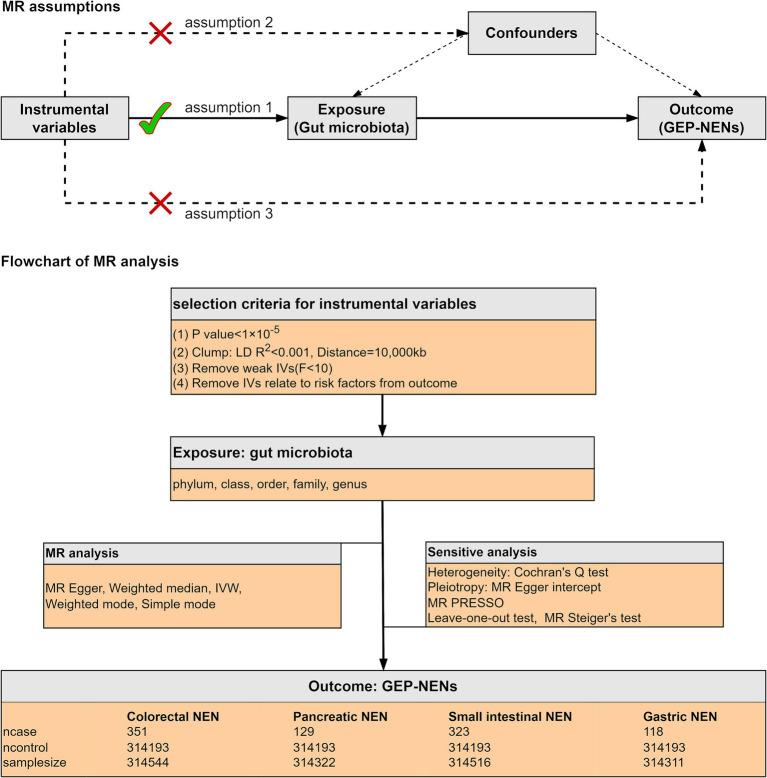
Two-sample MR analysis was conducted using the summary statistics of the gut microbiota from the MiBioGen consortium and those of GEP-NENs from the FinnGen research project. The inverse-variance weighted approach was utilized as the primary analytical method. To enhance the robustness of our findings, multiple sensitivity tests were performed, including Cochran's Q test for evaluating heterogeneity, the MR-Egger intercept test to detect horizontal pleiotropy, and the MR-PRESSO test to identify outliers and assess pleiotropy bias. Additionally, a leave-one-out analysis was performed to validate the consistency of our findings. The MR-Steiger test was also utilized to determine the causal direction in the correlation between the gut microbiota and GEP-NENs. Finally, a reverse MR analysis was performed to assess reverse causality between the intestinal flora and GEP-NENs.
RESULTS
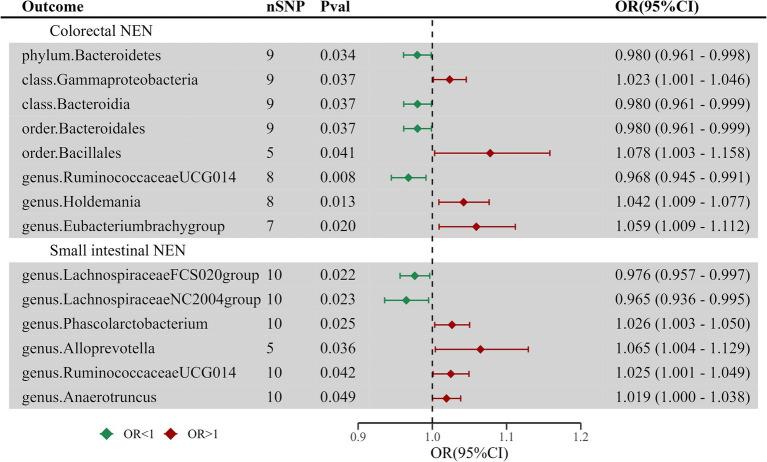
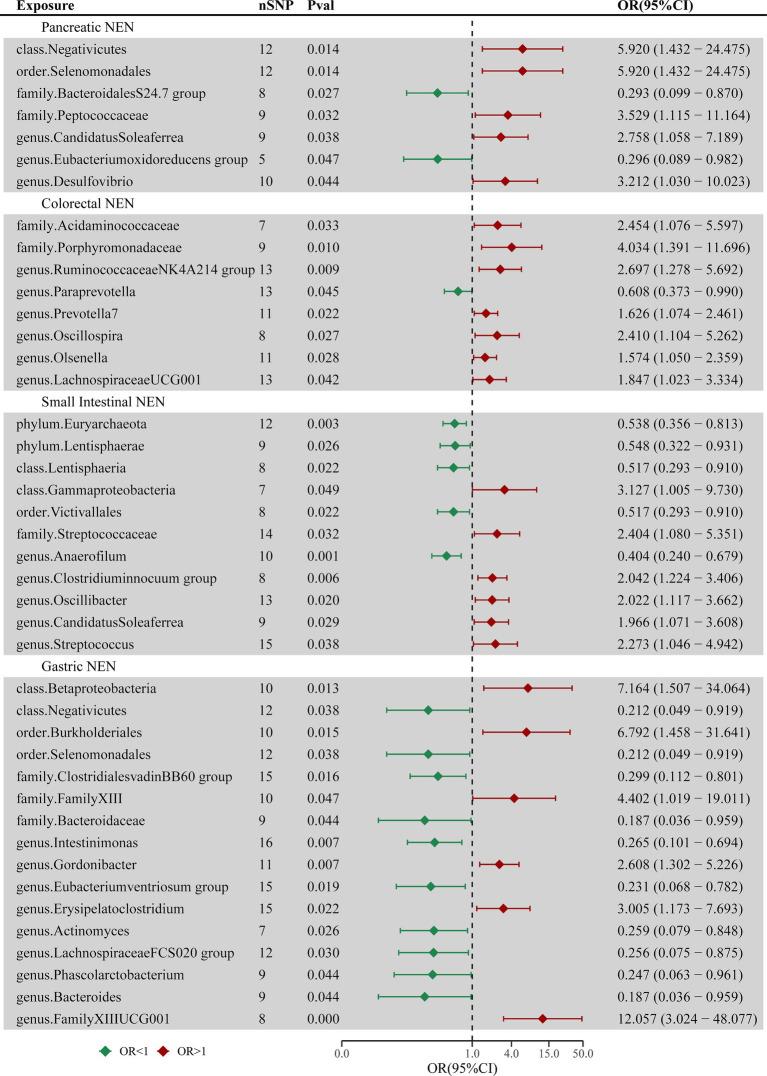
We identified 42 taxa of the gut microbiota that were potentially causally associated with GEP-NENs; of these taxa, 7, 8, 11, and 16 taxa were causally associated with pancreatic NENs, colorectal NENs, small intestinal NENs, and gastric NENs, respectively. After adjusting for false discovery rate (FDR) correction, we found significant causal links of Euryarchaeota with small intestinal NENs and Family XIII UCG-001 with gastric NENs. The sensitivity analyses confirmed the stability of these correlations. In the reverse MR analysis, colorectal NENs and small intestinal NENs were found to be associated with variations in 8 and 6 different taxa of the gut microbiota, respectively. After adjusting for FDR correction, no significant causal links were detected between GEP-NENs and the intestinal flora.
CONCLUSION
The present study reveals a potential causal association between certain taxa of the intestinal flora and GEP-NENs, thus providing new perspectives regarding the role of the intestinal flora in the development of these tumors. These insights could provide innovative approaches to screen and prevent these diseases.
背景
尽管已知肠道微生物群对胃肠道腺癌有影响,但肠道菌群与胃肠胰神经内分泌肿瘤(GEP-NENs)之间的相互作用仍知之甚少。因此,本研究旨在通过进行双向孟德尔随机化(MR)分析来确定肠道菌群与GEP-NENs之间潜在的因果关系。
方法
使用来自MiBioGen联盟的肠道微生物群汇总统计数据和来自FinnGen研究项目的GEP-NENs汇总统计数据进行两样本MR分析。采用逆方差加权法作为主要分析方法。为了增强研究结果的稳健性,进行了多项敏感性测试,包括用于评估异质性的Cochran's Q检验、用于检测水平多效性的MR-Egger截距检验以及用于识别异常值和评估多效性偏差的MR-PRESSO检验。此外,进行了留一法分析以验证研究结果的一致性。还使用MR-Steiger检验来确定肠道微生物群与GEP-NENs之间相关性的因果方向。最后,进行了反向MR分析以评估肠道菌群与GEP-NENs之间的反向因果关系。
结果
我们确定了42种肠道微生物群分类单元可能与GEP-NENs存在因果关联;在这些分类单元中,分别有7、8、11和16个分类单元与胰腺NENs、结直肠NENs、小肠NENs和胃NENs存在因果关联。在调整错误发现率(FDR)校正后,我们发现广古菌门与小肠NENs以及XIII族UCG-001与胃NENs之间存在显著的因果联系。敏感性分析证实了这些相关性的稳定性。在反向MR分析中,发现结直肠NENs和小肠NENs分别与8种和6种不同的肠道微生物群分类单元的变化有关。在调整FDR校正后,未检测到GEP-NENs与肠道菌群之间存在显著的因果联系。
结论
本研究揭示了某些肠道菌群分类单元与GEP-NENs之间潜在的因果关联,从而为肠道菌群在这些肿瘤发生发展中的作用提供了新的视角。这些见解可为这些疾病的筛查和预防提供创新方法。
 Zotero 插件