
利用真实世界数据模拟物质使用障碍临床试验的可行性:一项横断面研究。
Feasibility of using real-world data to emulate substance use disorder clinical trials: a cross-sectional study.
机构信息
Yale School of Medicine, New Haven, CT, USA.
Division of Health Care Delivery Research, Mayo Clinic, Rochester, MN, USA.
出版信息
BMC Med Res Methodol. 2024 Aug 28;24(1):187. doi: 10.1186/s12874-024-02307-1.
INTRODUCTION
Real-world evidence is receiving considerable attention as a way to evaluate the efficacy and safety of medical products for substance use disorders (SUDs). However, the feasibility of using real-world data (RWD) to emulate clinical trials evaluating treatments for SUDs is uncertain. The aim of this study is to identify the number of clinical trials evaluating treatments for SUDs with reported results that could be feasibly emulated using observational data from contemporary insurance claims and/or electronic health record (EHR) data.
METHODS
In this cross-sectional study, all phase 2-4 trials evaluating treatments for SUDs registered on ClinicalTrials.gov with reported results were identified. Each trial was evaluated to determine if the indications, interventions, at least 80% of eligibility criteria, comparators, and primary end points could be ascertained using contemporarily available administrative claims and/or structured EHR data.
RESULTS
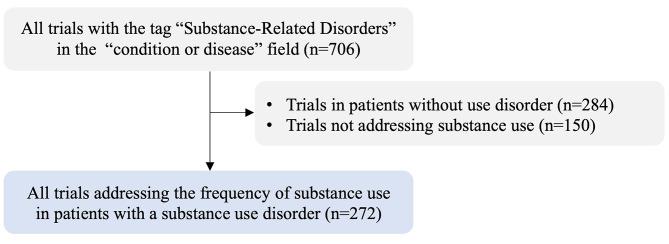
There were 272 SUD trials on ClinicalTrials.gov with reported results. Of these, when examining feasibility using contemporarily available administrative claims and/or structured EHR data, 262 (96.3%) had indications that were ascertainable; 194 (71.3%) had interventions that were ascertainable; 21 (7.7%) had at least 80% of eligibility criteria that were ascertainable; 17 (6.3%) had active comparators that were ascertainable; and 61 (22.4%) had primary end points that were ascertainable. In total, there were no trials for which all 5 characteristics were ascertainable using contemporarily available administrative claims and/or structured EHR data. When considering placebo comparators as ascertainable, there were 6 (2.2%) trials that had all 5 key characteristics classified as ascertainable from contemporarily available administrative claims and/or structured EHR data.
CONCLUSIONS
No trials evaluating treatments for SUDs could be feasibly emulated using contemporarily available RWD, demonstrating a need for an increase in the resolution of data capture within a public health system to facilitate trial emulation.
简介
真实世界证据作为评估物质使用障碍(SUD)药物疗效和安全性的一种方法受到了广泛关注。然而,使用真实世界数据(RWD)来模拟评估 SUD 治疗方法的临床试验的可行性尚不确定。本研究旨在确定可使用当代保险索赔和/或电子健康记录(EHR)数据来模拟报告结果的评估 SUD 治疗方法的临床试验数量。
方法
在这项横断面研究中,确定了在 ClinicalTrials.gov 上注册并报告结果的所有评估 SUD 治疗方法的 2 期至 4 期试验。评估每个试验以确定是否可以使用当代可用的行政索赔和/或结构化 EHR 数据来确定适应证、干预措施、至少 80%的入选标准、对照和主要终点。
结果
ClinicalTrials.gov 上有 272 项报告结果的 SUD 试验。在使用当代可用的行政索赔和/或结构化 EHR 数据检查可行性时,262 项(96.3%)试验具有可确定的适应证;194 项(71.3%)试验具有可确定的干预措施;21 项(7.7%)试验具有至少 80%的可确定的入选标准;17 项(6.3%)试验具有可确定的活性对照;61 项(22.4%)试验具有可确定的主要终点。总体而言,没有一项试验的所有 5 项特征都可使用当代可用的行政索赔和/或结构化 EHR 数据来确定。考虑到将安慰剂对照视为可确定,有 6 项(2.2%)试验具有所有 5 项关键特征,可从当代可用的行政索赔和/或结构化 EHR 数据中分类为可确定。
结论
没有评估 SUD 治疗方法的试验可以使用当代可用的 RWD 来模拟,这表明需要提高公共卫生系统的数据捕获分辨率,以促进试验模拟。
 Zotero 插件