
丘脑在伤害感受中的作用:重要却被遗忘。
The Role of the Thalamus in Nociception: Important but Forgotten.
作者信息
Galdino Giovane, Veras Flavio Protasio, Dos Anjos-Garcia Tayllon
机构信息
Multicenter Postgraduate Program in Physiological Sciences, Department of Physiological Sciences, Institute of Biomedical Sciences, Federal University of Alfenas, Alfenas 37133-840, MG, Brazil.
出版信息
Brain Sci. 2024 Jul 25;14(8):741. doi: 10.3390/brainsci14080741.
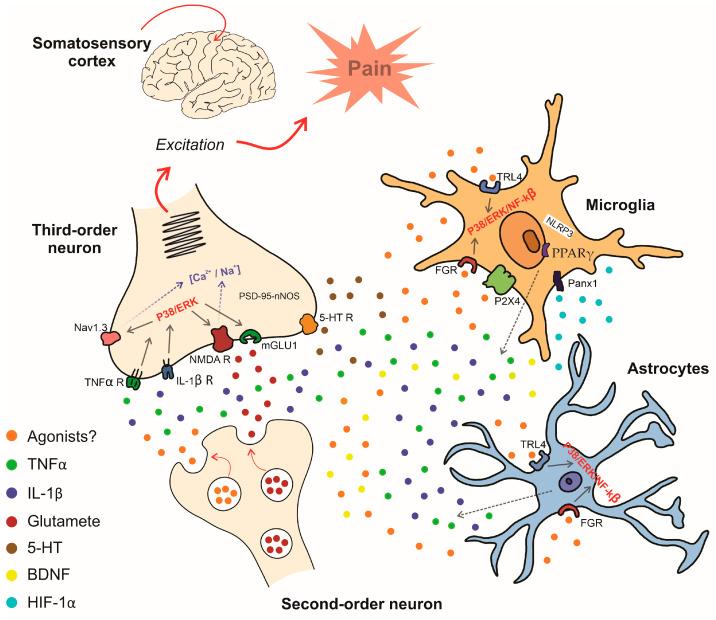
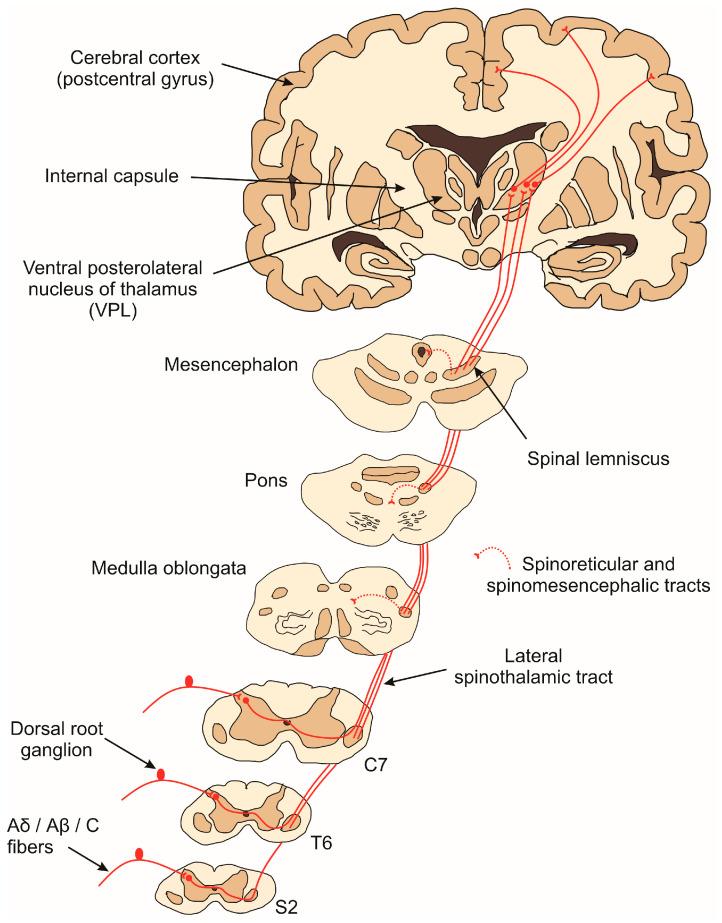
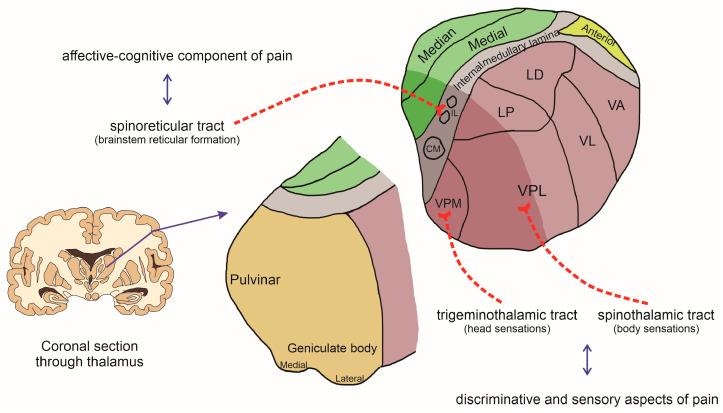
Pain is a complex response to noxious stimuli. Upon detection of the nociceptive stimulus by first-order neurons or nociceptors, an action potential ascends to the spinal dorsal horn, a crucial site for synapsing with second-order neurons. These second-order neurons carry the nociceptive stimulus to supraspinal regions, notably the thalamus. Although extensive research has focused on spinal-level nociceptive mechanisms (e.g., neurotransmitters, receptors, and glial cells), the thalamus is still poorly elucidated. The role of the thalamus in relaying sensory and motor responses to the cortex is well known. However, a comprehensive understanding of the mechanisms in the synapse between the second-order and third-order neurons that transmit this impulse to the somatosensory cortex, where the response is processed and interpreted as pain, is still lacking. Thus, this review investigated the thalamus's role in transmitting nociceptive impulses. Current evidence indicates the involvement of the neurotransmitters glutamate and serotonin, along with NMDA, P2X4, TLR4, FGR, and NLRP3 receptors, as well as signaling pathways including ERK, P38, NF-κB, cytokines, and glial cells at nociceptive synapses within the thalamus.
疼痛是对伤害性刺激的复杂反应。当一级神经元或伤害感受器检测到伤害性刺激时,动作电位会上升至脊髓背角,这是与二级神经元发生突触联系的关键部位。这些二级神经元将伤害性刺激传递到脊髓以上区域,尤其是丘脑。尽管广泛的研究集中在脊髓水平的伤害感受机制(如神经递质、受体和神经胶质细胞),但丘脑仍未得到充分阐明。丘脑在将感觉和运动反应传递到皮层方面的作用是众所周知的。然而,对于将这种冲动传递到躯体感觉皮层(在那里反应被处理并解释为疼痛)的二级和三级神经元之间突触的机制,仍缺乏全面的了解。因此,本综述研究了丘脑在传递伤害性冲动中的作用。目前的证据表明,神经递质谷氨酸和血清素、以及NMDA、P2X4、TLR4、FGR和NLRP3受体,以及包括ERK、P38、NF-κB、细胞因子和神经胶质细胞在内的信号通路,参与了丘脑内伤害性突触的活动。
 Zotero 插件