
全球 8 个地区的一般和腹部肥胖与高血压:837 项基于人群的研究的汇总分析,涉及 750 万人。
General and abdominal adiposity and hypertension in eight world regions: a pooled analysis of 837 population-based studies with 7·5 million participants.
出版信息
Lancet. 2024 Aug 31;404(10455):851-863. doi: 10.1016/S0140-6736(24)01405-3.
BACKGROUND
Adiposity can be measured using BMI (which is based on weight and height) as well as indices of abdominal adiposity. We examined the association between BMI and waist-to-height ratio (WHtR) within and across populations of different world regions and quantified how well these two metrics discriminate between people with and without hypertension.
METHODS
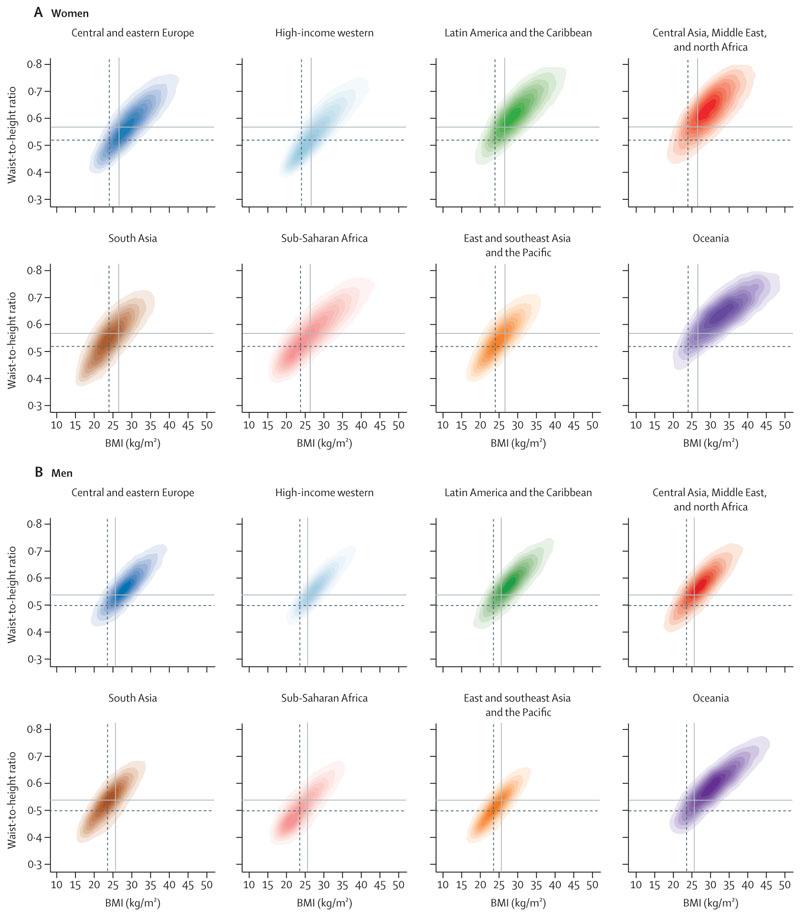
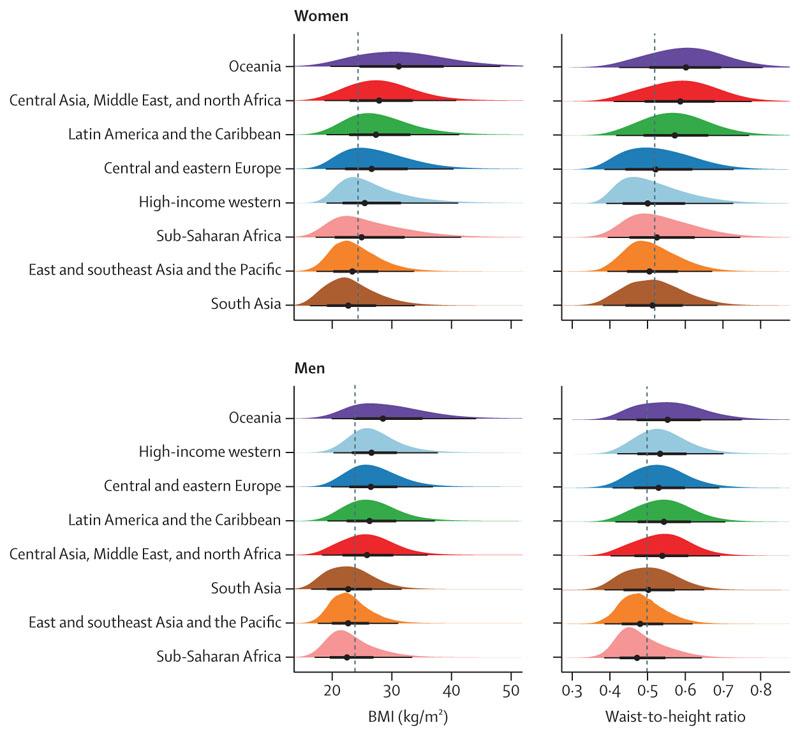
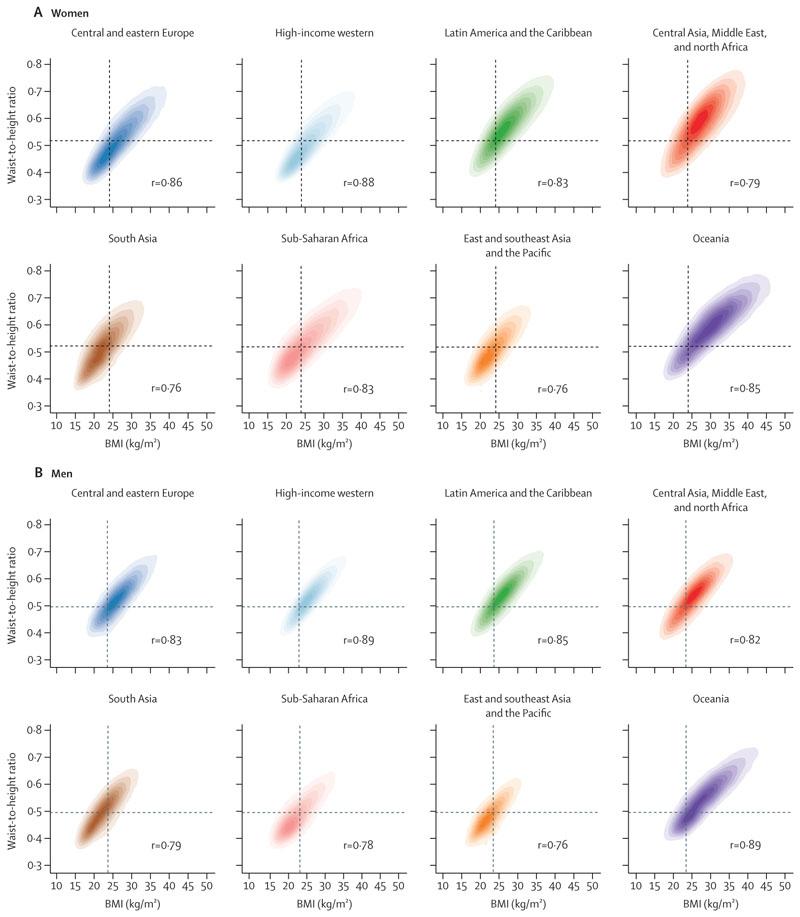
We used data from studies carried out from 1990 to 2023 on BMI, WHtR and hypertension in people aged 20-64 years in representative samples of the general population in eight world regions. We graphically compared the regional distributions of BMI and WHtR, and calculated Pearson's correlation coefficients between BMI and WHtR within each region. We used mixed-effects linear regression to estimate the extent to which WHtR varies across regions at the same BMI. We graphically examined the prevalence of hypertension and the distribution of people who have hypertension both in relation to BMI and WHtR, and we assessed how closely BMI and WHtR discriminate between participants with and without hypertension using C-statistic and net reclassification improvement (NRI).
FINDINGS
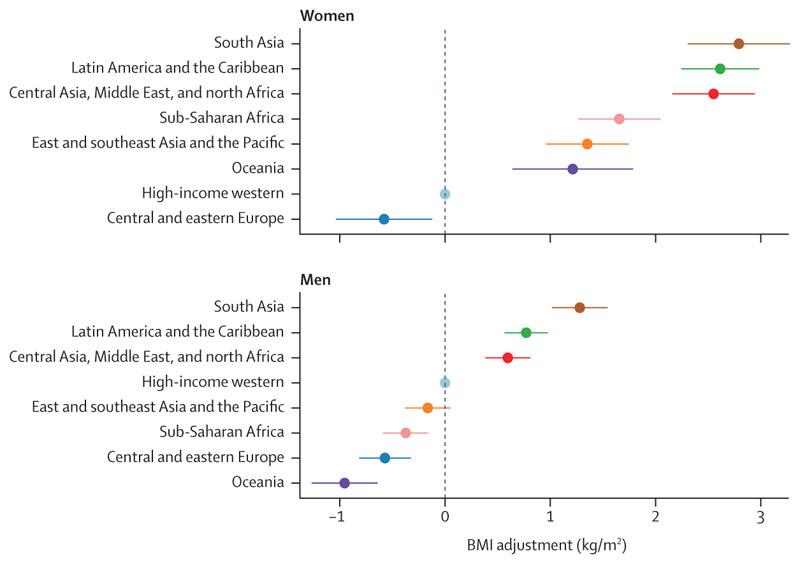
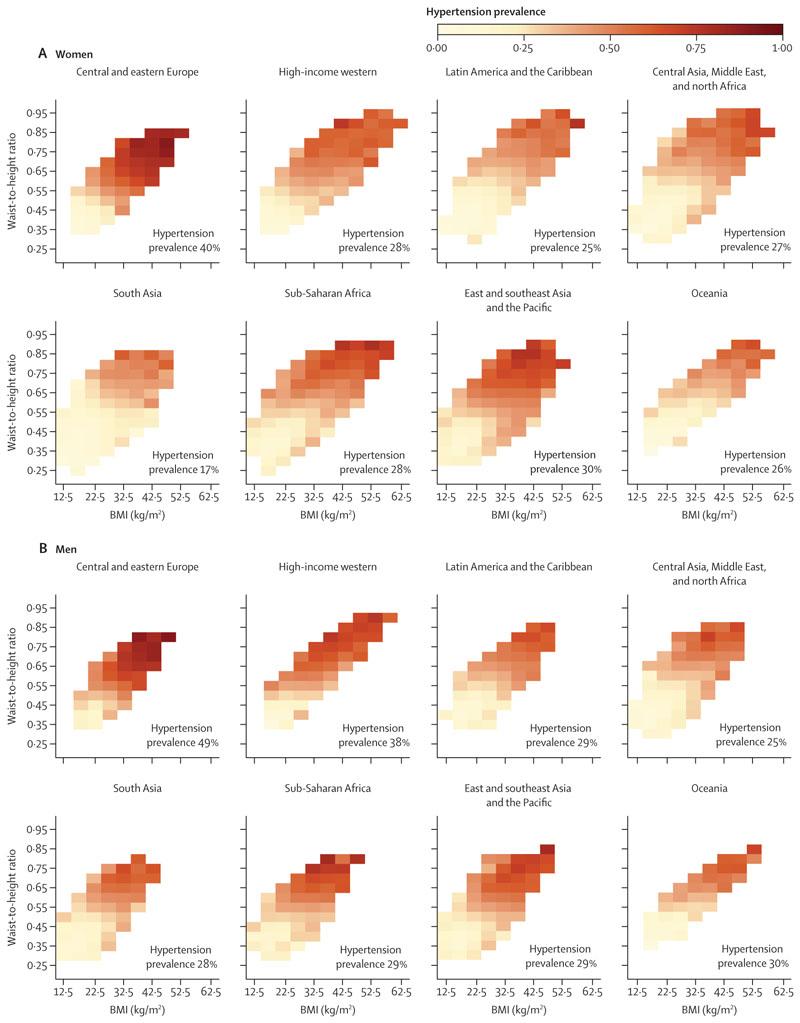
The correlation between BMI and WHtR ranged from 0·76 to 0·89 within different regions. After adjusting for age and BMI, mean WHtR was highest in south Asia for both sexes, followed by Latin America and the Caribbean and the region of central Asia, Middle East and north Africa. Mean WHtR was lowest in central and eastern Europe for both sexes, in the high-income western region for women, and in Oceania for men. Conversely, to achieve an equivalent WHtR, the BMI of the population of south Asia would need to be, on average, 2·79 kg/m (95% CI 2·31-3·28) lower for women and 1·28 kg/m (1·02-1·54) lower for men than in the high-income western region. In every region, hypertension prevalence increased with both BMI and WHtR. Models with either of these two adiposity metrics had virtually identical C-statistics and NRIs for every region and sex, with C-statistics ranging from 0·72 to 0·81 and NRIs ranging from 0·34 to 0·57 in different region and sex combinations. When both BMI and WHtR were used, performance improved only slightly compared with using either adiposity measure alone.
INTERPRETATION
BMI can distinguish young and middle-aged adults with higher versus lower amounts of abdominal adiposity with moderate-to-high accuracy, and both BMI and WHtR distinguish people with or without hypertension. However, at the same BMI level, people in south Asia, Latin America and the Caribbean, and the region of central Asia, Middle East and north Africa, have higher WHtR than in the other regions.
FUNDING
UK Medical Research Council and UK Research and Innovation (Innovate UK).
背景
肥胖可以通过 BMI(基于体重和身高)以及腹部肥胖指数来衡量。我们在不同世界区域的人群中研究了 BMI 和腰高比(WHtR)之间的关联,并量化了这两个指标在区分高血压患者和非高血压患者方面的表现。
方法
我们使用了 1990 年至 2023 年期间在八个世界区域的一般人群代表性样本中进行的关于 BMI、WHtR 和高血压的研究数据。我们对 BMI 和 WHtR 的区域分布进行了图形比较,并计算了每个区域内 BMI 和 WHtR 之间的皮尔逊相关系数。我们使用混合效应线性回归来估计在相同 BMI 下 WHtR 在不同区域之间的差异程度。我们使用图形方式检查了高血压的患病率以及与 BMI 和 WHtR 相关的高血压患者的分布,并使用 C 统计量和净重新分类改善(NRI)评估了 BMI 和 WHtR 在区分高血压患者和非高血压患者方面的准确性。
结果
BMI 和 WHtR 之间的相关性在不同区域内从 0.76 到 0.89 不等。在调整了年龄和 BMI 后,男女的平均 WHtR 在南亚最高,其次是拉丁美洲和加勒比地区以及中亚、中东和北非地区。男女的平均 WHtR 在中欧和东欧最低,在高收入的西方国家女性的平均 WHtR 最低,在大洋洲男性的平均 WHtR 最低。相反,为了达到相同的 WHtR,南亚人口的 BMI 需要比高收入西方国家的 BMI 低 2.79kg/m(95%CI 2.31-3.28),男性低 1.28kg/m(1.02-1.54)。在每个区域中,高血压的患病率都随着 BMI 和 WHtR 的增加而增加。在每个区域和性别中,使用这两个肥胖指标中的任何一个,C 统计量和 NRI 几乎都是相同的,在不同区域和性别的组合中,C 统计量的范围为 0.72 到 0.81,NRI 的范围为 0.34 到 0.57。当同时使用 BMI 和 WHtR 时,与单独使用任何一个肥胖指标相比,性能仅略有提高。
解释
BMI 可以以中等至高度的准确性区分具有较高和较低腹部肥胖量的年轻和中年成年人,BMI 和 WHtR 可以区分有或没有高血压的人。然而,在相同的 BMI 水平下,南亚、拉丁美洲和加勒比地区以及中亚、中东和北非地区的 WHtR 高于其他地区。
资助
英国医学研究理事会和英国研究与创新署(英国创新署)。
 Zotero 插件