
METTL16-SENP3-LTF 轴赋予肝癌细胞对铁死亡的抗性并促进肿瘤发生。
METTL16-SENP3-LTF axis confers ferroptosis resistance and facilitates tumorigenesis in hepatocellular carcinoma.
机构信息
Department of Oncology, Shanghai East Hospital, School of Medicine, Tongji University, 150 Ji-Mo Rd., Pudong New District, Shanghai, 200120, China.
出版信息
J Hematol Oncol. 2024 Sep 2;17(1):78. doi: 10.1186/s13045-024-01599-6.
BACKGROUND
Ferroptosis, characterized by iron-dependent lipid peroxidation, emerges as a promising avenue for hepatocellular carcinoma (HCC) intervention due to its tumor susceptibility. RNA N6-methyladenosine (m6A) modification has been involved in several types of regulated cell death. However, the roles and molecular mechanisms of m6A-related regulators in HCC cell ferroptosis remain unclear.
METHODS
By examining a series of m6A modification enzymes upon ferroptosis induction or inhibition, we identified METTL16 as a novel ferroptotic repressor in HCC cells. The roles of METTL16 on ferroptosis and HCC development were investigated in multiple cell lines, human HCC organoids, subcutaneous xenografts and MYC/Trp53 HCC model in hepatocyte-specific Mettl16 knockout and overexpression mice. The underlying mechanism was elucidated with MeRIP/RIP-qPCR, luciferase assay, Co-IP assay and Mass Spectrometry. The clinical significance and relevance were evaluated in human samples.
RESULTS
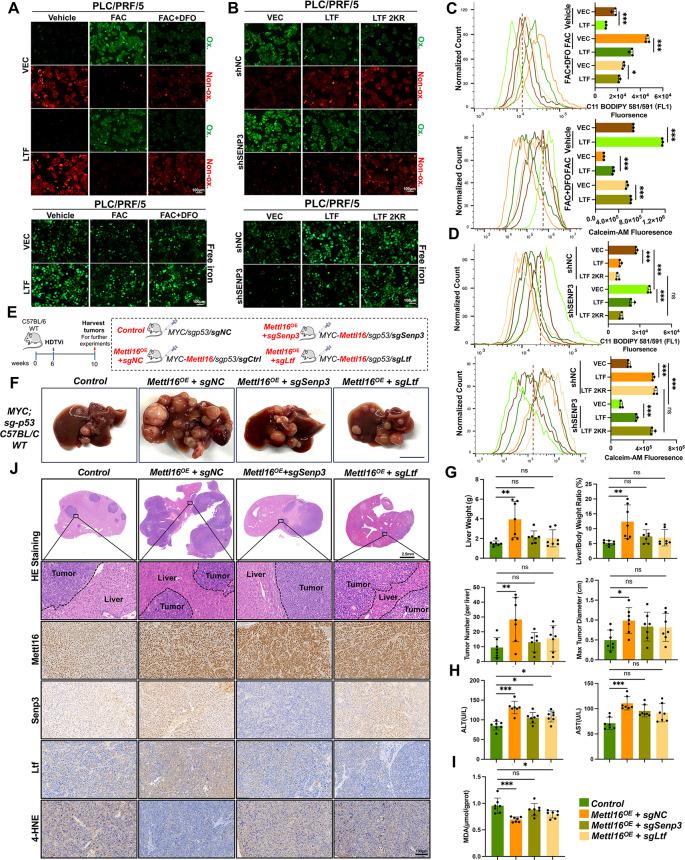
High METTL16 expression confers ferroptosis resistance in HCC cells and mouse models, and promotes cell viability and tumor progression. Mechanistically, METTL16 collaborates with IGF2BP2 to modulate SENP3 mRNA stability in an m6A-dependent manner, and the latter impedes the proteasome-mediated ubiquitination degradation of Lactotransferrin (LTF) via de-SUMOylation. Elevated LTF expression facilitates the chelation of free iron and reduces liable iron pool level. SENP3 and LTF are implicated in METTL16-mediated HCC progression and anti-ferroptotic effects both in vivo and in vitro. Clinically, METTL16 and SENP3 expression were positively correlated, and high METTL16 and SENP3 expression predicts poor prognosis in human HCC samples.
CONCLUSIONS
Our study reveals a new METTL16-SENP3-LTF signaling axis regulating ferroptosis and driving HCC development. Targeting this axis is a promising strategy for sensitizing ferroptosis and against HCC.
背景
铁死亡是一种铁依赖性脂质过氧化,由于其肿瘤易感性,成为肝癌(HCC)干预的有前途的途径。RNA N6-甲基腺苷(m6A)修饰已涉及多种类型的受调控的细胞死亡。然而,m6A 相关调节剂在 HCC 细胞铁死亡中的作用和分子机制尚不清楚。
方法
通过检查铁死亡诱导或抑制时的一系列 m6A 修饰酶,我们确定 METTL16 是 HCC 细胞中的新型铁死亡抑制剂。在多种细胞系、人 HCC 类器官、皮下异种移植和 MYC/Trp53 HCC 模型中,在肝细胞特异性 Mettl16 敲除和过表达小鼠中研究了 METTL16 对铁死亡和 HCC 发展的作用。通过 MeRIP/RIP-qPCR、荧光素酶测定、Co-IP 测定和质谱法阐明了潜在机制。在人类样本中评估了临床意义和相关性。
结果
高 METTL16 表达赋予 HCC 细胞和小鼠模型铁死亡抗性,并促进细胞活力和肿瘤进展。机制上,METTL16 与 IGF2BP2 合作,以 m6A 依赖的方式调节 SENP3 mRNA 的稳定性,后者通过去 SUMOylation 阻碍乳转铁蛋白(LTF)的蛋白酶体介导的泛素化降解。升高的 LTF 表达促进游离铁的螯合并降低易铁池水平。SENP3 和 LTF 参与 METTL16 介导的 HCC 进展和体内外的抗铁死亡作用。临床上,METTL16 和 SENP3 的表达呈正相关,高 METTL16 和 SENP3 的表达预示着人类 HCC 样本的预后不良。
结论
我们的研究揭示了一个新的 METTL16-SENP3-LTF 信号轴调节铁死亡并驱动 HCC 发展。靶向该轴是一种有前途的策略,可增强铁死亡敏感性并对抗 HCC。



 Zotero 插件