
心力衰竭指南指导下的药物治疗优化的协议驱动方法:恢复的实际应用。
Protocol-driven approach to guideline-directed medical therapy optimization for heart failure: A real-world application to recovery.
作者信息
Yan Crystal Lihong, Snipelisky David, Velez Mauricio, Baran David, Estep Jerry D, Bauerlein E Joseph, Thakkar Rivera Nina
机构信息
Divison of Internal Medicine, University of Miami Health System, Miami, FL, USA.
Heart, Vascular & Thoracic Institute, Cleveland Clinic Florida, Weston, FL, USA.
出版信息
Am Heart J Plus. 2024 Aug 3;45:100438. doi: 10.1016/j.ahjo.2024.100438. eCollection 2024 Sep.
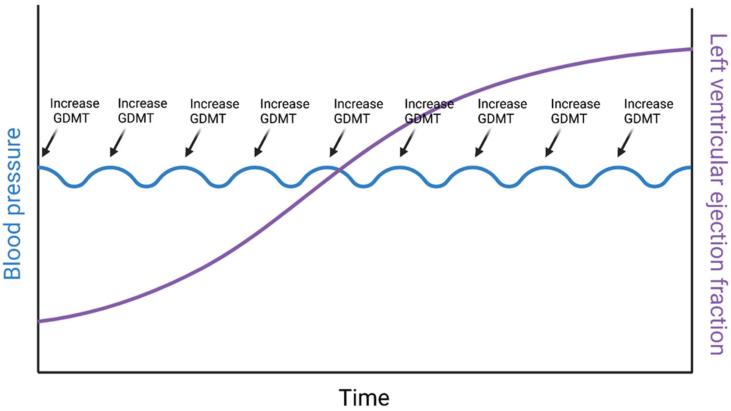
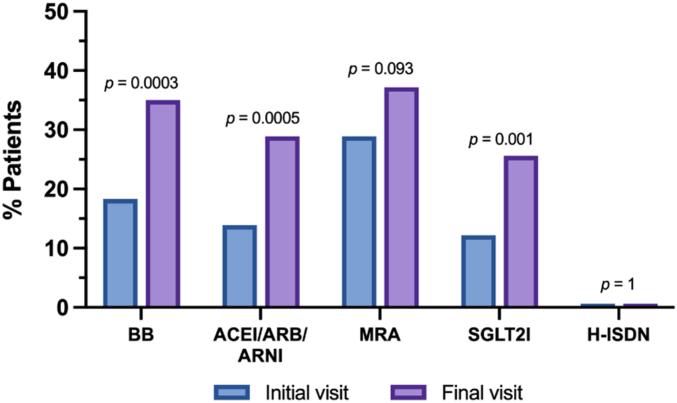
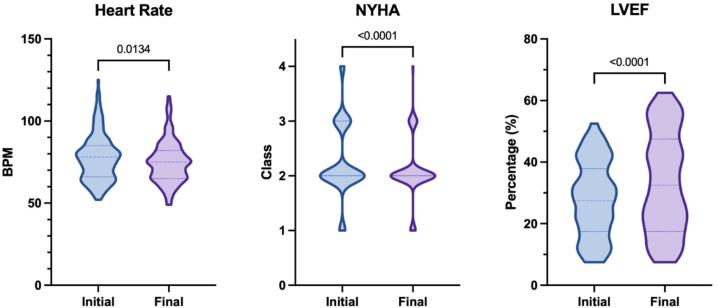
The objective of our study was to evaluate the real-world effects of an aggressive, personalized protocol for guideline-directed medical therapy (GDMT) titration in patients with heart failure (HF) with reduced ejection fraction (HFrEF). We conducted a two-center retrospective cohort study. Patients with HFrEF who presented to a HF clinic from January 2020 to December 2022 were placed on a GDMT protocol. 180 patients were included in the study. Mean GDMT score significantly increased from 4.7 to 5.9 ( < 0.001) between initial and final visits. Mean left ventricular ejection fraction (LVEF) significantly increased from 28 % to 33 % (+5 %, < 0.001). 27 (15.7 %) of the 172 patients with complete New York Heart Association (NYHA) classification data had improvement by at least 1 class, while 2 (1.2 %) patients had worsening NYHA classification. 140 (77.8 %) patients had no unplanned hospitalizations between visits. 21 (11.7 %) patients had an unplanned hospitalization for acute HF during the study period with a mean time from first clinic visit to hospitalization of 183 days (range: 13-821 days). 2 (1.1 %) patients were hospitalized due to GDMT-associated adverse drug events (i.e. hypotension, hyperkalemia). 7 (3.9 %) patients died during the study period, which was lower than the predicted 1-year death rate for our cohort (12.3 %) using the MAGGIC score. In conclusion, an aggressive, personalized protocol for GDMT titration in patients with HFrEF led to significant improvements in LVEF, NYHA classification, hospitalization, and mortality in a real-world setting. This protocol may help serve as a road map to lessen the gap between clinical knowledge and practice surrounding optimization of GDMT and move HFrEF patients toward a path to recovery.
我们研究的目的是评估积极的、个性化的指南指导药物治疗(GDMT)滴定方案对射血分数降低的心力衰竭(HFrEF)患者的实际效果。我们进行了一项双中心回顾性队列研究。2020年1月至2022年12月到心力衰竭门诊就诊的HFrEF患者被纳入GDMT方案。180名患者纳入研究。初次就诊和末次就诊之间,平均GDMT评分从4.7显著提高到5.9(<0.001)。平均左心室射血分数(LVEF)从28%显著提高到33%(提高5%,<0.001)。172例有完整纽约心脏协会(NYHA)分级数据的患者中,27例(15.7%)至少改善了1级,而2例(1.2%)患者NYHA分级恶化。140例(77.8%)患者在就诊期间没有非计划住院。21例(11.7%)患者在研究期间因急性心力衰竭非计划住院,从首次门诊就诊到住院的平均时间为183天(范围:13 - 821天)。2例(1.1%)患者因GDMT相关不良药物事件(即低血压、高钾血症)住院。7例(3.9%)患者在研究期间死亡,这低于使用MAGGIC评分预测的我们队列的1年死亡率(12.3%)。总之,针对HFrEF患者的积极、个性化的GDMT滴定方案在现实环境中使LVEF、NYHA分级、住院率和死亡率有显著改善。该方案可能有助于作为一个路线图,缩小围绕GDMT优化的临床知识与实践之间的差距,并使HFrEF患者走向康复之路。


 Zotero 插件