
一种用于在显性播散性血管内凝血进展到显性阶段之前进行早期准确预测的机器学习模型。
A machine learning model for early and accurate prediction of overt disseminated intravascular coagulation before its progression to an overt stage.
作者信息
Umemura Yutaka, Okada Naoki, Ogura Hiroshi, Oda Jun, Fujimi Satoshi
机构信息
Division of Trauma and Surgical Critical Care, Osaka General Medical Center, Osaka, Japan.
Department of Traumatology and Acute Critical Medicine, Osaka University Graduate School of Medicine, Osaka, Japan.
出版信息
Res Pract Thromb Haemost. 2024 Jul 22;8(5):102519. doi: 10.1016/j.rpth.2024.102519. eCollection 2024 Jul.
BACKGROUND
Recent studies suggested an expected survival benefit associated with anticoagulant therapies for sepsis in patients with disseminated intravascular coagulation (DIC). However, anticoagulant therapies for overt DIC are no longer assumed to regulate pathologic progression as overt DIC is a late-phase coagulation disorder. Therefore, methods for early prediction of sepsis-induced DIC before its progression to an overt stage are strongly required.
OBJECTIVES
We aimed to develop a prediction model for overt DIC using machine learning.
METHODS
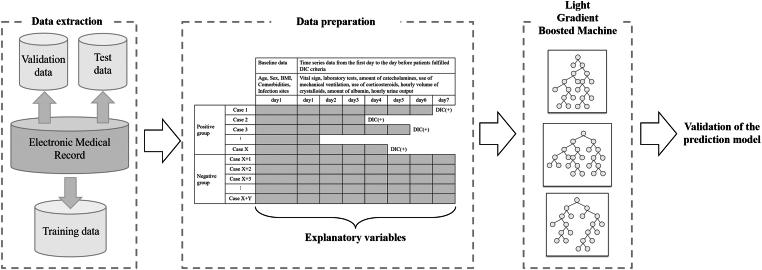
This retrospective, observational study included adult septic patients without overt DIC. The objective variable was binary classification of whether patients developed overt DIC based on International Society on Thrombosis and Haemostasis (ISTH) overt DIC criteria. Explanatory variables were the baseline and time series data within 7 days from sepsis diagnosis. Light Gradient Boosted Machine method was used to construct the prediction model. For controls, we assessed sensitivity and specificity of Japanese Association for Acute Medicine DIC criteria and ISTH sepsis-induced coagulopathy criteria for subsequent onset of overt DIC.
RESULTS
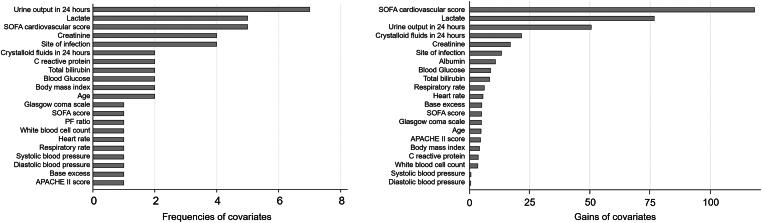
Among 912 patients with sepsis, 139 patients developed overt DIC within 7 days from diagnosis of sepsis. Sensitivity, specificity, and area under the receiver operating characteristic curve for predicting onset of overt DIC within 7 days were 84.4%, 87.5%, and 0.867 in the test cohort and 95.0%, 75.9%, and 0.851 in the validation cohort, respectively. Sensitivity and specificity by the diagnostic thresholds were 54.7% and 74.9% for Japanese Association for Acute Medicine DIC criteria and 63.3% and 71.9% for ISTH sepsis-induced coagulopathy criteria, respectively.
CONCLUSION
Compared with conventional DIC scoring systems, a machine learning model might exhibit higher prediction accuracy.
背景
近期研究表明,对于弥散性血管内凝血(DIC)患者,抗凝治疗对脓毒症具有预期的生存益处。然而,由于显性DIC是一种晚期凝血障碍,不再认为抗凝治疗能调节其病理进展。因此,迫切需要在脓毒症诱导的DIC进展到显性阶段之前对其进行早期预测的方法。
目的
我们旨在使用机器学习开发一种显性DIC的预测模型。
方法
这项回顾性观察研究纳入了无显性DIC的成年脓毒症患者。目标变量是根据国际血栓与止血学会(ISTH)显性DIC标准对患者是否发生显性DIC进行二分类。解释变量是脓毒症诊断后7天内的基线和时间序列数据。使用轻梯度提升机方法构建预测模型。作为对照,我们评估了日本急性医学协会DIC标准和ISTH脓毒症诱导的凝血病标准对随后发生显性DIC的敏感性和特异性。
结果
在912例脓毒症患者中,139例在脓毒症诊断后7天内发生显性DIC。在测试队列中,预测7天内显性DIC发作的敏感性、特异性和受试者工作特征曲线下面积分别为84.4%、87.5%和0.867,在验证队列中分别为95.0%、75.9%和0.851。日本急性医学协会DIC标准的诊断阈值的敏感性和特异性分别为54.7%和74.9%,ISTH脓毒症诱导的凝血病标准的敏感性和特异性分别为63.3%和71.9%。
结论
与传统的DIC评分系统相比,机器学习模型可能具有更高的预测准确性。


 Zotero 插件