
缺乏 Caspase-3 的多巴胺能神经元在 MPTP 处理后避免凋亡,但会发生坏死,从而引发 Galectin-3 依赖性选择性小胶质细胞吞噬反应。
Dopaminergic neurons lacking Caspase-3 avoid apoptosis but undergo necrosis after MPTP treatment inducing a Galectin-3-dependent selective microglial phagocytic response.
机构信息
Experimental Neuroinflammation Laboratory, Department of Experimental Medical Science, Lund University, BMC B11, 221 84, Lund, Sweden.
Instituto de Biomedicina de Sevilla, IBiS/Hospital Universitario Virgen del Rocío/CSIC/Universidad de Sevilla, Seville, Spain.
出版信息
Cell Death Dis. 2024 Aug 27;15(8):625. doi: 10.1038/s41419-024-07014-9.
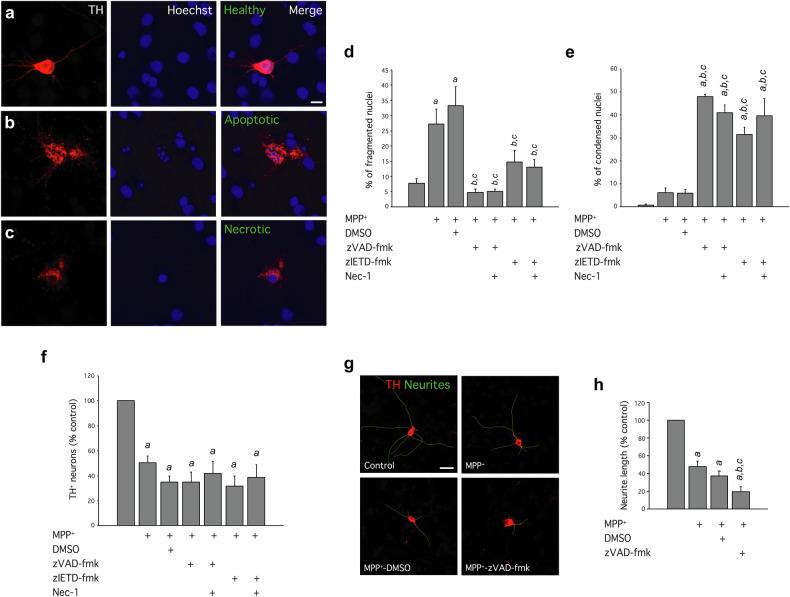
Parkinson's Disease (PD) is a progressive neurodegenerative disorder characterized by the loss of dopaminergic neurons in the Substantia nigra pars compacta (SNpc). Apoptosis is thought to play a critical role in the progression of PD, and thus understanding the effects of antiapoptotic strategies is crucial for developing potential therapies. In this study, we developed a unique genetic model to selectively delete Casp3, the gene encoding the apoptotic protein caspase-3, in dopaminergic neurons (TH-C3KO) and investigated its effects in response to a subacute regime of 1-methyl-4-phenyl-1,2,3,6-tetrahydropyridine (MPTP) administration, which is known to trigger apoptotic loss of SNpc dopaminergic neurons. We found that Casp3 deletion did not protect the dopaminergic system in the long term. Instead, we observed a switch in the cell death pathway from apoptosis in wild-type mice to necrosis in TH-C3KO mice. Notably, we did not find any evidence of necroptosis in our model or in in vitro experiments using primary dopaminergic cultures exposed to 1-methyl-4-phenylpyridinium in the presence of pan-caspase/caspase-8 inhibitors. Furthermore, we detected an exacerbated microglial response in the ventral mesencephalon of TH-C3KO mice in response to MPTP, which mimicked the microglia neurodegenerative phenotype (MGnD). Under these conditions, it was evident the presence of numerous microglial phagocytic cups wrapping around apparently viable dopaminergic cell bodies that were inherently associated with galectin-3 expression. We provide evidence that microglia exhibit phagocytic activity towards both dead and stressed viable dopaminergic neurons through a galectin-3-dependent mechanism. Overall, our findings suggest that inhibiting apoptosis is not a beneficial strategy for treating PD. Instead, targeting galectin-3 and modulating microglial response may be more promising approaches for slowing PD progression.
帕金森病(PD)是一种进行性神经退行性疾病,其特征是黑质致密部(SNpc)中的多巴胺能神经元丧失。细胞凋亡被认为在 PD 的进展中起着关键作用,因此了解抗细胞凋亡策略的影响对于开发潜在的治疗方法至关重要。在这项研究中,我们开发了一种独特的遗传模型,选择性地在多巴胺能神经元中删除 Casp3(编码凋亡蛋白 caspase-3 的基因)(TH-C3KO),并研究了其对亚急性 1-甲基-4-苯基-1,2,3,6-四氢吡啶(MPTP)处理的反应,已知该处理会引发 SNpc 多巴胺能神经元的凋亡性丧失。我们发现 Casp3 缺失并不能长期保护多巴胺能系统。相反,我们观察到细胞死亡途径从野生型小鼠的凋亡转变为 TH-C3KO 小鼠的坏死。值得注意的是,在我们的模型中或在使用 1-甲基-4-苯基吡啶在泛半胱氨酸酶/胱天蛋白酶-8 抑制剂存在下暴露于原代多巴胺能培养物的体外实验中,我们没有发现任何坏死性凋亡的证据。此外,我们在 TH-C3KO 小鼠的腹侧中脑检测到对 MPTP 的反应中微胶质反应加剧,这模拟了微胶质神经退行性表型(MGnD)。在这些条件下,显然存在许多微胶质吞噬杯,包裹着明显存活的多巴胺能细胞体,这些细胞体与半乳糖凝集素-3 的表达密切相关。我们提供的证据表明,微胶质通过半乳糖凝集素-3 依赖的机制对死亡和应激存活的多巴胺能神经元表现出吞噬活性。总体而言,我们的研究结果表明,抑制细胞凋亡不是治疗 PD 的有益策略。相反,靶向半乳糖凝集素-3 并调节小胶质细胞反应可能是减缓 PD 进展的更有前途的方法。




 Zotero 插件