
m6A 相关的无膜细胞器在 RNA 代谢过程和人类疾病中的作用。
The role of m6A-associated membraneless organelles in the RNA metabolism processes and human diseases.
机构信息
College of Pharmacy and Department of Hepatology, Institute of Hepatology and Metabolic Diseases, the Affiliated Hospital of Hangzhou Normal University, Hangzhou Normal University, Hangzhou, Zhejiang 311121, China.
Key Laboratory of Elemene Class Anti-Cancer Chinese Medicines; Engineering Laboratory of Development and Application of Traditional Chinese Medicines; Collaborative Innovation Center of Traditional Chinese Medicines of Zhejiang Province, Hangzhou Normal University, Hangzhou, Zhejiang 311121, China.
出版信息
Theranostics. 2024 Aug 6;14(12):4683-4700. doi: 10.7150/thno.99019. eCollection 2024.
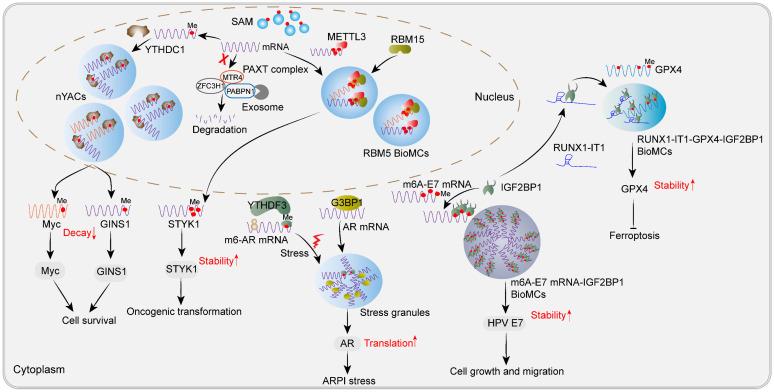
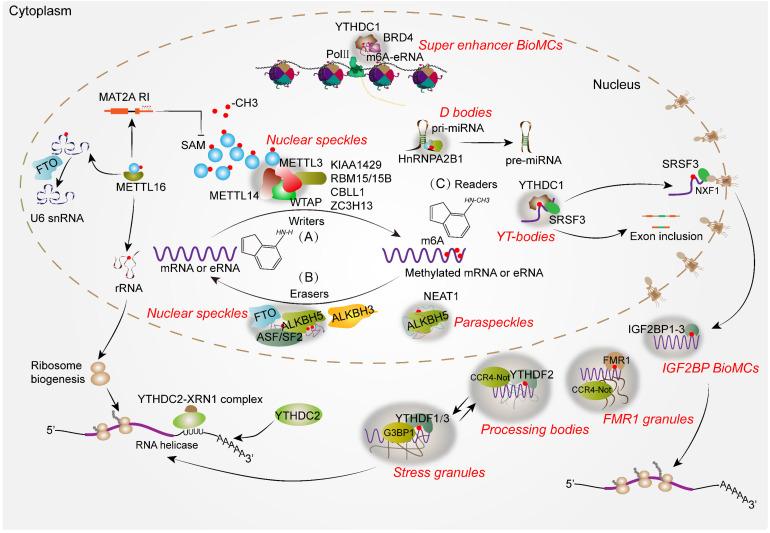
6-methyladenosine (m6A) is the most abundant post-transcriptional dynamic RNA modification process in eukaryotes, extensively implicated in cellular growth, embryonic development and immune homeostasis. One of the most profound biological functions of m6A is to regulate RNA metabolism, thereby determining the fate of RNA. Notably, the regulation of m6A-mediated organized RNA metabolism critically relies on the assembly of membraneless organelles (MLOs) in both the nucleus and cytoplasm, such as nuclear speckles, stress granules and processing bodies. In addition, m6A-associated MLOs exert a pivotal role in governing diverse RNA metabolic processes encompassing transcription, splicing, transport, decay and translation. However, emerging evidence suggests that dysregulated m6A levels contribute to the formation of pathological condensates in a range of human diseases, including tumorigenesis, reproductive diseases, neurological diseases and respiratory diseases. To date, the molecular mechanism by which m6A regulates the aggregation of biomolecular condensates associated with RNA metabolism is unclear. In this review, we comprehensively summarize the updated biochemical processes of m6A-associated MLOs, particularly focusing on their impact on RNA metabolism and their pivotal role in disease development and related biological mechanisms. Furthermore, we propose that m6A-associated MLOs could serve as predictive markers for disease progression and potential drug targets in the future.
6-甲基腺嘌呤(m6A)是真核生物中转录后最丰富的动态 RNA 修饰过程,广泛参与细胞生长、胚胎发育和免疫稳态。m6A 的一个最深刻的生物学功能是调节 RNA 代谢,从而决定 RNA 的命运。值得注意的是,m6A 介导的有组织的 RNA 代谢的调节严重依赖于核和细胞质中无膜细胞器(MLOs)的组装,如核斑点、应激颗粒和加工体。此外,m6A 相关的 MLOs 在调节包括转录、剪接、运输、降解和翻译在内的多种 RNA 代谢过程中发挥着关键作用。然而,新出现的证据表明,m6A 水平的失调导致一系列人类疾病中病理性凝聚物的形成,包括肿瘤发生、生殖疾病、神经疾病和呼吸疾病。迄今为止,m6A 调节与 RNA 代谢相关的生物分子凝聚物聚集的分子机制尚不清楚。在这篇综述中,我们全面总结了 m6A 相关 MLOs 的最新生化过程,特别是它们对 RNA 代谢的影响及其在疾病发展和相关生物学机制中的关键作用。此外,我们提出 m6A 相关的 MLOs 可以作为疾病进展的预测标志物和未来的潜在药物靶点。

 Zotero 插件