
泰国达府和夜丰颂府不同民族对野生动物的信仰、禁忌、使用、健康认知和实践。
Beliefs, taboos, usages, health perceptions, and practices toward wildlife among different ethnicities in Tak and Mae Hong Son Provinces, Thailand.
机构信息
Center of Excellence for Emerging and Re-emerging Infectious Diseases in Animals, Faculty of Veterinary Science, Chulalongkorn University, Pathumwan, Bangkok, Thailand.
SUPA71 Co., Ltd, Ladprao, Bangkok, Thailand.
出版信息
BMC Public Health. 2024 Sep 6;24(1):2432. doi: 10.1186/s12889-024-19941-5.
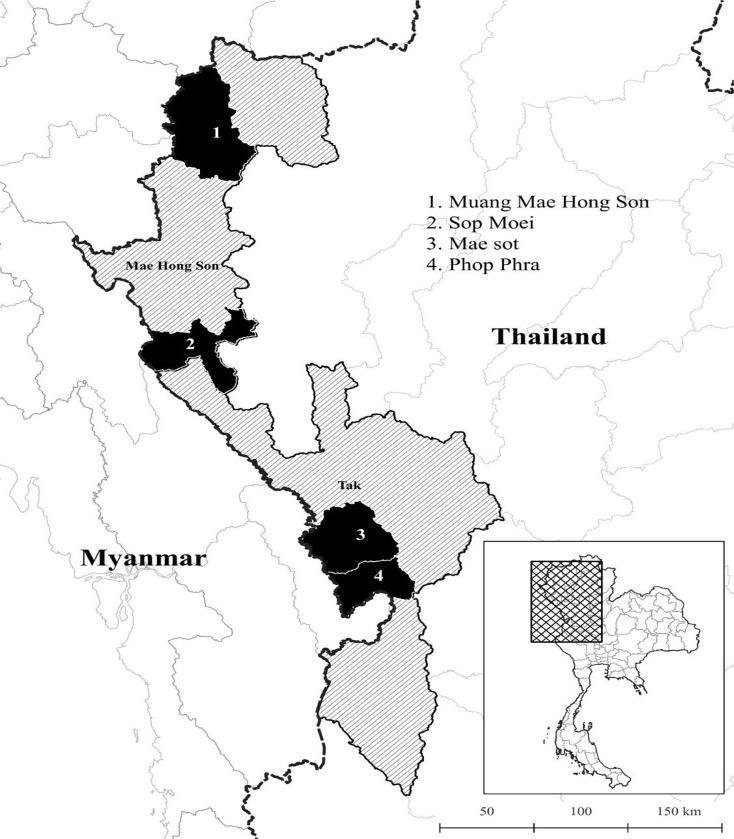
This concurrent qualitative study was carried out with the main objective to determine wildlife beliefs, taboos, usages, health perceptions, and practices among ten ethnic groups in four communities in Tak and Mae Hong Son provinces of Thailand from November 2020 to January 2021. We also gathered comprehensive information on study respondents' knowledge related to potential risk behaviors that could lead to zoonotic disease transmission and infection. Furthermore, we intended to use the study's findings to develop communication strategies and health literacy improvement interventions for mitigating risky behaviors, with a focus on ethnic groups and particular individuals who live in close proximity to forests and wildlife, to prevent future pandemics. Sixty-five respondents were purposively selected based on their extensive knowledge, active participation in local cultural contexts, beliefs, and exposure to wildlife contact or consuming game animals. Twenty (30.8%) participated in in-depth interviews (IDIs), while 45 (69.2%) participated in eight focused group discussions (FGDs). The results revealed that the characteristics of wildlife contact are similar and distinct based on their beliefs and taboos among various ethnic groups and study locations, which are influenced by cultural backgrounds and traditions. Although some ethnic groups do not have explicit restrictions on the consumption of wildlife, others adhere to specific beliefs and taboos that forbid the consumption or killing of specific wild animals. These beliefs frequently correspond with conservation initiatives, thereby facilitating the preservation of threatened species. The study also revealed a lack of appropriate health knowledge, perceptions, and practices regarding wildlife contact and consumption. As a result, it is recommended that public health officials and local governments develop and execute communication and education initiatives. These campaigns should aim to increase health literacy and promote safe handling, preparation, and cooking practices to reduce the risk of zoonotic disease transmission and infection effectively. Moreover, it is necessary to design and implement wildlife conservation education and outreach activities. The programs should promote environmental stewardship while considering the cultural contexts, beliefs, and practices of various ethnic groups. The activities should involve diverse stakeholders, including local leaders, religious influencers, community members, schoolteachers, students, health professionals, village health volunteers, and civil society organizations.
本同步定性研究的主要目的是在 2020 年 11 月至 2021 年 1 月期间,确定泰国塔可和湄宏顺省的四个社区中十个民族的野生动物信仰、禁忌、用途、健康认知和实践。我们还收集了研究对象与可能导致人畜共患病传播和感染的潜在风险行为相关的综合知识。此外,我们打算利用研究结果制定沟通策略和提高健康素养的干预措施,以减少风险行为,重点是与森林和野生动物密切接触或食用野味的少数民族群体和个人,以防止未来的大流行。根据他们的广泛知识、积极参与当地文化背景、信仰以及接触野生动物或食用野味的情况,我们有目的地选择了 65 名受访者。其中 20 人(30.8%)参加了深度访谈(IDIs),45 人(69.2%)参加了 8 次焦点小组讨论(FGDs)。结果表明,基于不同民族和研究地点的信仰和禁忌,野生动物接触的特征既有相似之处,也有明显的区别,这些特征受到文化背景和传统的影响。虽然有些民族对食用野生动物没有明确的限制,但其他民族则有特定的信仰和禁忌,禁止食用或捕杀特定的野生动物。这些信仰通常与保护倡议相符,从而有助于保护受威胁的物种。研究还揭示了缺乏关于野生动物接触和食用的适当健康知识、认知和实践。因此,建议公共卫生官员和地方政府制定和执行沟通和教育倡议。这些活动旨在提高健康素养,促进安全处理、准备和烹饪实践,以有效降低人畜共患病传播和感染的风险。此外,有必要设计和实施野生动物保护教育和外展活动。这些项目应在考虑到各民族的文化背景、信仰和实践的同时,促进环境管理。活动应涉及包括地方领导、宗教影响者、社区成员、学校教师、学生、卫生专业人员、乡村卫生志愿者和民间社会组织在内的各种利益攸关方。
 Zotero 插件