
门诊呼吸道感染的抗菌药物处方模式和适宜性:系统评价和荟萃分析。
Antimicrobial prescription pattern and appropriateness for respiratory tract infection in outpatients: a systematic review and meta-analysis.
机构信息
School of Health, Faculty of Medicine and Health, University of New England, Armidale, 2351, Australia.
Department of Clinical Medicine, College of Veterinary Medicine and Animal Science, University of Gondar, Gondar, 196, Ethiopia.
出版信息
Syst Rev. 2024 Sep 6;13(1):229. doi: 10.1186/s13643-024-02649-3.
BACKGROUND
Millions of people die every year as a result of antimicrobial resistance worldwide. An inappropriate prescription of antimicrobials (e.g., overuse, inadequate use, or a choice that diverges from established guidelines) can lead to a heightened risk of antimicrobial resistance. This study aimed to determine the rate and appropriateness of antimicrobial prescriptions for respiratory tract infections.
METHODS
This review was conducted in accordance with the PRISMA guidelines. Web of Science, PubMed, ProQuest Health and Medicine, and Scopus were searched between October 1, 2023, and December 15, 2023, with no time constraints. Studies were independently screened by the first author and the co-authors. We included original studies reporting antimicrobial prescription patterns and appropriateness for respiratory tract infections. The quality of included studies' was assessed via the Joanna Briggs Institute's Critical Appraisal Checklists for Cross-Sectional Studies. The assessment of publication bias was conducted using a funnel plot and Egger's regression test. A random effect model was employed to estimate the pooled antibiotic prescribing and inappropriate rates. Subgroup analysis was conducted by country, study period, data source, and age group.
RESULTS
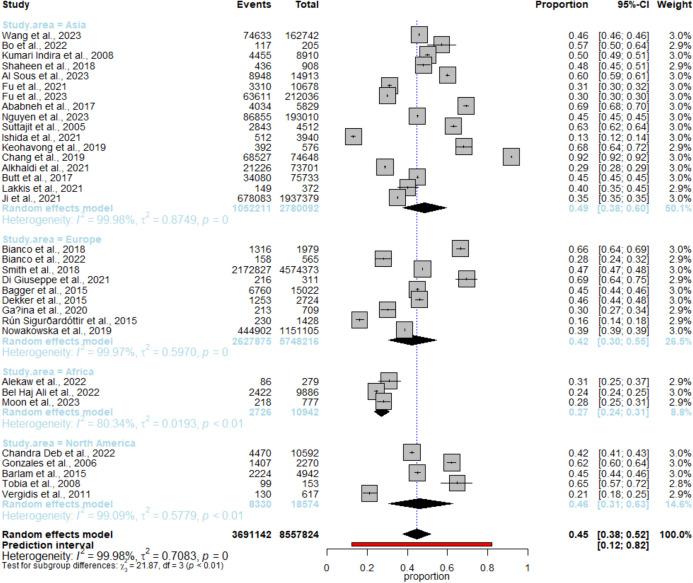
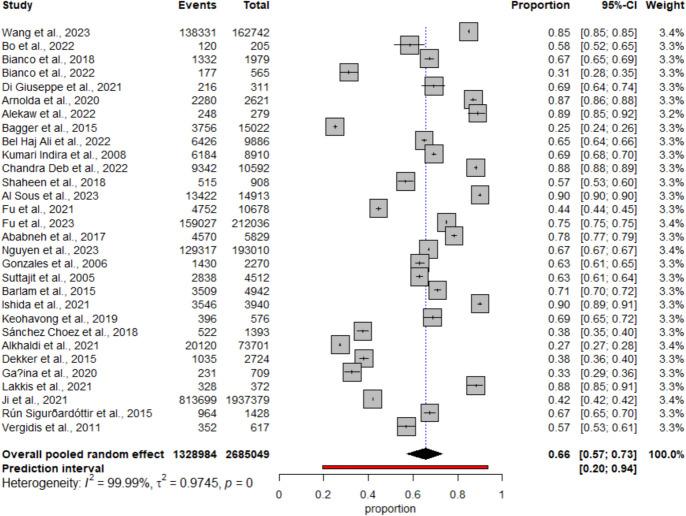
Of the total 1220 identified studies, 36 studies were included in the review. The antimicrobial prescribing rate ranged from 25% (95% CI 0.24-0.26) to 90% (95% CI 0.89-0.91). The pooled antimicrobial prescription rate was 66% (95% CI 0.57 to 0.73). Subgroup analysis by region revealed that the antimicrobial prescription rate was highest in Africa (79%, 95% CI 0.48-0.94) and lowest in Europe (47%, 95% CI 0.32-0.62). Amoxicillin and amoxicillin-clavulanate antimicrobials from the Access group, along with azithromycin and erythromycin from the Watch group, were the most frequently used antimicrobial agents. This study revealed that the major reasons for antimicrobial prescription were acute bronchitis, pharyngitis, sinusitis, and the common cold. The pooled inappropriate antimicrobial prescription rate was 45% (95% CI 0.38-0.52). Twenty-eight of the included studies reported that prescribing antimicrobials without proper indications was the main cause of inappropriate antimicrobial prescriptions. Additionally, subgroup analysis by region showed a higher inappropriate antimicrobial prescription rate in Asia at 49% (95% CI 0.38-0.60). The result of the funnel plot and Egger's tests revealed no substantial publication bias (Egger's test: p = 0.268).
CONCLUSION
The prescribing rate and inappropriate use of antimicrobials remain high and vary among countries. Further studies should be conducted to generate information about factors contributing to unnecessary antimicrobial prescriptions in outpatients.
SYSTEMATIC REVIEW REGISTRATION
Systematic review registration: CRD42023468353.
背景
全球每年有数百万人因抗菌药物耐药而死亡。抗菌药物的不当处方(例如,过度使用、使用不足或选择与既定指南不符)可能会增加抗菌药物耐药的风险。本研究旨在确定呼吸道感染抗菌药物处方的率和适当性。
方法
本综述按照 PRISMA 指南进行。2023 年 10 月 1 日至 12 月 15 日,在 Web of Science、PubMed、ProQuest Health and Medicine 和 Scopus 中进行了检索,没有时间限制。第一作者和共同作者独立筛选了研究。我们纳入了报告呼吸道感染抗菌药物处方模式和适当性的原始研究。使用 Joanna Briggs 研究所的横断面研究批判性评估清单评估纳入研究的质量。使用漏斗图和 Egger 回归检验评估发表偏倚。使用随机效应模型估计抗生素处方和不适当率的汇总值。通过国家、研究期间、数据来源和年龄组进行亚组分析。
结果
在总共 1220 项确定的研究中,有 36 项研究纳入了综述。抗菌药物的处方率范围从 25%(95%CI 0.24-0.26)到 90%(95%CI 0.89-0.91)。汇总的抗菌药物处方率为 66%(95%CI 0.57 至 0.73)。按地区进行的亚组分析显示,非洲的抗菌药物处方率最高(79%,95%CI 0.48-0.94),欧洲最低(47%,95%CI 0.32-0.62)。Access 组的阿莫西林和阿莫西林克拉维酸抗菌药物以及 Watch 组的阿奇霉素和红霉素是最常使用的抗菌药物。本研究表明,抗菌药物处方的主要原因是急性支气管炎、咽炎、鼻窦炎和普通感冒。汇总的不适当抗菌药物处方率为 45%(95%CI 0.38-0.52)。28 项纳入的研究报告称,没有适当的指征就开具抗菌药物是不适当使用抗菌药物的主要原因。此外,按地区进行的亚组分析显示,亚洲的不适当抗菌药物处方率较高,为 49%(95%CI 0.38-0.60)。漏斗图和 Egger 检验的结果表明没有明显的发表偏倚(Egger 检验:p=0.268)。
结论
抗菌药物的处方率和不适当使用仍然很高,并且在各国之间存在差异。应进一步开展研究,以了解门诊患者中导致不必要使用抗菌药物的因素。
系统评价注册
系统评价注册:CRD42023468353。


 Zotero 插件