
中枢神经系统铜耗竭小鼠脊髓运动神经元数量减少。
Decreased spinal cord motor neuron numbers in mice depleted of central nervous system copper.
机构信息
Department of Anatomy and Physiology, The University of Melbourne, Parkville, VIC 3010, Australia.
Atomic Medicine Initiative, University of Technology Sydney, Sydney, NSW 2007, Australia.
出版信息
Metallomics. 2024 Sep 5;16(9). doi: 10.1093/mtomcs/mfae036.
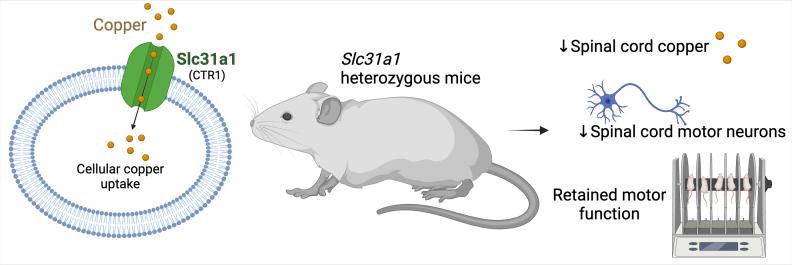
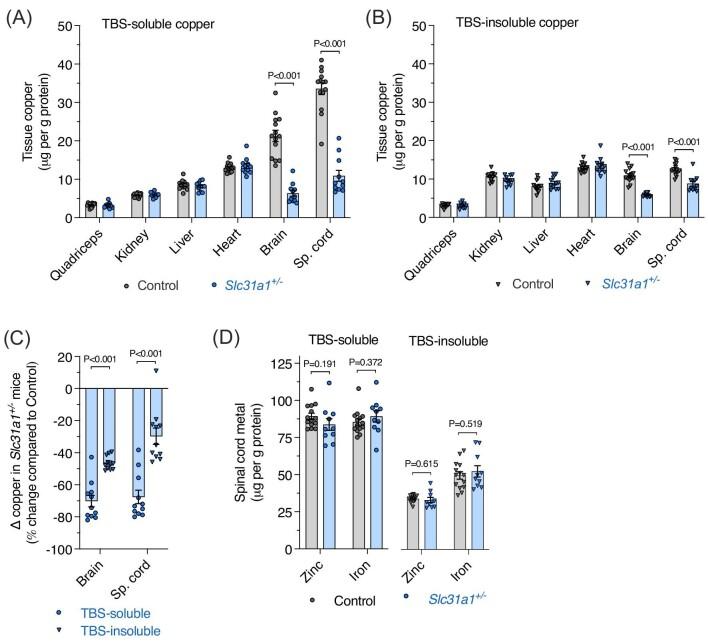
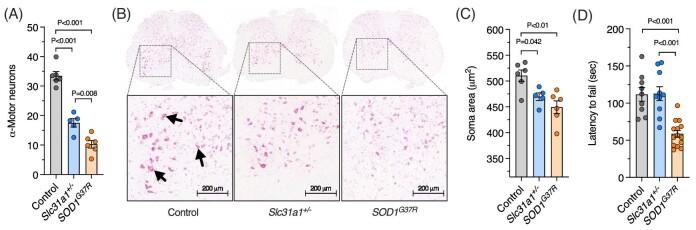
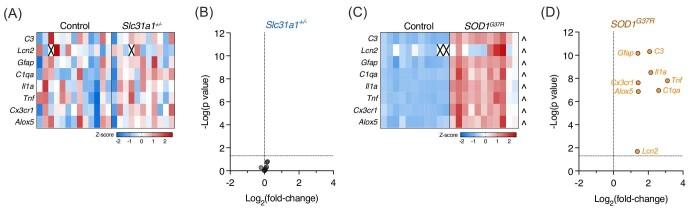
Disrupted copper availability in the central nervous system (CNS) is implicated as a significant feature of the neurodegenerative disease amyotrophic lateral sclerosis (ALS). Solute carrier family 31 member 1 (Slc31a1; Ctr1) governs copper uptake in mammalian cells and mutations affecting Slc31a1 are associated with severe neurological abnormalities. Here, we examined the impact of decreased CNS copper caused by ubiquitous heterozygosity for functional Slc31a1 on spinal cord motor neurons in Slc31a1+/- mice. Congruent with the CNS being relatively susceptible to disrupted copper availability, brain and spinal cord tissue from Slc31a1+/- mice contained significantly less copper than wild-type littermates, even though copper levels in other tissues were unaffected. Slc31a1+/- mice had less spinal cord α-motor neurons compared to wild-type littermates, but they did not develop any overt physical signs of motor impairment. By contrast, ALS model SOD1G37R mice had fewer α-motor neurons than control mice and exhibited clear signs of motor function impairment. With the expression of Slc31a1 notwithstanding, spinal cord expression of genes related to copper handling revealed only minor differences between Slc31a1+/- and wild-type mice. This contrasted with SOD1G37R mice where changes in the expression of copper handling genes were pronounced. Similarly, the expression of genes related to toxic glial activation was unchanged in spinal cords from Slc31a1+/- mice but highly upregulated in SOD1G37R mice. Together, results from the Slc31a1+/- mice and SOD1G37R mice indicate that although depleted CNS copper has a significant impact on spinal cord motor neuron numbers, the manifestation of overt ALS-like motor impairment requires additional factors.
中枢神经系统 (CNS) 中铜的可用性受到干扰被认为是神经退行性疾病肌萎缩侧索硬化症 (ALS) 的一个重要特征。溶质载体家族 31 成员 1 (Slc31a1; Ctr1) 控制着哺乳动物细胞中的铜摄取,影响 Slc31a1 的突变与严重的神经异常有关。在这里,我们研究了由于 Slc31a1 的普遍杂合性功能丧失导致中枢神经系统铜减少对 Slc31a1+/- 小鼠脊髓运动神经元的影响。与中枢神经系统相对容易受到铜可用性中断的影响一致,Slc31a1+/- 小鼠的大脑和脊髓组织中的铜含量明显低于野生型同窝仔鼠,尽管其他组织中的铜含量不受影响。Slc31a1+/- 小鼠的脊髓 α-运动神经元比野生型同窝仔鼠少,但它们没有出现任何明显的运动功能障碍迹象。相比之下,ALS 模型 SOD1G37R 小鼠的 α-运动神经元比对照小鼠少,并且表现出明显的运动功能障碍迹象。尽管 Slc31a1 表达,与铜处理相关的基因在脊髓中的表达在 Slc31a1+/- 和野生型小鼠之间仅显示出微小差异。这与 SOD1G37R 小鼠形成对比,其中铜处理基因的表达变化非常明显。同样,Slc31a1+/- 小鼠脊髓中与毒性神经胶质激活相关的基因表达不变,但在 SOD1G37R 小鼠中高度上调。总的来说,Slc31a1+/- 小鼠和 SOD1G37R 小鼠的结果表明,尽管中枢神经系统铜的消耗对脊髓运动神经元数量有重大影响,但明显的 ALS 样运动功能障碍的表现还需要其他因素。


 Zotero 插件