
在常规实践中,多聚(ADP-核糖)聚合酶抑制剂对转移性前列腺癌有持久获益:生物标志物相关性及其对最佳临床下一代测序检测的影响。
Durable benefit from poly(ADP-ribose) polymerase inhibitors in metastatic prostate cancer in routine practice: biomarker associations and implications for optimal clinical next-generation sequencing testing.
机构信息
Department of Urology, Michigan Medicine, Ann Arbor, USA.
Foundation Medicine, Cambridge, USA.
出版信息
ESMO Open. 2024 Sep;9(9):103684. doi: 10.1016/j.esmoop.2024.103684. Epub 2024 Sep 9.
BACKGROUND
Controlled trials have consistently demonstrated the efficacy of poly(ADP-ribose) polymerase inhibitors (PARPis) in patients with metastatic castration-resistant prostate cancer (mCRPC) and BRCA1 or BRCA2 alterations (BRCAalt). However, the reported efficacy of PARPi for alterations in other homologous recombination repair (HRR) genes is less consistent. We sought to evaluate the routine practice effectiveness of PARPi between and within these groups.
DESIGN
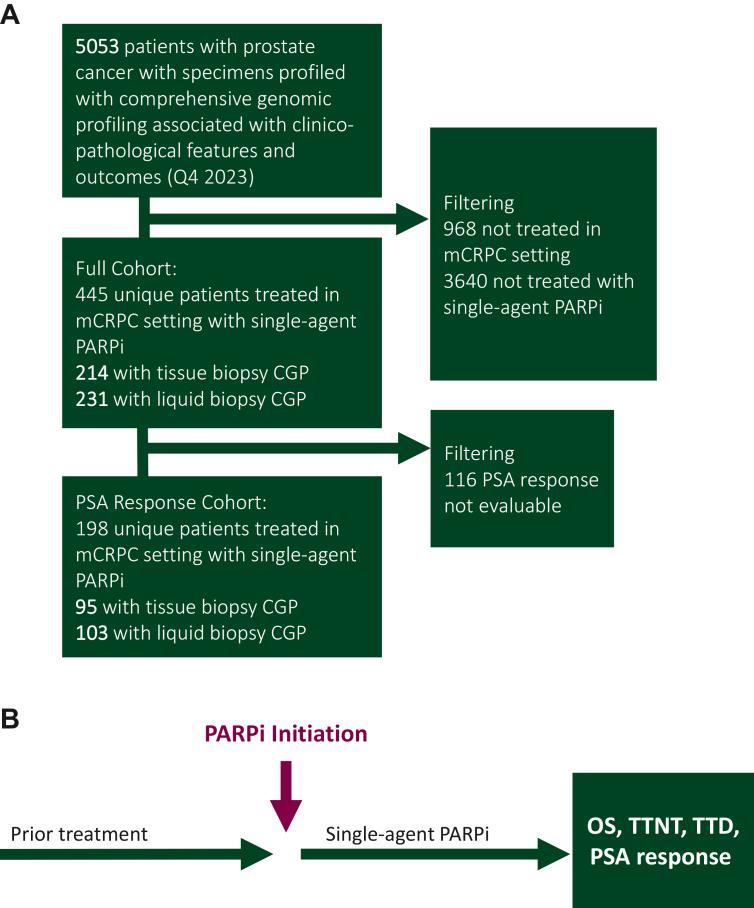
Patient-level data from a deidentified nationwide (USA-based) cancer clinico-genomic database between January 2011 and September 2023 were extracted. Patients with mCRPC and comprehensive genomic profiling by liquid biopsy [circulating tumor DNA (ctDNA)] or tissue (tumor) biopsy and who received single-agent PARPi were included and grouped by BRCAalt, ATMalt, other HRR, or no HRR. We further subcategorized BRCAalt into homozygous loss (BRCAloss) and all other deleterious BRCAalt (otherBRCAalt).
RESULTS
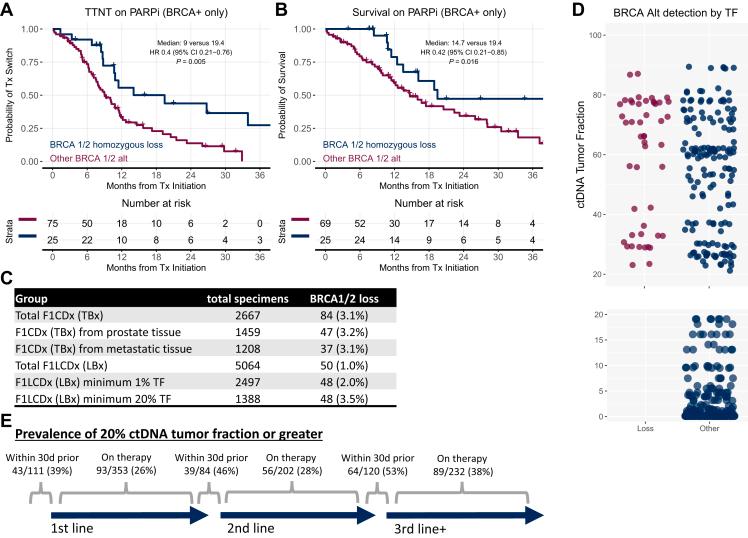
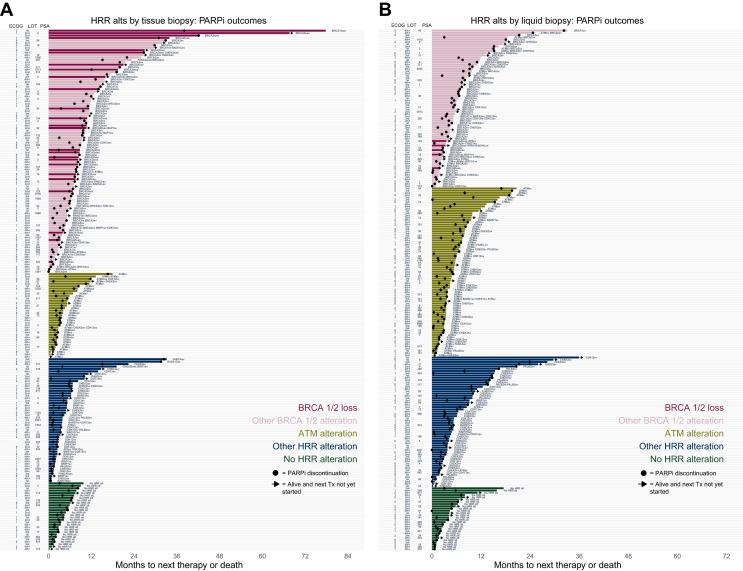
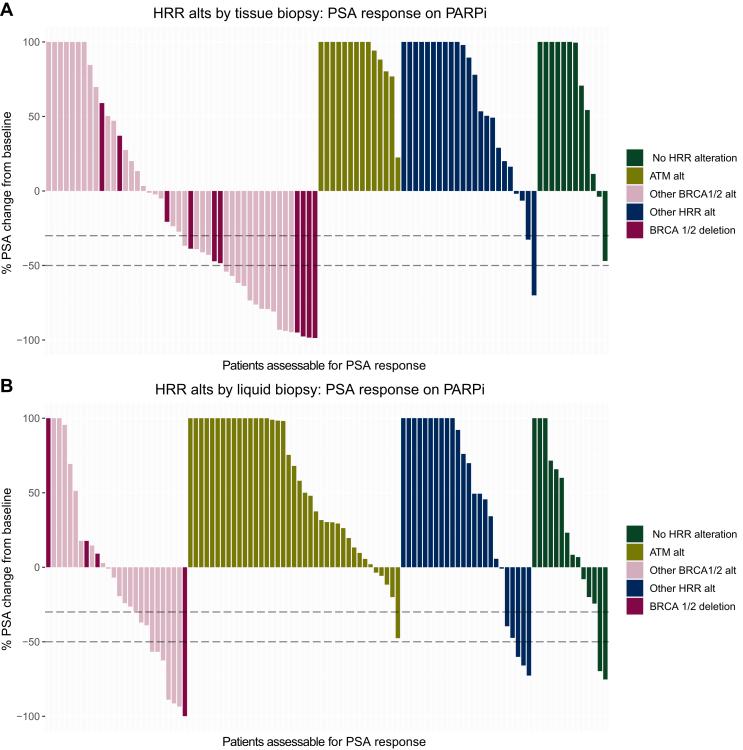
A total of 445 patients met inclusion criteria: 214 with tumor and 231 with ctDNA. BRCAalt had more favorable outcomes to PARPi compared with ATM, other HRR, and no HRR groups. Within the BRCAalt subgroup, compared with other BRCAalt, BRCAloss had a more favorable time to next treatment (median 9 versus 19.4 months, P = 0.005), time to treatment discontinuation (median 8 versus 14 months, P = 0.006), and routine practice overall survival (median 14.7 versus 19.4 months, P = 0.016). Tumor BRCAloss prevalence (3.1%) was similar to ctDNA prevalence in liquid biopsy specimens with high tumor fraction (>20%). BRCAloss was not detected in orthogonal germline testing.
CONCLUSIONS
PARPi routine practice effectiveness between groups mirrors prospective trials. Within the BRCAalt group, BRCAloss had the best outcomes. Unless the ctDNA tumor fraction is very high, somatic tissue testing (archival or metastatic) should be prioritized to identify patients who may benefit most from PARPi. When tissue testing is not clinically feasible, sufficient ctDNA tumor fraction levels for detection are enriched at clinical timepoints associated with tumor progression.
背景
对照试验一致表明,聚(ADP-核糖)聚合酶抑制剂(PARPi)在转移性去势抵抗性前列腺癌(mCRPC)和 BRCA1 或 BRCA2 改变(BRCAalt)患者中具有疗效。 然而,PARPi 对其他同源重组修复(HRR)基因改变的疗效报告并不一致。 我们旨在评估这些组之间和组内 PARPi 的常规实践效果。
设计
从 2011 年 1 月至 2023 年 9 月期间一个基于美国的全国性癌症临床基因组数据库中提取患者水平数据。 纳入接受单药 PARPi 治疗且通过液体活检(循环肿瘤 DNA [ctDNA])或组织(肿瘤)活检进行全面基因组分析的 mCRPC 患者,并按 BRCAalt、ATMalt、其他 HRR 或无 HRR 分组。 我们进一步将 BRCAalt 细分为纯合缺失(BRCAloss)和所有其他有害 BRCAalt(otherBRCAalt)。
结果
共有 445 名患者符合纳入标准:肿瘤 214 例,ctDNA 231 例。 BRCAalt 与 ATM、其他 HRR 和无 HRR 组相比,对 PARPi 的疗效更好。 在 BRCAalt 亚组中,与其他 BRCAalt 相比,BRCAloss 具有更有利的下一次治疗时间(中位 9 个月 vs 19.4 个月,P=0.005)、治疗终止时间(中位 8 个月 vs 14 个月,P=0.006)和常规实践总生存期(中位 14.7 个月 vs 19.4 个月,P=0.016)。 肿瘤 BRCAloss 的发生率(3.1%)与液体活检标本中高肿瘤分数(>20%)的发生率相似。 在正交种系测试中未检测到 BRCAloss。
结论
组间 PARPi 常规实践效果反映了前瞻性试验。 在 BRCAalt 组中,BRCAloss 的疗效最好。 除非 ctDNA 肿瘤分数非常高,否则应优先进行组织检测(存档或转移性)以确定最有可能从 PARPi 中获益的患者。 当组织检测在临床上不可行时,在与肿瘤进展相关的临床时间点上,应富集足够的 ctDNA 肿瘤分数水平以进行检测。
 Zotero 插件