
胃癌风险预测模型:一项范围综述
Risk Prediction Models for Gastric Cancer: A Scoping Review.
作者信息
Xu Linyu, Lyu Jianxia, Zheng Xutong, Wang Aiping
机构信息
Department of Public Service, The First Affiliated Hospital of China Medical University, Shenyang, 110001, People's Republic of China.
出版信息
J Multidiscip Healthc. 2024 Sep 6;17:4337-4352. doi: 10.2147/JMDH.S479699. eCollection 2024.
BACKGROUND
Gastric cancer is a significant contributor to the global cancer burden. Risk prediction models aim to estimate future risk based on current and past information, and can be utilized for risk stratification in population screening programs for gastric cancer. This review aims to explore the research design of existing models, as well as the methods, variables, and performance of model construction.
METHODS
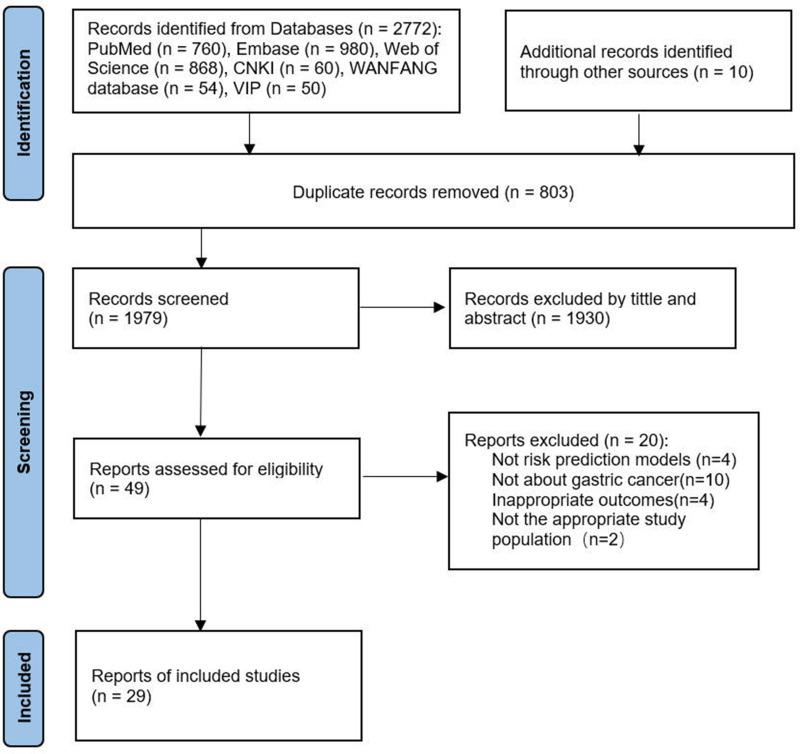
Six databases were searched through to November 4, 2023 to identify appropriate studies. PRISMA extension for scoping reviews and the Arksey and O'Malley framework were followed. Data sources included PubMed, Embase, Web of Science, CNKI, Wanfang, and VIP, focusing on gastric cancer risk prediction model studies.
RESULTS
A total of 29 articles met the inclusion criteria, from which 28 original risk prediction models were identified that met the analysis criteria. The risk prediction model is screened, and the data extracted includes research characteristics, prediction variables selection, model construction methods and evaluation indicators. The area under the curve (AUC) of the models ranged from 0.560 to 0.989, while the C-statistics varied between 0.684 and 0.940. The number of predictor variables is mainly concentrated between 5 to 11. The top 5 most frequently included variables were age, helicobacter pylori (Hp), precancerous lesion, pepsinogen (PG), sex, and smoking. Age and Hp were the most consistently included variables.
CONCLUSION
This review enhances understanding of current gastric cancer risk prediction research and its future directions. The findings provide a strong scientific basis and technical support for developing more accurate gastric cancer risk models. We expect that these conclusions will point the way for future research and clinical practice in this area to assist in the early prevention and treatment of gastric cancer.
背景
胃癌是全球癌症负担的重要成因。风险预测模型旨在根据当前和过去的信息估计未来风险,可用于胃癌人群筛查项目中的风险分层。本综述旨在探讨现有模型的研究设计以及模型构建的方法、变量和性能。
方法
检索了六个数据库直至2023年11月4日以确定合适的研究。遵循PRISMA扩展的范围综述和Arksey与O'Malley框架。数据来源包括PubMed、Embase、科学网、中国知网、万方和维普,重点关注胃癌风险预测模型研究。
结果
共有29篇文章符合纳入标准,从中确定了28个符合分析标准的原始风险预测模型。对风险预测模型进行筛选,提取的数据包括研究特征、预测变量选择、模型构建方法和评估指标。模型的曲线下面积(AUC)范围为0.560至0.989,而C统计量在0.684至0.940之间变化。预测变量的数量主要集中在5至11个之间。最常包含的前5个变量是年龄、幽门螺杆菌(Hp)、癌前病变、胃蛋白酶原(PG)、性别和吸烟。年龄和Hp是最常一致包含的变量。
结论
本综述增进了对当前胃癌风险预测研究及其未来方向的理解。研究结果为开发更准确的胃癌风险模型提供了有力的科学依据和技术支持。我们期望这些结论将为该领域未来的研究和临床实践指明方向,以协助胃癌的早期预防和治疗。


 Zotero 插件