
通过序列推理检测内出血:一项计算机模拟可行性研究。
Detection of Internal Hemorrhage via Sequential Inference: An In Silico Feasibility Study.
作者信息
Chalumuri Yekanth Ram, Jin Xin, Tivay Ali, Hahn Jin-Oh
机构信息
Department of Mechanical Engineering, University of Maryland, College Park, MD 20742, USA.
出版信息
Diagnostics (Basel). 2024 Sep 6;14(17):1970. doi: 10.3390/diagnostics14171970.
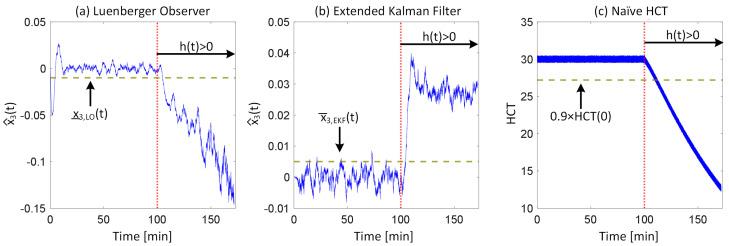
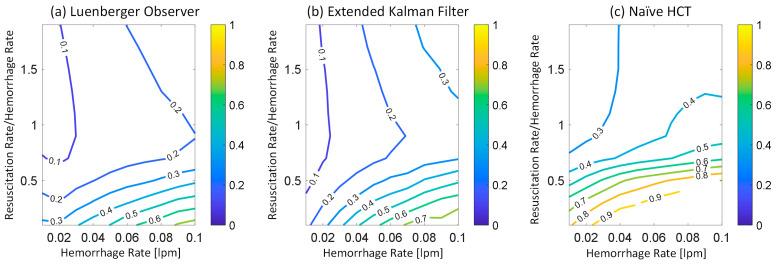
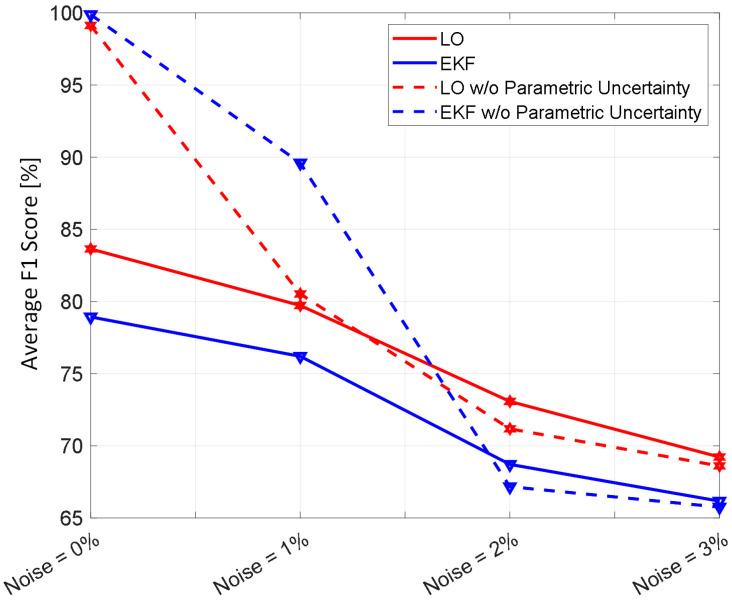
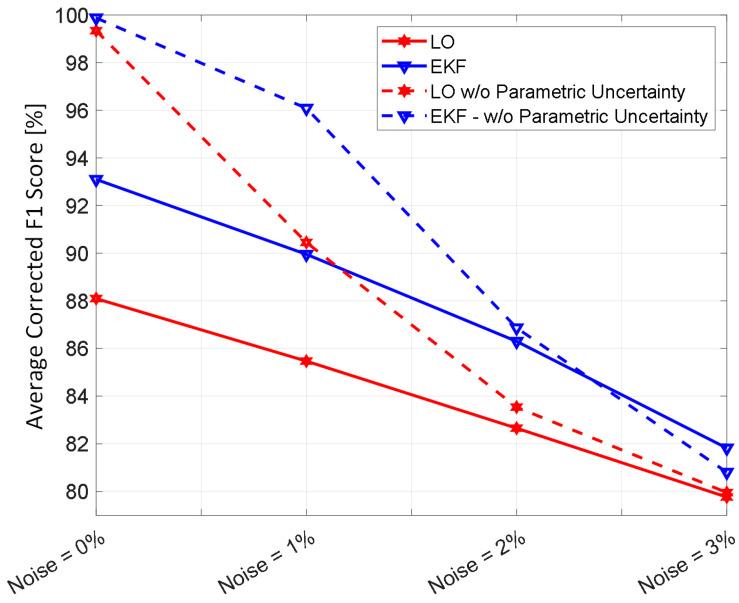
This paper investigates the feasibility of detecting and estimating the rate of internal hemorrhage based on continuous noninvasive hematocrit measurement. A unique challenge in hematocrit-based hemorrhage detection is that hematocrit decreases in response to hemorrhage and resuscitation with fluids, which makes hemorrhage detection during resuscitation challenging. We developed two sequential inference algorithms for detection of internal hemorrhage based on the Luenberger observer and the extended Kalman filter. The sequential inference algorithms use fluid resuscitation dose and hematocrit measurement as inputs to generate signatures to enable detection of internal hemorrhage. In the case of the extended Kalman filter, the signature is nothing but inferred hemorrhage rate, which allows it to also estimate internal hemorrhage rate. We evaluated the proof-of-concept of these algorithms based on in silico evaluation in 100 virtual patients subject to diverse hemorrhage and resuscitation rates. The results showed that the sequential inference algorithms outperformed naïve internal hemorrhage detection based on the decrease in hematocrit when hematocrit noise level was 1% (average F1 score: Luenberger observer 0.80; extended Kalman filter 0.76; hematocrit 0.59). Relative to the Luenberger observer, the extended Kalman filter demonstrated comparable internal hemorrhage detection performance and superior accuracy in estimating the hemorrhage rate. The analysis of the dependence of the sequential inference algorithms on measurement noise and plant parametric uncertainty showed that small (≤1%) hematocrit noise level and personalization of sequential inference algorithms may enable continuous noninvasive detection of internal hemorrhage and estimation of its rate.
本文研究了基于连续无创血细胞比容测量来检测和估计内出血速率的可行性。基于血细胞比容的出血检测面临的一个独特挑战是,血细胞比容会因出血和液体复苏而降低,这使得在复苏过程中进行出血检测具有挑战性。我们基于Luenberger观测器和扩展卡尔曼滤波器开发了两种用于检测内出血的序贯推理算法。序贯推理算法将液体复苏剂量和血细胞比容测量值作为输入,以生成特征信号来实现内出血的检测。对于扩展卡尔曼滤波器而言,特征信号就是推断出的出血速率,这使其还能估计内出血速率。我们基于对100名经历不同出血和复苏速率的虚拟患者的计算机模拟评估,对这些算法的概念验证进行了评估。结果表明,当血细胞比容噪声水平为1%时,序贯推理算法优于基于血细胞比容降低的简单内出血检测方法(平均F1分数:Luenberger观测器为0.80;扩展卡尔曼滤波器为0.76;血细胞比容为0.59)。相对于Luenberger观测器,扩展卡尔曼滤波器在内出血检测性能上相当,在估计出血速率方面具有更高的准确性。对序贯推理算法对测量噪声和对象参数不确定性的依赖性分析表明,较小(≤1%)的血细胞比容噪声水平以及序贯推理算法的个性化处理可能实现内出血的连续无创检测及其速率估计。





 Zotero 插件