
顺铂耐药性与代谢:化繁为简
Cisplatin Resistance and Metabolism: Simplification of Complexity.
作者信息
Pervushin Nikolay V, Yapryntseva Maria A, Panteleev Mikhail A, Zhivotovsky Boris, Kopeina Gelina S
机构信息
Faculty of Medicine, Lomonosov Moscow State University, 119991 Moscow, Russia.
Engelhardt Institute of Molecular Biology, Russian Academy of Sciences, 119991 Moscow, Russia.
出版信息
Cancers (Basel). 2024 Sep 4;16(17):3082. doi: 10.3390/cancers16173082.
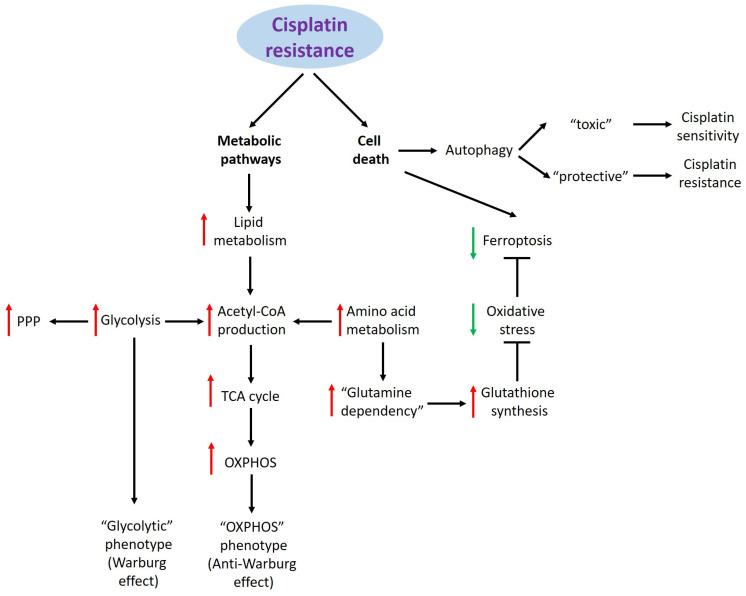
Cisplatin is one of the most well-known anti-cancer drugs and has demonstrated efficacy against numerous tumor types for many decades. However, a key challenge with cisplatin, as with any chemotherapeutic agent, is the development of resistance with a resultant loss of efficacy. This resistance is often associated with metabolic alterations that allow insensitive cells to divide and survive under treatment. These adaptations could vary greatly among different tumor types and may seem questionable and incomprehensible at first glance. Here we discuss the disturbances in glucose, lipid, and amino acid metabolism in cisplatin-resistant cells as well as the roles of ferroptosis and autophagy in acquiring this type of drug intolerance.
顺铂是最著名的抗癌药物之一,几十年来已证明对多种肿瘤类型有效。然而,与任何化疗药物一样,顺铂面临的一个关键挑战是耐药性的产生,导致疗效丧失。这种耐药性通常与代谢改变有关,代谢改变使不敏感细胞在治疗下仍能分裂和存活。这些适应性变化在不同肿瘤类型之间可能有很大差异,乍一看可能令人质疑和难以理解。在这里,我们讨论顺铂耐药细胞中葡萄糖、脂质和氨基酸代谢的紊乱,以及铁死亡和自噬在获得这种药物耐受性中的作用。
 Zotero 插件