
非奈利酮在日本慢性肾脏病合并2型糖尿病患者中的早期临床经验——来自FOUNTAIN(非奈利酮多数据库证据生成网络)平台的多队列研究
Early Clinical Experience of Finerenone in People with Chronic Kidney Disease and Type 2 Diabetes in Japan-A Multi-Cohort Study from the FOUNTAIN (FinerenOne mUltidatabase NeTwork for Evidence generAtIoN) Platform.
作者信息
Sato Atsuhisa, Rodriguez-Molina Daloha, Yoshikawa-Ryan Kanae, Yamashita Satoshi, Okami Suguru, Liu Fangfang, Farjat Alfredo, Oberprieler Nikolaus G, Kovesdy Csaba P, Kanasaki Keizo, Vizcaya David
机构信息
Department of Nephrology and Hypertension, International University of Health and Welfare Shioya Hospital, Yaita 329-2145, Japan.
Integrated Evidence Generation & Business Innovation, Bayer AG, 13342 Berlin, Germany.
出版信息
J Clin Med. 2024 Aug 28;13(17):5107. doi: 10.3390/jcm13175107.
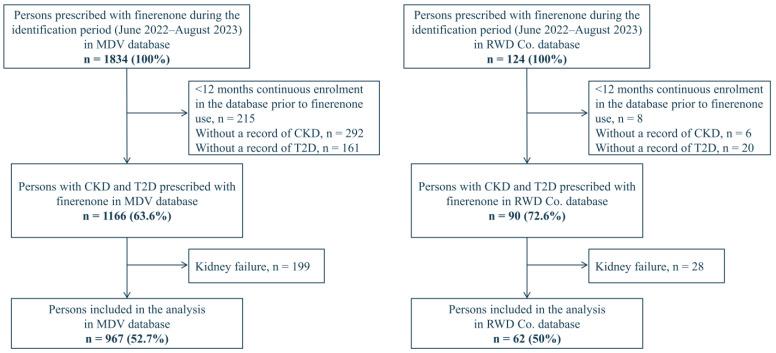
In the phase 3 clinical trials FIGARO-DKD and FIDELIO-DKD, finerenone reduced the risk of cardiovascular and kidney events among people with chronic kidney disease (CKD) and type 2 diabetes (T2D). Evidence regarding finerenone use in real-world settings is limited. A retrospective cohort study (NCT06278207) using two Japanese nationwide hospital-based databases provided by Medical Data Vision (MDV) and Real World Data Co., Ltd. (RWD Co., Kyoto Japan), converted to the OMOP common data model, was conducted. Persons with CKD and T2D initiating finerenone from 1 July 2021, to 30 August 2023, were included. Baseline characteristics were described. The occurrence of hyperkalemia after finerenone initiation was assessed. 1029 new users of finerenone were included (967 from MDV and 62 from RWD Co.). Mean age was 69.5 and 72.4 years with 27.3% and 27.4% being female in the MDV and RWD Co. databases, respectively. Hypertension (92 and 95%), hyperlipidemia (59 and 71%), and congestive heart failure (60 and 66%) were commonly observed comorbidities. At baseline, 80% of persons were prescribed angiotensin-converting-enzyme inhibitors or angiotensin-receptor blockers. Sodium-glucose cotransporter 2 inhibitors and glucagon-like peptide 1 receptor agonists were prescribed in 72% and 30% of the study population, respectively. The incidence proportions of hyperkalemia were 2.16 and 2.70 per 100 persons in the MDV and RWD Co. databases, respectively. There were no hospitalizations associated with hyperkalemia observed in either of the two datasets. For the first time, we report the largest current evidence on the clinical use of finerenone in real-world settings early after the drug authorization in Japan. This early evidence from clinical practice suggests that finerenone is used across comorbidities and comedications.
在3期临床试验FIGARO-DKD和FIDELIO-DKD中,非奈利酮降低了慢性肾脏病(CKD)合并2型糖尿病(T2D)患者发生心血管和肾脏事件的风险。关于非奈利酮在现实环境中使用的证据有限。一项回顾性队列研究(NCT06278207)利用了由Medical Data Vision(MDV)和Real World Data Co., Ltd.(日本京都RWD Co.)提供的两个日本全国性医院数据库,并转换为OMOP通用数据模型。纳入了2021年7月1日至2023年8月30日开始使用非奈利酮的CKD合并T2D患者。描述了基线特征。评估了开始使用非奈利酮后高钾血症的发生情况。共纳入1029名非奈利酮新使用者(MDV数据库967名,RWD Co.数据库62名)。MDV和RWD Co.数据库中患者的平均年龄分别为69.5岁和72.4岁,女性分别占27.3%和27.4%。常见的合并症有高血压(92%和95%)、高脂血症(59%和71%)和充血性心力衰竭(60%和66%)。基线时,80%的患者使用血管紧张素转换酶抑制剂或血管紧张素受体阻滞剂。钠-葡萄糖协同转运蛋白2抑制剂和胰高血糖素样肽1受体激动剂分别在72%和30%的研究人群中使用。MDV和RWD Co.数据库中高钾血症的发病率分别为每100人2.16例和2.70例。在两个数据集中均未观察到与高钾血症相关的住院情况。我们首次报告了日本药物获批后早期现实环境中非奈利酮临床使用的最大现有证据。来自临床实践的这一早期证据表明,非奈利酮可用于各种合并症和联合用药情况。

 Zotero 插件