
骨转移患者发生后续骨相关事件的临床、肿瘤学及预后差异。
Clinical, oncological, and prognostic differences of patients with subsequent skeletal-related events in bone metastases.
作者信息
Hsieh Hsiang-Chieh, Yen Hung-Kuan, Hsieh Wen-Tung, Lin Ching-Wei, Pan Yu-Ting, Jaw Fu-Shan, Janssen Stein J, Lin Wei-Hsin, Hu Ming-Hsiao, Groot Olivier
机构信息
Institute of Biomedical Engineering, National Taiwan University, Taipei, Taiwan.
Department of Orthopaedic Surgery, National Taiwan University Hospital, Taipei, Taiwan.
出版信息
Bone Joint Res. 2024 Sep 16;13(9):497-506. doi: 10.1302/2046-3758.139.BJR-2023-0372.R1.
AIMS
Advances in treatment have extended the life expectancy of patients with metastatic bone disease (MBD). Patients could experience more skeletal-related events (SREs) as a result of this progress. Those who have already experienced a SRE could encounter another local management for a subsequent SRE, which is not part of the treatment for the initial SRE. However, there is a noted gap in research on the rate and characteristics of subsequent SREs requiring further localized treatment, obligating clinicians to extrapolate from experiences with initial SREs when confronting subsequent ones. This study aimed to investigate the proportion of MBD patients developing subsequent SREs requiring local treatment, examine if there are prognostic differences at the initial treatment between those with single versus subsequent SREs, and determine if clinical, oncological, and prognostic features differ between initial and subsequent SRE treatments.
METHODS
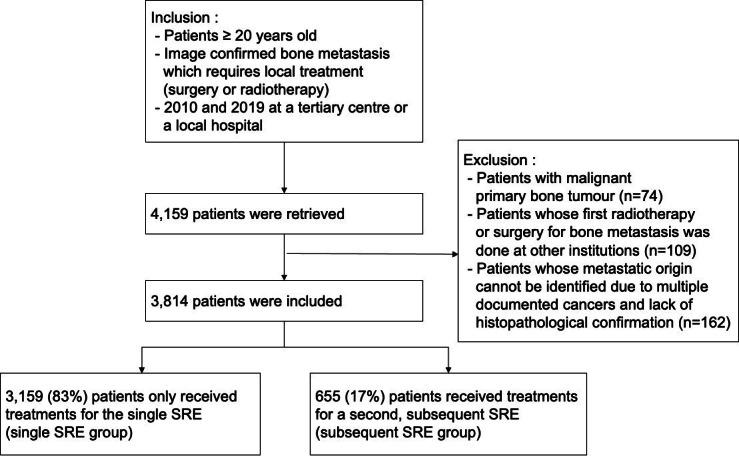
This retrospective study included 3,814 adult patients who received local treatment - surgery and/or radiotherapy - for bone metastasis between 1 January 2010 and 31 December 2019. All included patients had at least one SRE requiring local treatment. A subsequent SRE was defined as a second SRE requiring local treatment. Clinical, oncological, and prognostic features were compared between single SREs and subsequent SREs using Mann-Whitney U test, Fisher's exact test, and Kaplan-Meier curve.
RESULTS
Of the 3,814 patients with SREs, 3,159 (83%) patients had a single SRE and 655 (17%) patients developed a subsequent SRE. Patients who developed subsequent SREs generally had characteristics that favoured longer survival, such as higher BMI, higher albumin levels, fewer comorbidities, or lower neutrophil count. Once the patient got to the point of subsequent SRE, their clinical and oncological characteristics and one-year survival (28%) were not as good as those with only a single SRE (35%; p < 0.001), indicating that clinicians' experiences when treating the initial SRE are not similar when treating a subsequent SRE.
CONCLUSION
This study found that 17% of patients required treatments for a second, subsequent SRE, and the current clinical guideline did not provide a specific approach to this clinical condition. We observed that referencing the initial treatment, patients in the subsequent SRE group had longer six-week, 90-day, and one-year median survival than patients in the single SRE group. Once patients develop a subsequent SRE, they have a worse one-year survival rate than those who receive treatment for a single SRE. Future research should identify prognostic factors and assess the applicability of existing survival prediction models for better management of subsequent SREs.
目的
治疗方法的进步延长了转移性骨病(MBD)患者的预期寿命。这一进展可能导致患者经历更多的骨相关事件(SREs)。那些已经经历过一次SRE的患者可能会因后续的SRE而接受另一种局部治疗,而这并非初始SRE治疗的一部分。然而,关于需要进一步局部治疗的后续SRE的发生率和特征的研究存在明显空白,这使得临床医生在面对后续SRE时不得不从初始SRE的经验中进行推断。本研究旨在调查发生需要局部治疗的后续SREsre的MBD患者的比例,检查单次sre患者与后续sre患者在初始治疗时是否存在预后差异,并确定初始和后续sre治疗在临床、肿瘤学和预后特征上是否不同。
方法
这项回顾性研究纳入了2010年1月1日至2019年12月31日期间接受骨转移局部治疗(手术和/或放疗)的3814例成年患者。所有纳入患者至少有一次需要局部治疗的SRE。后续SRE定义为第二次需要局部治疗的SRE。使用Mann-Whitney U检验、Fisher精确检验和Kaplan-Meier曲线比较单次SRE和后续SRE之间的临床、肿瘤学和预后特征。
结果
在3814例SRE患者中,3159例(83%)患者有单次SRE,655例(17%)患者发生了后续SRE。发生后续SRE的患者通常具有有利于更长生存期的特征,如更高的BMI、更高的白蛋白水平、更少的合并症或更低的中性粒细胞计数。一旦患者进入后续SRE阶段,他们的临床和肿瘤学特征以及一年生存率(28%)不如仅有单次SRE的患者(35%;p<0.001),这表明临床医生在治疗初始SRE和后续SRE时的经验并不相同。
结论
本研究发现17%的患者需要对第二次后续SRE进行治疗,而目前的临床指南并未针对这种临床情况提供具体方法。我们观察到,参考初始治疗情况,后续SRE组患者的六周、90天和一年中位生存期比单次SRE组患者更长。一旦患者发生后续SRE,他们的一年生存率比接受单次SRE治疗的患者更差。未来的研究应确定预后因素,并评估现有生存预测模型的适用性,以更好地管理后续SRE。


 Zotero 插件