
新辅助化疗达到病理完全缓解的不同分子亚型乳腺浸润性导管癌的临床病理特征和生存分析。
Clinicopathological characteristics and survival analysis of different molecular subtypes of breast invasive ductal carcinoma achieving pathological complete response through neoadjuvant chemotherapy.
机构信息
Cancer Prevention and Treatment Institute of Chengdu, Department of Thyroid and Breast Surgery, Chengdu Fifth People's Hospital (Affiliated Fifth People's Hospital of Chengdu University of Traditional Chinese Medicine), NO.33 Ma Shi Street, Wenjiang District, Chengdu, 611137, China.
出版信息
World J Surg Oncol. 2024 Sep 16;22(1):250. doi: 10.1186/s12957-024-03535-x.
BACKGROUND
To investigate the prognostic differences following the achievement of a pathological complete response (pCR) through neoadjuvant chemotherapy across different molecular subtypes of breast invasive ductal carcinoma.
METHODS
Data from the Surveillance, Epidemiology, and End Results (SEER) were identified for patients undergoing neoadjuvant chemotherapy who achieved pathological complete response for invasive ductal carcinoma of the breast between 2010 and 2019.Comparing the clinicopathological characteristics of patients across different molecular subtypes. Univariate and Cox multivariate analyses were utilized to identify independent predictors of overall survival (OS) and cancer-specific survival (CSS). The Kaplan-Meier method is used to compare OS and CSS among different molecular subtypes. After propensity score matching, subgroup analysis results were presented through forest plots.
RESULTS
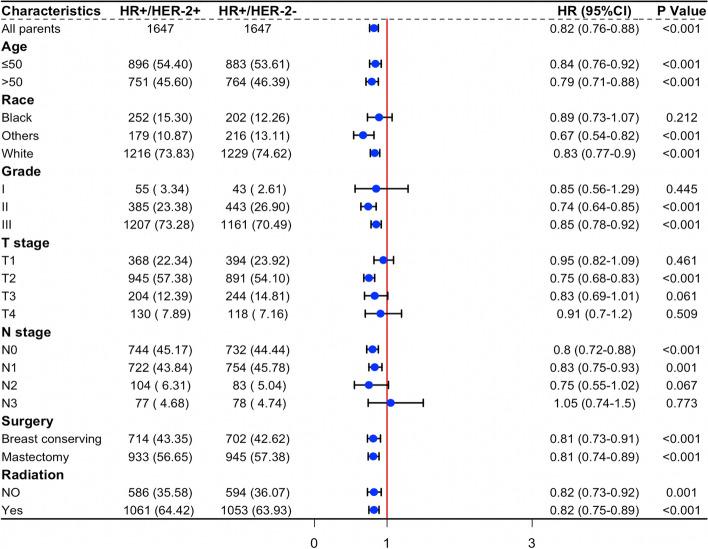
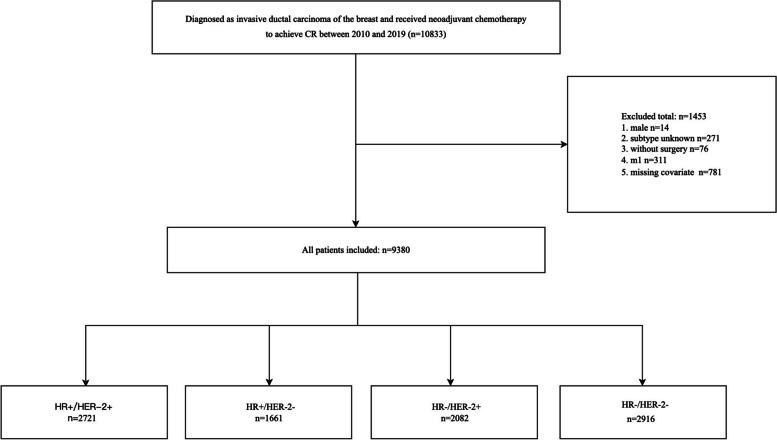
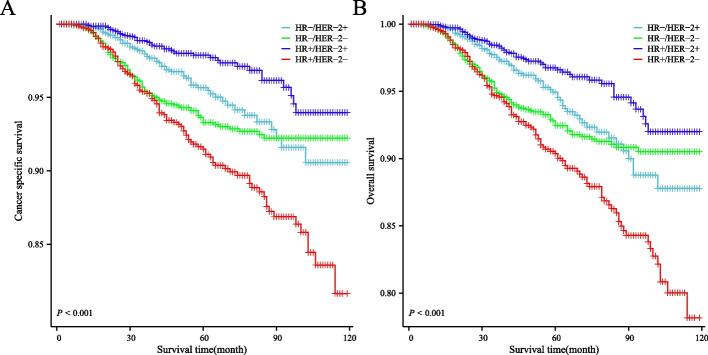
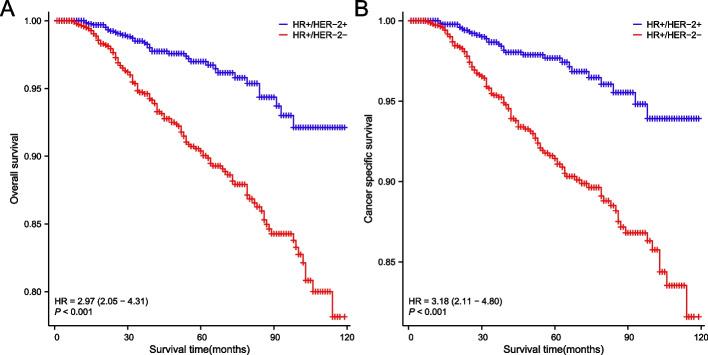
This study included 9,380 patients diagnosed with invasive ductal carcinoma, who were categorized into four molecular subtypes: 2,721 (29.01%) HR + /HER-2 + , 1,661 (17.71%) HR + /HER2-, 2,082 (22.20%) HR-/HER2 + , and 2,916 (31.08%) HR-/HER-2-. HR + /HER-2- subgroup exhibited a significantly higher proportion of patients under 50 years old than the other subtype groups (54.67% vs 40.2%, 50.35% and 51.82%, p < 0.01), and had a higher N2 + N3 stage (11.2% vs 7.24%, 8.69% and 7.48%, p < 0.01). Univariate and multivariate analysis revealed that molecular subtype was the independent risk factor for OS and CSS in patients(p < 0.05). The Kaplan-Meier curves indicated that the HR + /HER-2 + subtype had the highest OS and CSS(p < 0.05). Next, were the HR-/HER-2 + and HR-/HER-2- subtypes, with the HR + /HER-2- group having the lowest OS and CSS(p < 0.05). After propensity score matching, the OS and CSS of patients in the HR + /HER-2 + group remained higher compared to HR + /HER-2- group(p < 0.05).
CONCLUSIONS
Patients with invasive ductal carcinoma of different molecular subtypes exhibit varying prognoses after achieving pCR to neoadjuvant chemotherapy. Those in the HR + /HER-2- group are younger, have a higher lymph node stage, and the lowest OS and CSS, whereas patients in the HR + /HER-2 + group have the highest OS and CSS.
背景
本研究旨在探讨新辅助化疗后达到病理完全缓解(pCR)的不同分子亚型浸润性乳腺导管癌患者的预后差异。
方法
从 2010 年至 2019 年期间,SEER 数据库中选取接受新辅助化疗且浸润性乳腺导管癌患者为研究对象,达到 pCR。比较不同分子亚型患者的临床病理特征。采用单因素和 Cox 多因素分析确定总生存期(OS)和癌症特异性生存期(CSS)的独立预测因素。Kaplan-Meier 法比较不同分子亚型的 OS 和 CSS。进行倾向评分匹配后,通过森林图呈现亚组分析结果。
结果
本研究共纳入 9380 例浸润性乳腺导管癌患者,分为 4 种分子亚型:HR+/HER2+型 2721 例(29.01%)、HR+/HER2-型 1661 例(17.71%)、HR-/HER2+型 2082 例(22.20%)、HR-/HER-2-型 2916 例(31.08%)。HR+/HER2-型中年龄小于 50 岁的患者比例显著高于其他亚型(54.67%比 40.2%、50.35%比 51.82%,p<0.01),N2+N3 期患者比例也更高(11.2%比 7.24%、8.69%比 7.48%,p<0.01)。单因素和多因素分析均显示,分子亚型是影响患者 OS 和 CSS 的独立危险因素(p<0.05)。Kaplan-Meier 曲线表明 HR+/HER2+型 OS 和 CSS 最高(p<0.05),其次是 HR-/HER2+和 HR-/HER-2-型,HR+/HER2-型 OS 和 CSS 最低(p<0.05)。进行倾向评分匹配后,HR+/HER2+型患者的 OS 和 CSS 仍高于 HR+/HER2-型(p<0.05)。
结论
不同分子亚型的浸润性乳腺导管癌患者在新辅助化疗后达到 pCR 后,预后存在差异。HR+/HER2-型患者较年轻,淋巴结转移程度更高,OS 和 CSS 最低,而 HR+/HER2+型患者 OS 和 CSS 最高。
 Zotero 插件