
鲑科鱼在体内平衡状态下的大脑微生物组。
A brain microbiome in salmonids at homeostasis.
机构信息
Center for Evolutionary and Theoretical Immunology, Department of Biology, University of New Mexico, Albuquerque, NM 87108, USA.
Department of Fisheries, Wildlife, and Conservation Sciences, Oregon State University, Corvallis, OR 97331, USA.
出版信息
Sci Adv. 2024 Sep 20;10(38):eado0277. doi: 10.1126/sciadv.ado0277. Epub 2024 Sep 18.
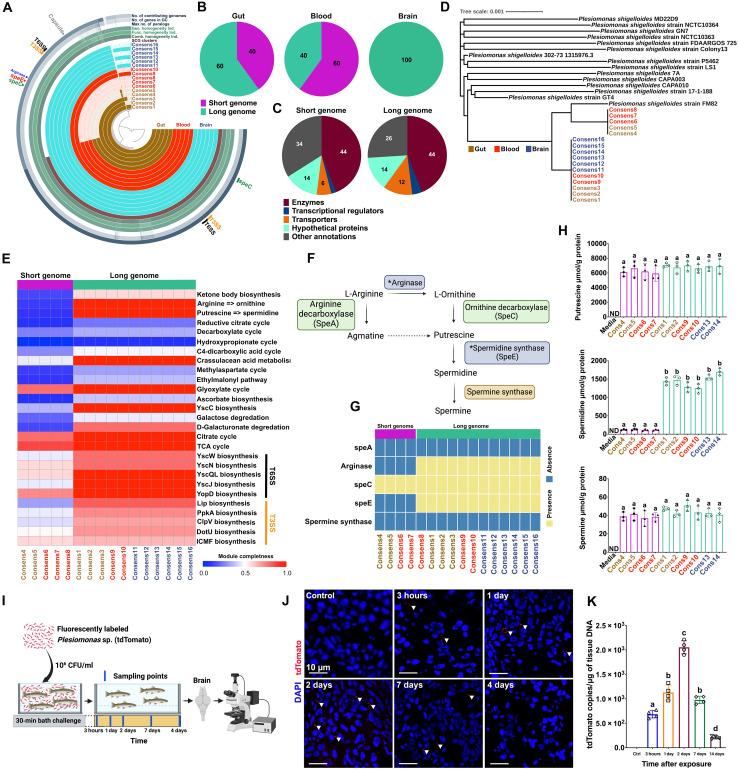
Ectotherms have peculiar relationships with microorganisms. For instance, bacteria are recovered from the blood and internal organs of healthy teleosts. However, the presence of microbial communities in the healthy teleost brain has not been proposed. Here, we report a living bacterial community in the brain of healthy salmonids with bacterial loads comparable to those of the spleen and 1000-fold lower than in the gut. Brain bacterial communities share >50% of their diversity with gut and blood bacterial communities. Using culturomics, we obtained 54 bacterial isolates from the brains of healthy trout. Comparative genomics suggests that brain bacteria may have adaptations for niche colonization and polyamine biosynthesis. In a natural system, Chinook salmon brain microbiomes shift from juveniles to reproductively mature adults. Our study redefines the physiological relationships between the brain and bacteria in teleosts. This symbiosis may endow salmonids with a direct mechanism to sense and respond to environmental microbes.
变温动物与微生物有着特殊的关系。例如,从健康硬骨鱼类的血液和内脏器官中可回收细菌。然而,尚未提出健康硬骨鱼类大脑中存在微生物群落的观点。在这里,我们报道了健康鲑鱼脑中存在一个活菌群落,其细菌负荷与脾脏相当,而比肠道低 1000 倍。脑细菌群落与肠道和血液细菌群落共享超过 50%的多样性。使用培养组学,我们从健康鳟鱼的大脑中获得了 54 个细菌分离株。比较基因组学表明,大脑细菌可能具有适应小生境定殖和多胺生物合成的能力。在自然系统中,奇努克鲑鱼的大脑微生物组从幼体转变为生殖成熟的成年个体。我们的研究重新定义了硬骨鱼类大脑与细菌之间的生理关系。这种共生关系可能使鲑鱼具有直接感知和响应环境微生物的机制。



 Zotero 插件