
1 型糖尿病对特定部位消化道癌症的偶然影响:孟德尔随机分析。
Casual effects of type 1 diabetes mellitus on site-specific digestive cancers: a Mendelian randomisation analysis.
机构信息
Department of Emergency Medicine, The First Affiliated Hospital, Hengyang Medical School, University of South China, Hengyang, China.
Department of Nutrition, The Second Affiliated Hospital, Hengyang Medical School, University of South China, Hengyang, China.
出版信息
Front Endocrinol (Lausanne). 2024 Sep 5;15:1407329. doi: 10.3389/fendo.2024.1407329. eCollection 2024.
OBJECTIVE
Despite several observational studies attempting to investigate the potential association between type 1 diabetes mellitus (T1DM) and the risk of digestive cancers, the results remain controversial. The purpose of this study is to examine whether there is a causal relationship between T1DM and the risk of digestive cancers.
METHODS
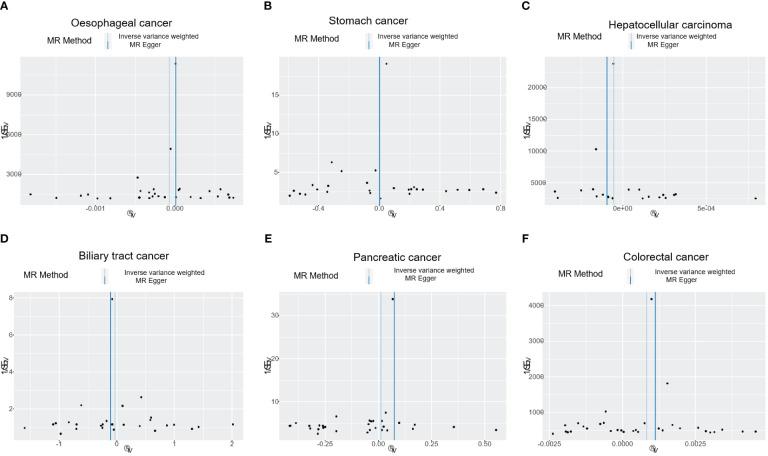
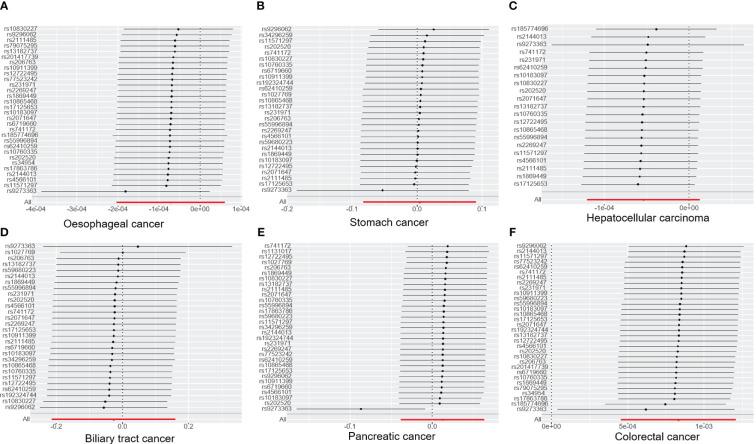
We conducted a Mendelian randomisation (MR) study to systematically investigate the effect of T1DM on six most prevalent types of digestive cancers (oesophageal cancer, stomach cancer, hepatocellular carcinoma, biliary tract cancer, pancreatic cancer, and colorectal cancer). A total of 1,588,872 individuals were enrolled in this analysis, with 372,756 being the highest number for oesophageal cancer and 3,835 being the lowest for pancreatic cancer. Multiple MR methods were performed to evaluate the causal association of T1DM with the risk of six site-specific cancers using genome-wide association study summary data. Sensitivity analyses were also conducted to assess the robustness of the observed associations.
RESULTS
We selected 35 single nucleotide polymorphisms associated with T1DM as instrumental variables. Our findings indicate no significant effect of T1DM on the overall risk of oesophageal cancer (OR= 0.99992, 95% CI: 0.99979-1.00006, P= 0.2866), stomach cancer (OR=0.9298,95% CI: 0.92065-1.09466, P= 0.9298), hepatocellular carcinoma (OR= 0.99994,95% CI: 0.99987-1.00001, P= 0.1125), biliary tract cancer (OR=0.97348,95% CI: 0.8079-1.1729, P= 0.7775)), or pancreatic cancer (OR =1.01258, 95% CI: 0.96243-1.06533, P= 0.6294). However, we observed a causal association between T1DM and colorectal cancer (OR=1.000, 95% CI: 1.00045-1.0012, P<0.001), indicating that T1DM increases the risk of colorectal cancer. We also performed sensitivity analyses, which showed no heterogeneity or horizontal pleiotropy. For the reverse MR from T1DM to six digestive cancers, no significant causal relationships were identified.
CONCLUSIONS
In this MR study with a large number of digestive cancer cases, we found no evidence to support the causal role of T1DM in the risk of oesophageal cancer, stomach cancer, hepatocellular carcinoma, biliary tract cancer, or pancreatic cancer. However, we found a causal positive association between T1DM and colorectal cancer. Further large-scale prospective studies are necessary to replicate our findings.
目的
尽管有几项观察性研究试图探讨 1 型糖尿病(T1DM)与消化系统癌症风险之间的潜在关联,但结果仍存在争议。本研究的目的是检验 T1DM 与消化系统癌症风险之间是否存在因果关系。
方法
我们进行了孟德尔随机化(MR)研究,系统地调查了 T1DM 对六种最常见的消化系统癌症(食管癌、胃癌、肝细胞癌、胆道癌、胰腺癌和结直肠癌)的影响。共有 1588872 人纳入了这项分析,其中食管癌的人数最多,为 372756 人,胰腺癌的人数最少,为 3835 人。使用全基因组关联研究汇总数据,采用多种 MR 方法评估 T1DM 与六种部位特异性癌症风险之间的因果关联。还进行了敏感性分析,以评估观察到的关联的稳健性。
结果
我们选择了 35 个与 T1DM 相关的单核苷酸多态性作为工具变量。我们的研究结果表明,T1DM 对食管癌(OR=0.99992,95%CI:0.99979-1.00006,P=0.2866)、胃癌(OR=0.9298,95%CI:0.92065-1.09466,P=0.9298)、肝细胞癌(OR=0.99994,95%CI:0.99987-1.00001,P=0.1125)、胆道癌(OR=0.97348,95%CI:0.8079-1.1729,P=0.7775)或胰腺癌(OR=1.01258,95%CI:0.96243-1.06533,P=0.6294)的总体风险没有显著影响。然而,我们观察到 T1DM 与结直肠癌(OR=1.000,95%CI:1.00045-1.0012,P<0.001)之间存在因果关系,表明 T1DM 增加了结直肠癌的风险。我们还进行了敏感性分析,结果显示没有异质性或水平多效性。对于从 T1DM 到六种消化系统癌症的反向 MR,没有发现显著的因果关系。
结论
在这项具有大量消化系统癌症病例的 MR 研究中,我们没有发现证据支持 T1DM 在食管癌、胃癌、肝细胞癌、胆道癌或胰腺癌风险中的因果作用。然而,我们发现 T1DM 与结直肠癌之间存在因果正相关。需要进一步进行大规模前瞻性研究来复制我们的发现。


 Zotero 插件