
氮特异性互作组分析揭示了 SnRK1 和 TOR 激酶在植物氮信号转导中的作用。
A Nitrogen-specific Interactome Analysis Sheds Light on the Role of the SnRK1 and TOR Kinases in Plant Nitrogen Signaling.
机构信息
Department of Plant Biotechnology and Bioinformatics, Ghent University, Ghent, Belgium; VIB Center for Plant Systems Biology, Ghent, Belgium.
Department of Plant Biotechnology and Bioinformatics, Ghent University, Ghent, Belgium; VIB Center for Plant Systems Biology, Ghent, Belgium.
出版信息
Mol Cell Proteomics. 2024 Oct;23(10):100842. doi: 10.1016/j.mcpro.2024.100842. Epub 2024 Sep 20.
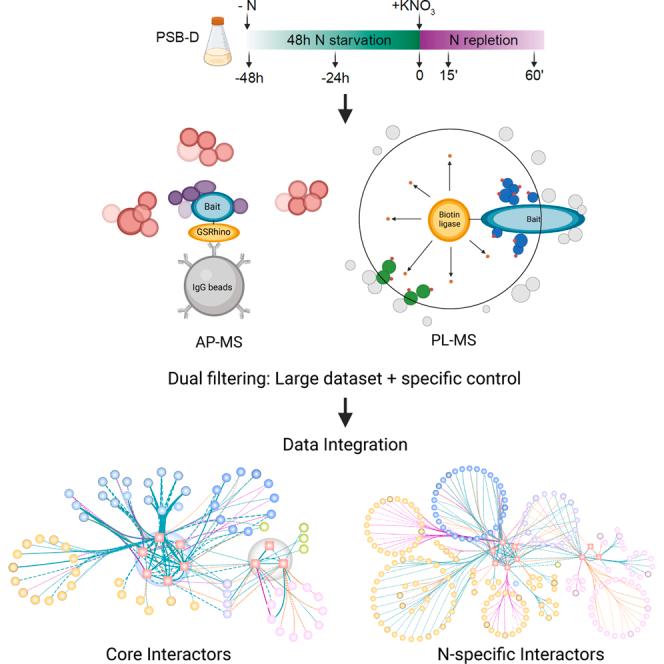
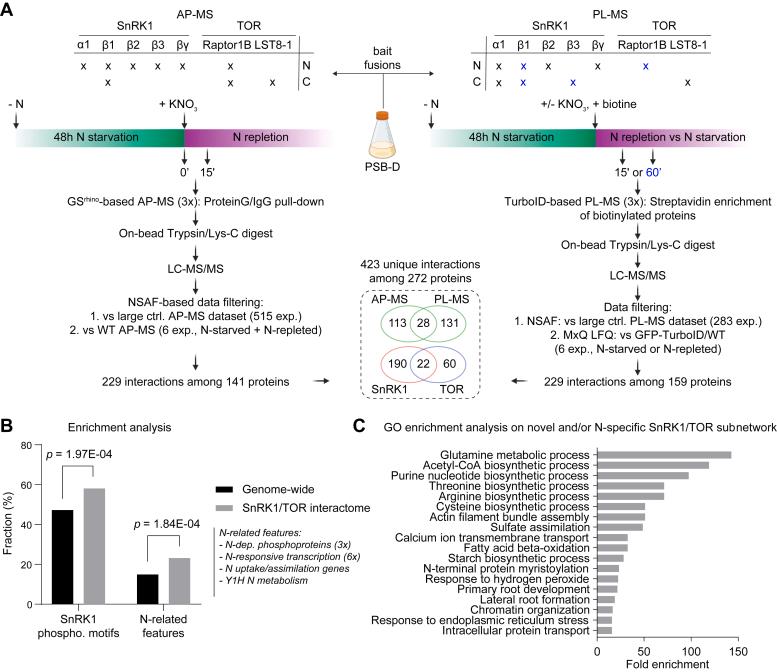
Nitrogen (N) is of utmost importance for plant growth and development. Multiple studies have shown that N signaling is tightly coupled with carbon (C) levels, but the interplay between C/N metabolism and growth remains largely an enigma. Nonetheless, the protein kinases Sucrose Non-fermenting 1 (SNF1)-Related Kinase 1 (SnRK1) and Target Of Rapamycin (TOR), two ancient central metabolic regulators, are emerging as key integrators that link C/N status with growth. Despite their pivotal importance, the exact mechanisms behind the sensing of N status and its integration with C availability to drive metabolic decisions are largely unknown. Especially for SnRK1, it is not clear how this kinase responds to altered N levels. Therefore, we first monitored N-dependent SnRK1 kinase activity with an in vivo Separation of Phase-based Activity Reporter of Kinase (SPARK) sensor, revealing a contrasting N-dependency in Arabidopsis thaliana (Arabidopsis) shoot and root tissues. Next, using affinity purification (AP) and proximity labeling (PL) coupled to mass spectrometry (MS) experiments, we constructed a comprehensive SnRK1 and TOR interactome in Arabidopsis cell cultures during N-starved and N-repleted growth conditions. To broaden our understanding of the N-specificity of the TOR/SnRK1 signaling events, the resulting network was compared to corresponding C-related networks, identifying a large number of novel, N-specific interactors. Moreover, through integration of N-dependent transcriptome and phosphoproteome data, we were able to pinpoint additional N-dependent network components, highlighting for instance SnRK1 regulatory proteins that might function at the crosstalk of C/N signaling. Finally, confirmation of known and identification of novel SnRK1 interactors, such as Inositol-Requiring 1 (IRE1A) and the RAB GTPase RAB18, indicate that SnRK1, present at the ER, is involved in N signaling and autophagy induction.
氮(N)对植物的生长和发育至关重要。多项研究表明,N 信号与碳(C)水平紧密相关,但 C/N 代谢与生长之间的相互作用在很大程度上仍是一个谜。尽管如此,蛋白激酶蔗糖非发酵 1(SNF1)相关激酶 1(SnRK1)和雷帕霉素靶蛋白(TOR),这两种古老的中心代谢调节剂,作为将 C/N 状态与生长联系起来的关键整合因子而出现。尽管它们至关重要,但感知 N 状态及其与 C 可用性的整合以驱动代谢决策的确切机制在很大程度上仍是未知的。特别是对于 SnRK1,尚不清楚这种激酶如何响应改变的 N 水平。因此,我们首先使用基于相位的激酶活性报告传感器(SPARK)监测 N 依赖性 SnRK1 激酶活性,揭示了拟南芥(Arabidopsis)地上和根组织中截然不同的 N 依赖性。接下来,我们使用亲和纯化(AP)和邻近标记(PL)与质谱(MS)实验相结合,在氮饥饿和氮充足生长条件下构建了拟南芥细胞培养物中综合的 SnRK1 和 TOR 互作组。为了扩大我们对 TOR/SnRK1 信号事件的 N 特异性的理解,将所得网络与相应的 C 相关网络进行比较,确定了大量新的、N 特异性的相互作用体。此外,通过整合 N 依赖性转录组和磷酸化组数据,我们能够确定其他 N 依赖性网络成分,例如可能在 C/N 信号转导的交叉点发挥作用的 SnRK1 调节蛋白。最后,对已知和鉴定的新型 SnRK1 相互作用体(如肌醇需求 1(IRE1A)和 RAB GTPase RAB18)的验证表明,存在于内质网(ER)中的 SnRK1 参与 N 信号转导和自噬诱导。



 Zotero 插件