
社区居住的弱势老年人中认知障碍和抑郁与营养不良的关联:一项大型横断面研究
The Association of Cognitive Impairment and Depression with Malnutrition among Vulnerable, Community-Dwelling Older Adults: A Large Cross-Sectional Study.
作者信息
Karam George, Abbas Nada, El Korh Lea, Abi Saad Alexander, Nasreddine Lara, Ouaijan Krystel
机构信息
Department of Psychiatry and Clinical Psychology, St. George Hospital University Medical Center, Beirut 11002807, Lebanon.
Institute for Development, Research, Advocacy and Applied Care (IDRAAC), Beirut 11002110, Lebanon.
出版信息
Geriatrics (Basel). 2024 Sep 19;9(5):122. doi: 10.3390/geriatrics9050122.
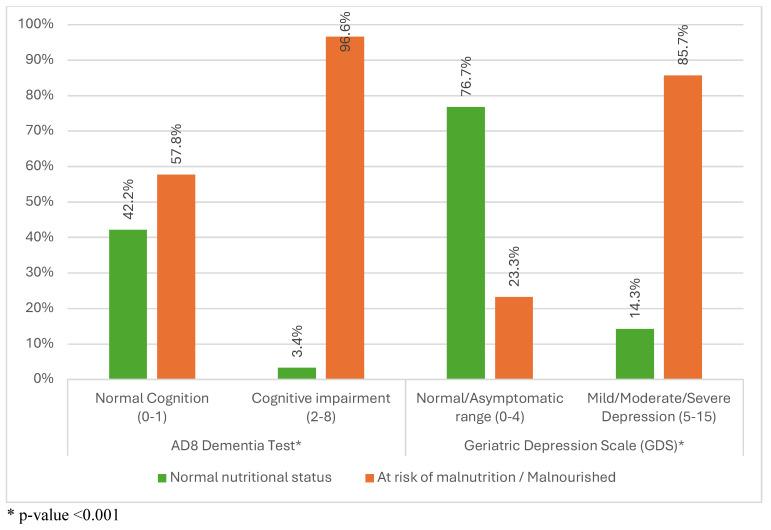
(1) Background: Mental health issues in older adults, particularly cognitive impairment and depression, can affect nutritional status. This study investigates the prevalence of malnutrition among community-dwelling older adults at risk of social exclusion and dependency in Lebanon and its association with cognitive impairment and depression. (2) Methods: This cross-sectional study used secondary data from the TEC-MED project, involving 1410 older adults aged 60 and above in Beirut. Nutritional status was assessed with the Mini Nutritional Assessment _Short Form (MNA_SF), cognitive impairment with the AD8 Dementia Screening Interview, and depression with the Geriatric Depression Scale (GDS-15). (3) Results: 87.2% of participants were at risk of malnutrition, and 2.5% were malnourished. Cognitive impairment was present in 82.2% of the sample and 45% experienced moderate to severe depression. Malnourished individuals had significantly higher rates of cognitive impairment (96.7% vs. 57.8%) and depression (85.7% vs. 23.2%). Significant associations were found between the risk of malnutrition, decreased food intake, cognitive impairment, and depression; however, no significant association was found with BMI. Logistic regression analysis indicated that older age, cognitive impairment, and depression were significant predictors of malnutrition, while having a caregiver was protective. (4) Conclusions: The high prevalence of risk of malnutrition among vulnerable older adults with cognitive impairment and depression underscores the need for policies integrating nutritional screening into routine health check-ups for older adults.
(1) 背景:老年人的心理健康问题,尤其是认知障碍和抑郁症,会影响营养状况。本研究调查了黎巴嫩面临社会排斥和依赖风险的社区居住老年人中营养不良的患病率及其与认知障碍和抑郁症的关联。(2) 方法:这项横断面研究使用了TEC - MED项目中的二手数据,该项目涉及贝鲁特1410名60岁及以上的老年人。营养状况通过简易营养评估简表(MNA_SF)进行评估,认知障碍通过AD8痴呆筛查访谈进行评估,抑郁症通过老年抑郁量表(GDS - 15)进行评估。(3) 结果:87.2%的参与者存在营养不良风险,2.5%为营养不良。样本中82.2%存在认知障碍,45%经历中度至重度抑郁。营养不良的个体认知障碍(96.7%对57.8%)和抑郁症(85.7%对23.2%)发生率显著更高。在营养不良风险、食物摄入量减少、认知障碍和抑郁症之间发现了显著关联;然而,与BMI未发现显著关联。逻辑回归分析表明,年龄较大、认知障碍和抑郁症是营养不良的显著预测因素,而有照顾者则具有保护作用。(4) 结论:认知障碍和抑郁症的脆弱老年人中营养不良风险的高患病率凸显了将营养筛查纳入老年人常规健康检查政策中的必要性。

 Zotero 插件