
印度母婴营养不良双重和三重负担的患病率及社会人口学因素:来自全国代表性调查(NFHS-5)的结果
Prevalence and socio-demographic factors associated with double and triple burden of malnutrition among mother-child pairs in India: Findings from a nationally representative survey (NFHS-5).
作者信息
Ramasubramani Premkumar, Krishnamoorthy Yuvaraj, Rajaa Sathish
机构信息
Department of Community Medicine, Mahatma Gandhi Medical College and Research Institute, Puducherry, India.
Evidence Synthesis Unit, Partnerships for Research, Opportunities, Planning, Upskilling, Leadership (PROPUL) Evidence, Chennai, India.
出版信息
Heliyon. 2024 Sep 11;10(18):e37794. doi: 10.1016/j.heliyon.2024.e37794. eCollection 2024 Sep 30.
INTRODUCTION
Improper consumption of food leads to various forms of malnutrition such as undernutrition, overnutrition and micronutrient deficiency. The coexistence of various malnutrition forms in the same household is a public health concern in developing countries. Very little research has been done on exploring the burden and risk factors associated with double (DBM) and triple burden of malnutrition (TBM).
METHODS
Secondary analysis was done using data from India's National Family Health Survey-5 (NFHS-5), 2019-21. Mothers and under-five children were paired at the household level as a unit of analysis. DBM and TBM were interpreted from children's height-for-age, weight-for-height, weight-for-age and anaemia status and mothers' body-mass-index. Stratification and clustering in the sample design were accounted for during the analysis in STATA v14.2. DBM and TBM were summarized as weighted proportions with 95 % confidence interval (CI) and the risk factors associated were reported as adjusted odds ratio (aOR) with 95%CI using mixed effects logistic regression.
RESULTS
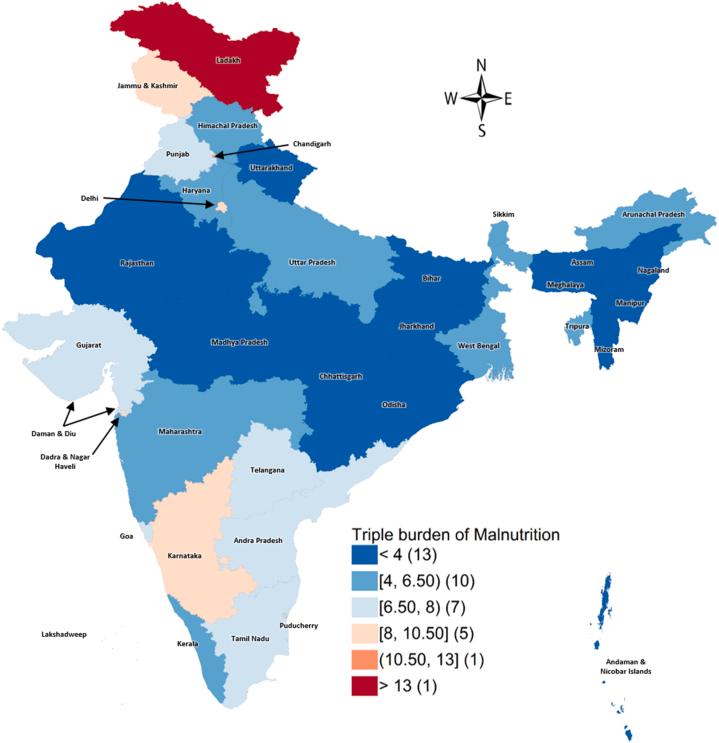
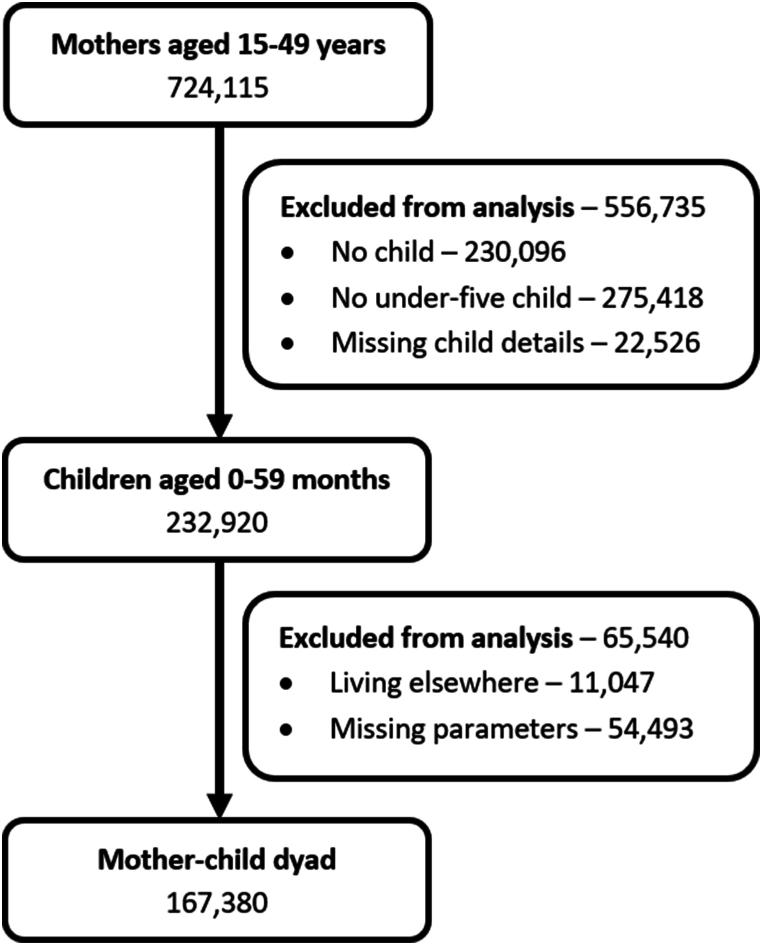
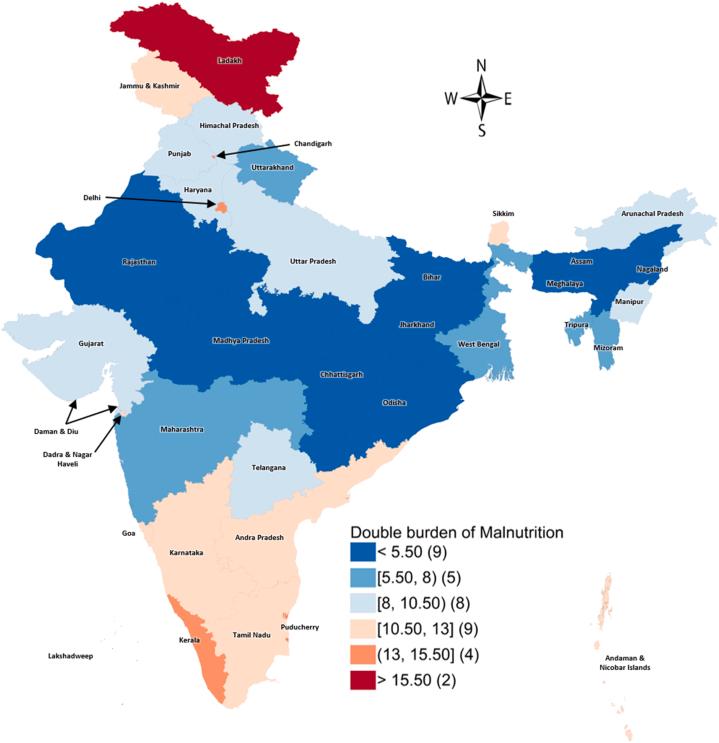
We included 167,380 mother-child pairs for analysis. In India, the prevalence of DBM was 7.7 % (95 % CI: 7.5-7.9 %) and TBM was 5.1 % (5.0-5.3 %) at the household level among mother-child dyads. Mothers' age, age at first birth, educational levels, current breastfeeding habits, mode of delivery, child's age, gender, twin birth, birth weight, geographical region, residence, caste and religion, and wealth index were associated with both DBM and TBM.
CONCLUSION
Both DBM and TBM are public health concerns in India. Thus, scaling-up of health intervention, effective implementation of nutritional programmes and life-course approach are needed to control malnutrition.
引言
食物摄入不当会导致各种形式的营养不良,如营养不足、营养过剩和微量营养素缺乏。在同一家庭中多种营养不良形式并存是发展中国家的一个公共卫生问题。关于探索双重营养不良负担(DBM)和三重营养不良负担(TBM)及其相关风险因素的研究非常少。
方法
利用2019 - 2021年印度全国家庭健康调查-5(NFHS - 5)的数据进行二次分析。以家庭层面的母亲和五岁以下儿童配对作为分析单位。根据儿童的年龄别身高、身高别体重、年龄别体重和贫血状况以及母亲的体重指数来解释DBM和TBM。在STATA v14.2分析过程中考虑了样本设计中的分层和聚类情况。DBM和TBM以加权比例及95%置信区间(CI)进行汇总,相关风险因素以调整后的比值比(aOR)及95%CI报告,采用混合效应逻辑回归分析。
结果
我们纳入了167,380对母婴对进行分析。在印度,家庭层面母婴二元组中DBM的患病率为7.7%(95%CI:7.5 - 7.9%),TBM为5.1%(5.0 - 5.3%)。母亲的年龄、初产年龄、教育水平、当前母乳喂养习惯、分娩方式、孩子的年龄、性别、双胞胎出生、出生体重、地理区域、居住地、种姓和宗教以及财富指数均与DBM和TBM相关。
结论
DBM和TBM在印度都是公共卫生问题。因此,需要扩大健康干预措施、有效实施营养计划并采用生命历程方法来控制营养不良。
 Zotero 插件