
严重急性呼吸综合征冠状病毒2(SARS-CoV-2)核衣壳蛋白参与模板转换机制和基因组RNA重组的结构基础。
Structural basis for the participation of the SARS-CoV-2 nucleocapsid protein in the template switch mechanism and genomic RNA reorganization.
作者信息
Bezerra Peter R, Almeida Fabio C L
机构信息
Program of Structural Biology, Institute of Medical Biochemistry, Federal University of Rio de Janeiro, Rio de Janeiro, Brazil; National Center of Nuclear Magnetic Resonance (CNRMN), CENABIO, Federal University of Rio de Janeiro, Rio de Janeiro, Brazil.
Program of Structural Biology, Institute of Medical Biochemistry, Federal University of Rio de Janeiro, Rio de Janeiro, Brazil; National Center of Nuclear Magnetic Resonance (CNRMN), CENABIO, Federal University of Rio de Janeiro, Rio de Janeiro, Brazil.
出版信息
J Biol Chem. 2024 Nov;300(11):107834. doi: 10.1016/j.jbc.2024.107834. Epub 2024 Sep 27.
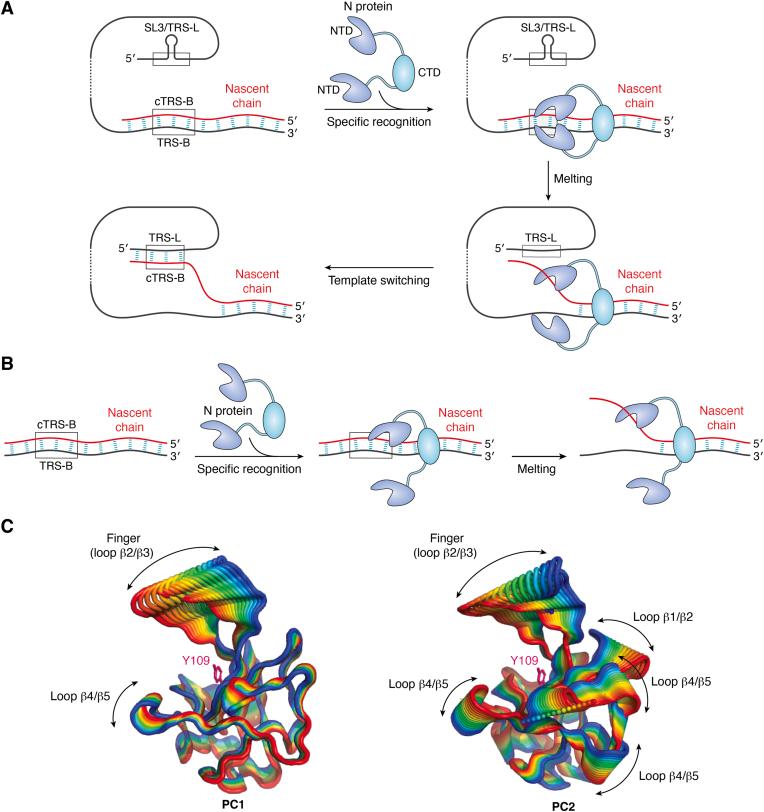
The COVID-19 pandemic has resulted in a significant toll of deaths worldwide, exceeding seven million individuals, prompting intensive research efforts aimed at elucidating the molecular mechanisms underlying the pathogenesis of SARS-CoV-2 infection. Despite the rapid development of effective vaccines and therapeutic interventions, COVID-19 remains a threat to humans due to the emergence of novel variants and largely unknown long-term consequences. Among the viral proteins, the nucleocapsid protein (N) stands out as the most conserved and abundant, playing the primary role in nucleocapsid assembly and genome packaging. The N protein is promiscuous for the recognition of RNA, yet it can perform specific functions. Here, we discuss the structural basis of specificity, which is directly linked to its regulatory role. Notably, the RNA chaperone activity of N is central to its multiple roles throughout the viral life cycle. This activity encompasses double-stranded RNA (dsRNA) annealing and melting and facilitates template switching, enabling discontinuous transcription. N also promotes the formation of membrane-less compartments through liquid-liquid phase separation, thereby facilitating the congregation of the replication and transcription complex. Considering the information available regarding the catalytic activities and binding signatures of the N protein-RNA interaction, this review focuses on the regulatory role of the SARS-CoV-2 N protein. We emphasize the participation of the N protein in discontinuous transcription, template switching, and RNA chaperone activity, including double-stranded RNA melting and annealing activities.
新冠疫情已在全球造成了巨大的死亡人数,超过700万人,这促使人们展开深入研究,旨在阐明严重急性呼吸综合征冠状病毒2(SARS-CoV-2)感染发病机制背后的分子机制。尽管有效疫苗和治疗干预措施迅速发展,但由于新变种的出现以及很大程度上未知的长期后果,新冠疫情仍然对人类构成威胁。在病毒蛋白中,核衣壳蛋白(N)最为保守且含量丰富,在核衣壳组装和基因组包装中起主要作用。N蛋白对RNA的识别具有多选择性,但它能执行特定功能。在此,我们讨论特异性的结构基础,这与其调节作用直接相关。值得注意的是,N蛋白的RNA伴侣活性对其在病毒整个生命周期中的多种作用至关重要。这种活性包括双链RNA(dsRNA)退火和解链,并促进模板转换,从而实现不连续转录。N蛋白还通过液-液相分离促进无膜区室的形成,从而促进复制和转录复合物的聚集。鉴于现有关于N蛋白-RNA相互作用的催化活性和结合特征的信息,本综述重点关注SARS-CoV-2 N蛋白的调节作用。我们强调N蛋白参与不连续转录、模板转换和RNA伴侣活性,包括双链RNA解链和退火活性。


 Zotero 插件