
关于接受电视胸腔镜检查患者使用异丙嗪后疼痛强度的前瞻性病例对照研究。
Prospective case-control study on pain intensity after the use of promethazine in patients undergoing videothoracoscopy.
作者信息
Zhou Xiangwei, He Benhui, Zheng Xia, Li Chao, Mi Zeyu, Peng Mingqing, Li Min
机构信息
Department of Anesthesiology and Perioperative Medicine, The Affiliated Yongchuan Hospital of Chongqing Medical University, Chongqing, China.
Department of Thoracic and Cardiovascular Surgery, The Affiliated Yongchuan Hospital of Chongqing Medical University, Chongqing, China.
出版信息
Front Med (Lausanne). 2024 Sep 16;11:1453694. doi: 10.3389/fmed.2024.1453694. eCollection 2024.
OBJECTIVE
Effective and secure pain management following video-assisted thoracoscopic surgery (VATS) is crucial for rapid postoperative recovery. This study evaluated analgesic and sedative effects of sufentanil and promethazine in patient-controlled intravenous analgesia (PCIA) post-thoracic surgery, along with potential adverse reactions.
METHODS
In this prospective, randomized, controlled, double-blind, clinical study, 60 patients (American Society of Anesthesiologists status I-III) undergoing VATS were enrolled. The patients were randomized into experimental (Group P) or control (Group C) groups. PCIA was administered post-general anesthesia using a double-blind method. Group P received sufentanil (3 μg/kg) + promethazine (1 mg/kg) + 0.9% sodium chloride solution (100 mL total), while Group C received sufentanil (3 μg/kg) + 0.9% sodium chloride solution (100 mL total). PCIA settings included a 1-mL bolus and 15-min locking time. The primary outcomes were the visual analog scale (VAS) at rest and during coughing and sedation (Ramsay) scores at 6, 12, 24, and 48 h. The secondary outcomes were rescue drug use rate, hemodynamic parameters (mean arterial pressure and heart rate), percutaneous oxygen saturation, respiratory rate, and occurrence of adverse reactions.
RESULTS
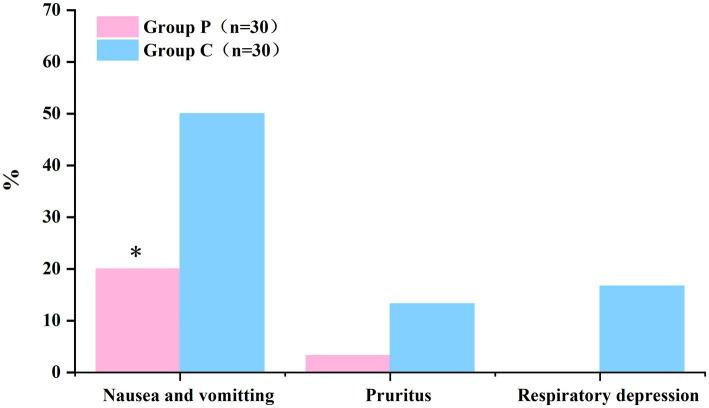
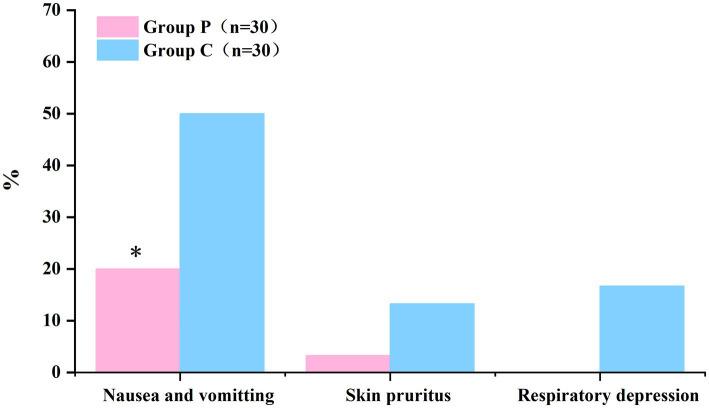
Group P exhibited lower resting and coughing VAS scores at 6, 12, 24, and 48 h, plus decreased incidence of nausea and vomiting within 48 h post-surgery compared with Group C ( < 0.05). No significant differences were observed in pruritus, sedation (Ramsay) scores, mean arterial pressure, heart rate, oxygen saturation, or respiratory rate between the two groups ( > 0.05).
DISCUSSION
The combination of sufentanil and promethazine for postoperative intravenous analgesia could effectively reduce adverse effects such as nausea and vomiting, contributing to postoperative pain relief.
目的
电视辅助胸腔镜手术(VATS)后有效且安全的疼痛管理对术后快速康复至关重要。本研究评估了舒芬太尼和异丙嗪在胸科手术后患者自控静脉镇痛(PCIA)中的镇痛和镇静效果以及潜在不良反应。
方法
在这项前瞻性、随机、对照、双盲临床研究中,纳入了60例行VATS的患者(美国麻醉医师协会分级I-III级)。患者被随机分为试验组(P组)或对照组(C组)。全身麻醉后采用双盲法实施PCIA。P组接受舒芬太尼(3μg/kg)+异丙嗪(1mg/kg)+0.9%氯化钠溶液(共100mL),而C组接受舒芬太尼(3μg/kg)+0.9%氯化钠溶液(共100mL)。PCIA设置包括1mL单次给药量和15分钟锁定时间。主要结局指标为术后6、12、24和48小时静息及咳嗽时的视觉模拟评分(VAS)以及镇静(Ramsay)评分。次要结局指标为补救药物使用率、血流动力学参数(平均动脉压和心率)、经皮血氧饱和度、呼吸频率及不良反应的发生情况。
结果
与C组相比,P组在术后6、12、24和48小时静息及咳嗽时的VAS评分更低,且术后48小时内恶心呕吐发生率降低(P<0.05)。两组在瘙痒、镇静(Ramsay)评分、平均动脉压、心率、血氧饱和度或呼吸频率方面未观察到显著差异(P>0.05)。
讨论
舒芬太尼和异丙嗪联合用于术后静脉镇痛可有效减少恶心呕吐等不良反应,有助于缓解术后疼痛。



 Zotero 插件