
用于正电子发射断层扫描(PET)成像癌症相关成纤维细胞的[F]AlF-FAP-NUR的临床前评估和首次人体研究。
Preclinical evaluation and first-in-human study of [F]AlF-FAP-NUR for PET imaging cancer-associated fibroblasts.
作者信息
Liu Shaoyu, Zhang Ziqi, Zhong Jiawei, Zhong Huizhen, Fu Yimin, Liu Lifang, Ye Xiaoting, Wang Xinlu
机构信息
Department of Nuclear Medicine, The First Affiliated Hospital of Guangzhou Medical University, Guangzhou, 510120, China.
Nuclear Medicine Department, The Sixth Affiliated Hospital, Sun Yat-sen University, Guangzhou, 510655, China.
出版信息
EJNMMI Res. 2024 Oct 1;14(1):87. doi: 10.1186/s13550-024-01139-w.
BACKGROUND
Fibroblast activation protein (FAP) has gained attention as a promising molecular target with potential utility for cancer diagnosis and therapy. [Ga]Ga-labeled FAP-targeting peptides have been successfully applied to positron emission tomography (PET) imaging of various tumor types. To meet the applicable demand for peptide-based FAP tracers with high patient throughput, we herein report the radiosynthesis, preclinical evaluation, and the first-in-human imaging of a novel [F]F-labeled FAP-targeting peptide.
RESULTS
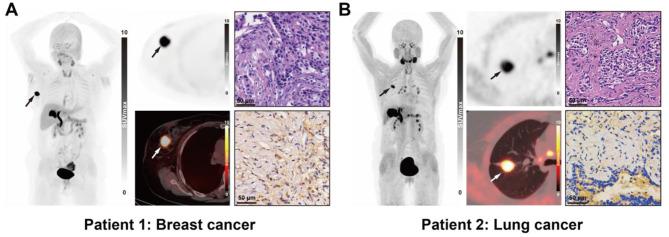
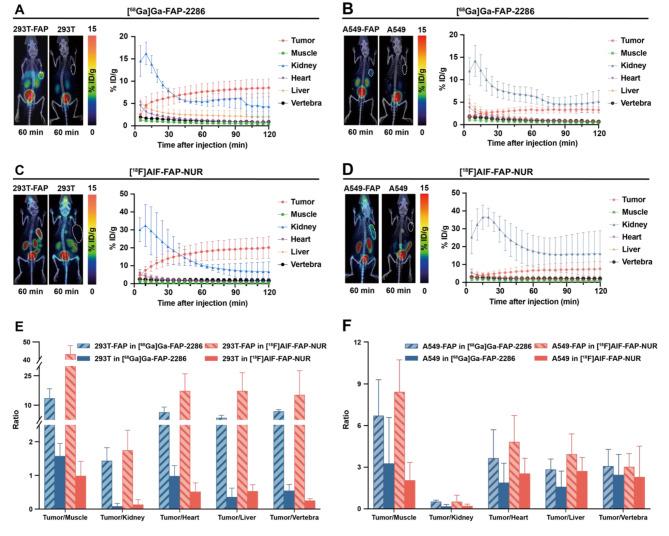
[F]AlF-FAP-NUR was automatedly prepared within 45 min with a non-decay corrected radiochemical yield of 18.73 ± 4.25% (n = 3). Compared to [Ga]Ga-FAP-2286, the [F]F-labeled peptide demonstrated more rapid, higher levels of cellular uptake and internalization, and lower levels of cellular efflux in HT1080-FAP cells. Micro-PET imaging and biodistribution studies conducted on xenograft mice models revealed a similar distribution pattern between the two tracers. However, [F]AlF-FAP-NUR demonstrated significantly higher tumor-specific uptake resulting in improved Tumor-Background Ratios (TBRs). In the patients, a significant accumulation of [F]AlF-FAP-NUR was found in the primary tumor. High uptake of the tracer within the bladder indicated that its major route of excretion was through urine.
CONCLUSIONS
Based on the physical imaging properties and longer half-life of [F]F, [F]AlF-FAP-NUR exhibited promising characteristics such as enhanced tumor-specific accumulation and elevated TBRs, which made it a viable candidate for further clinical investigation.
TRIAL REGISTRATION
www.Chictr.org.cn , ChiCTR2300076976 Retrospectively registered 25 October 2023. at, URL: https://www.chictr.org.cn/showproj.html?proj=206753 .
背景
成纤维细胞活化蛋白(FAP)作为一种有前景的分子靶点,在癌症诊断和治疗中具有潜在应用价值,已受到关注。[镓]镓标记的靶向FAP的肽已成功应用于多种肿瘤类型的正电子发射断层扫描(PET)成像。为满足对具有高患者通量的基于肽的FAP示踪剂的应用需求,我们在此报告一种新型[氟]氟标记的靶向FAP的肽的放射性合成、临床前评估及首次人体成像。
结果
[氟]AlF-FAP-NUR在45分钟内自动制备完成,非衰变校正放射化学产率为18.73±4.25%(n = 3)。与[镓]镓-FAP-2286相比,[氟]氟标记的肽在HT1080-FAP细胞中表现出更快、更高水平的细胞摄取和内化以及更低水平的细胞外排。在异种移植小鼠模型上进行的微型PET成像和生物分布研究显示,两种示踪剂之间的分布模式相似。然而,[氟]AlF-FAP-NUR表现出显著更高的肿瘤特异性摄取,从而提高了肿瘤-背景比(TBR)。在患者中,在原发性肿瘤中发现[氟]AlF-FAP-NUR有显著积聚。示踪剂在膀胱内的高摄取表明其主要排泄途径是通过尿液。
结论
基于[氟]氟的物理成像特性和更长的半衰期,[氟]AlF-FAP-NUR表现出有前景的特征,如增强的肿瘤特异性积聚和升高的TBR,这使其成为进一步临床研究的可行候选者。
试验注册


 Zotero 插件