
基于图自动编码器和多相似性融合的归纳矩阵补全预测微生物-疾病关联
Predicting microbe-disease association based on graph autoencoder and inductive matrix completion with multi-similarities fusion.
作者信息
Shi Kai, Huang Kai, Li Lin, Liu Qiaohui, Zhang Yi, Zheng Huilin
机构信息
College of Computer Science and Engineering, Guilin University of Technology, Guilin, China.
Guangxi Key Laboratory of Embedded Technology and Intelligent Systems, Guilin University of Technology, Guilin, China.
出版信息
Front Microbiol. 2024 Sep 6;15:1438942. doi: 10.3389/fmicb.2024.1438942. eCollection 2024.
BACKGROUND
Clinical studies have demonstrated that microbes play a crucial role in human health and disease. The identification of microbe-disease interactions can provide insights into the pathogenesis and promote the diagnosis, treatment, and prevention of disease. Although a large number of computational methods are designed to screen novel microbe-disease associations, the accurate and efficient methods are still lacking due to data inconsistence, underutilization of prior information, and model performance.
METHODS
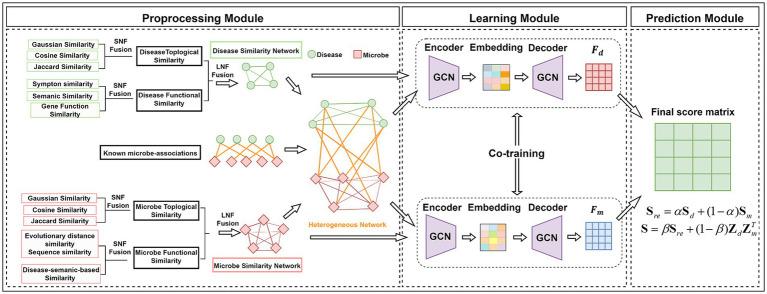
In this study, we proposed an improved deep learning-based framework, named GIMMDA, to identify latent microbe-disease associations, which is based on graph autoencoder and inductive matrix completion. By co-training the information from microbe and disease space, the new representations of microbes and diseases are used to reconstruct microbe-disease association in the end-to-end framework. In particular, a similarity fusion strategy is conducted to improve prediction performance.
RESULTS
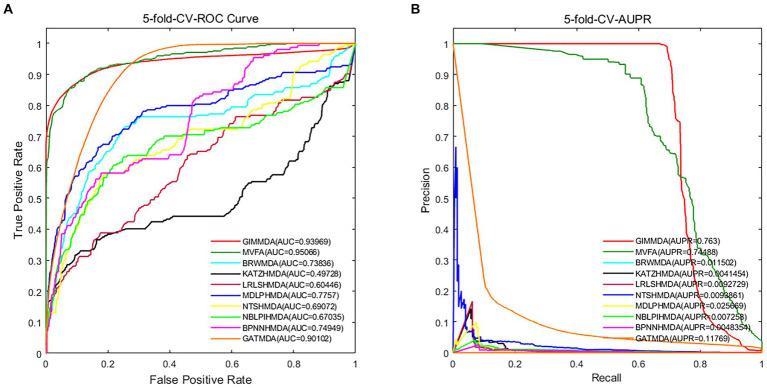
The experimental results show that the performance of GIMMDA is competitive with that of existing state-of-the-art methods on 3 datasets (i.e., HMDAD, Disbiome, and multiMDA). In particular, it performs best with the area under the receiver operating characteristic curve (AUC) of 0.9735, 0.9156, 0.9396 on abovementioned 3 datasets, respectively. And the result also confirms that different similarity fusions can improve the prediction performance. Furthermore, case studies on two diseases, i.e., asthma and obesity, validate the effectiveness and reliability of our proposed model.
CONCLUSION
The proposed GIMMDA model show a strong capability in predicting microbe-disease associations. We expect that GPUDMDA will help identify potential microbe-related diseases in the future.
背景
临床研究表明,微生物在人类健康和疾病中起着至关重要的作用。微生物与疾病相互作用的识别可为发病机制提供见解,并促进疾病的诊断、治疗和预防。尽管设计了大量计算方法来筛选新的微生物-疾病关联,但由于数据不一致、先验信息利用不足和模型性能等问题,仍缺乏准确有效的方法。
方法
在本研究中,我们提出了一种改进的基于深度学习的框架,名为GIMMDA,用于识别潜在的微生物-疾病关联,该框架基于图自动编码器和归纳矩阵补全。通过共同训练来自微生物和疾病空间的信息,在端到端框架中使用微生物和疾病的新表示来重建微生物-疾病关联。特别是,采用了一种相似性融合策略来提高预测性能。
结果
实验结果表明,GIMMDA在3个数据集(即HMDAD、Disbiome和multiMDA)上的性能与现有最先进方法具有竞争力。特别是,它在上述3个数据集上的受试者工作特征曲线下面积(AUC)分别为0.9735、0.9156、0.9396,表现最佳。结果还证实了不同的相似性融合可以提高预测性能。此外,对哮喘和肥胖两种疾病的案例研究验证了我们提出的模型的有效性和可靠性。
结论
所提出的GIMMDA模型在预测微生物-疾病关联方面表现出强大的能力。我们期望GIMMDA未来将有助于识别潜在的微生物相关疾病。


 Zotero 插件